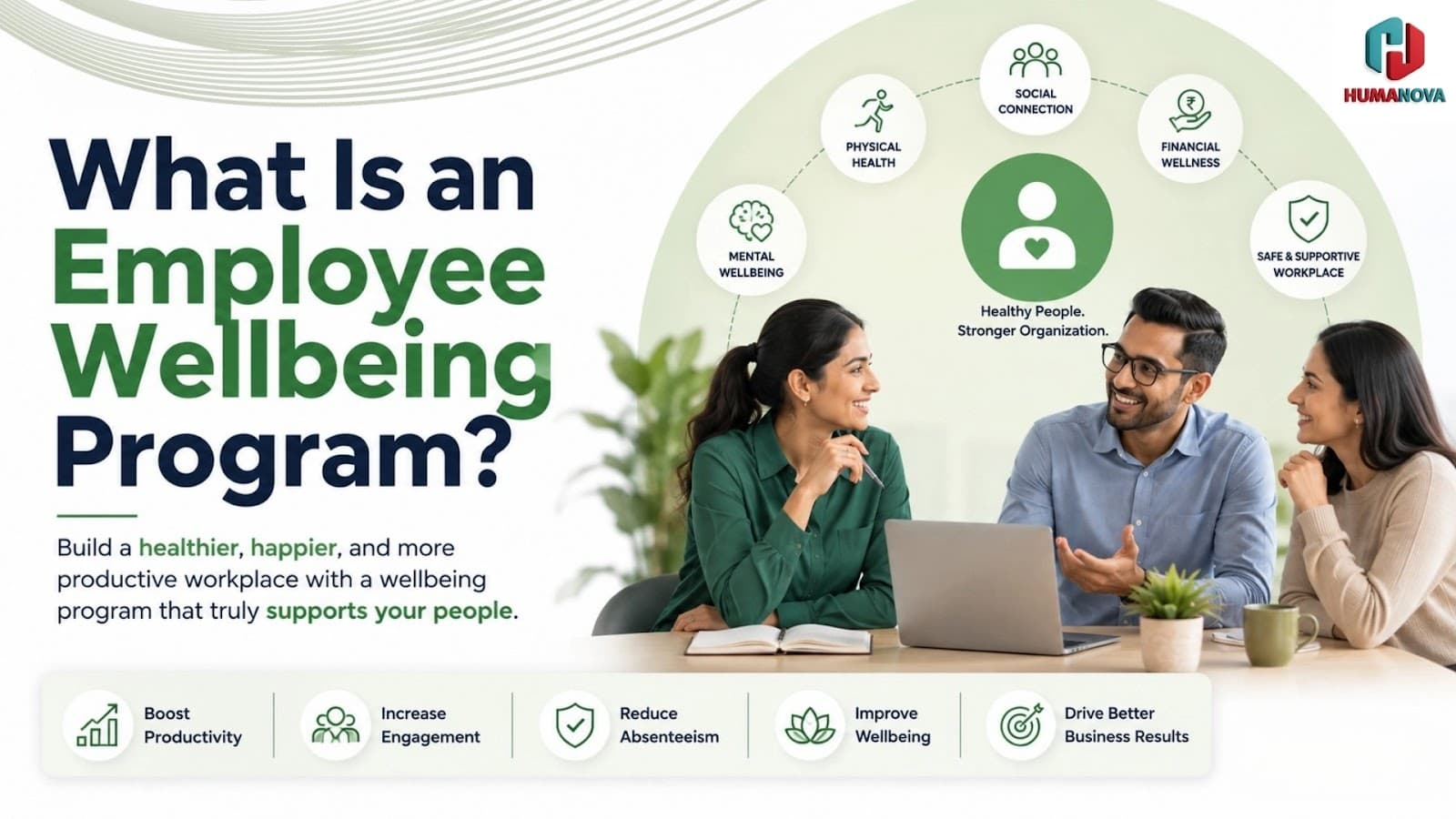
An employee wellbeing program is an organized set of workplace policies, services, and practices designed to support employees’ physical, mental, social, and financial wellbeing. A good program also addresses the conditions in which people work, including workload, management quality, flexibility, psychological safety, and access to confidential help.
That last point matters. A wellbeing program is not simply a collection of meditation subscriptions, fitness challenges, and occasional webinars. Those activities may have a place, but they cannot compensate for unclear roles, chronic overwork, poor management, or a culture in which asking for help feels unsafe.
For HR leaders and founders, the practical question is not whether the organization should “do wellbeing.” It is what employees need, what the employer can responsibly influence, and how the program will produce evidence that it is useful.
What does an employee wellbeing program cover?
Employee wellbeing is broader than the absence of illness. It includes how people experience their work, whether they have the resources to do it, how safely they can speak up, and whether support is available when personal or professional pressures become difficult to manage.
The US National Institute for Occupational Safety and Health takes a similarly broad view. Its [Worker Well-Being Questionnaire (https://www.cdc.gov/niosh/docs/2021-110/default.html) assesses work experience, workplace policies and culture, physical safety, health, and circumstances outside work. That framework is useful because it prevents employers from reducing wellbeing to a single survey score or benefit.
In practice, an employee wellbeing program may cover:
- Mental and emotional health support
- Physical health and healthy work practices
- Financial, family, and life-stage guidance
- Manager training and leadership support
- Workload, role clarity, flexibility, and job design
- Psychological safety, belonging, and respectful conduct
- Confidential counselling, coaching, or navigation services
- Return-to-work and reasonable workplace support
- Preventive education and early-help pathways
- Aggregate measurement for organizational improvement
Not every organization needs the same mix. A small technology company with a distributed workforce may need manager coaching, support across time zones, and clear boundaries around digital work. A manufacturer may place greater emphasis on shift patterns, fatigue, physical safety, supervisor capability, and access for frontline employees.
The program should follow the real shape of the workforce rather than a generic list of benefits.
Employee wellbeing program vs employee assistance program
The terms are often used interchangeably, but they are not identical.
An employee assistance program, or EAP, typically gives employees confidential access to counselling and other forms of short-term support. Depending on the provider and contract, it may also include crisis help, legal or financial guidance, manager consultations, and referrals.
An employee wellbeing program is the wider system. It may include an EAP, but it also considers prevention, work design, leadership practices, engagement, physical wellbeing, learning, measurement, and organizational change.
Employee assistance program Employee wellbeing program
Usually focused on confidential individual support Covers individual support and workplace conditions
Often activated when an employee needs help Includes prevention, education, and early intervention
Commonly delivered by an external provider May involve HR, leadership, benefits, safety, and external specialists
Reports utilization in aggregate Can combine utilization, experience, operational, and organizational measures
One component of the benefits package A broader workforce strategy
The distinction is useful when reviewing an existing program. If the organization has an EAP but utilization is low, the answer may not be another awareness email. Employees may not trust the confidentiality model, managers may not know how to direct people to support, or the service may not fit the languages and working patterns of the workforce.
The core elements of an effective employee wellbeing program
1. Clear goals tied to workforce needs
Begin with a problem, not a catalogue of activities. The organization may be dealing with manager burnout, high absence, low trust, retention pressure, rapid change, or poor access to support outside major offices.
Use several sources to understand the need:
- Anonymous employee feedback
- Absence and turnover patterns
- Exit interview themes
- Workload and overtime indicators
- EAP or benefit utilization reported in aggregate
- Manager and HR case themes
- Safety, conduct, and employee-relations data
- Focus groups with representative employee groups
The aim is not to diagnose employees. It is to understand workplace conditions and service gaps well enough to choose sensible interventions.
2. Organizational action
Employees cannot self-care their way out of a badly designed job. If workload, staffing, unclear priorities, or harmful conduct are driving distress, the program needs a route for changing those conditions.
The [World Health Organization’s guidelines on mental health at work](https://www.who.int/publications/i/item/9789240053052) cover organizational interventions as well as manager training, worker training, individual interventions, return to work, and support for employment. The accompanying [WHO/ILO policy brief](https://www.ilo.org/publications/mental-health-work) also focuses on preventing psychosocial risks, protecting and promoting mental health, and supporting workers with mental health conditions.
For an employer, organizational action may include:
- Reviewing workloads and staffing
- Giving employees clearer priorities and decision rights
- Improving schedule predictability
- Training managers to handle concerns and referrals responsibly
- Strengthening policies on bullying, harassment, and discrimination
- Providing reasonable flexibility where roles allow it
- Designing change programs that acknowledge uncertainty and workload
3. Confidential access to qualified human support
A wellbeing portal is useful only if people can reach appropriate support through it. Employees should understand what is confidential, what information the employer receives, and what happens in an emergency.
The program should clearly explain:
- Who provides counselling, coaching, or specialist guidance
- How providers are selected and credentialed
- Which services are clinical and which are not
- Whether family members are eligible
- Available languages, hours, and channels
- How urgent or crisis needs are handled
- What data is collected and retained
- What the employer can and cannot see
Technology can make access easier, support scheduling, and guide people toward relevant resources. Human judgment remains important when a situation is sensitive, complex, or outside the scope of self-directed content.
4. Manager capability
Managers often notice a change in performance, attendance, or behavior before HR does. Their role is not to diagnose a mental health condition. It is to notice, listen, discuss work, explain available support, protect confidentiality, and involve the right internal team when necessary.
Training should give managers language they can actually use. It should also cover boundaries: what not to ask, when to escalate a safety concern, how to document employment matters, and how to avoid making promises about confidentiality that they cannot keep.
5. Inclusive access
A program built for office-based employees may exclude large parts of the workforce. Check whether frontline staff, shift workers, remote employees, employees with disabilities, caregivers, and people in different regions can use the service in practice.
This affects communication as much as delivery. A QR code on a factory noticeboard, a multilingual phone option, a manager referral route, and a mobile-friendly booking flow may matter more than a polished desktop portal.
6. Trustworthy measurement
Measurement should help the organization improve the program without exposing individuals. Employers usually need aggregate trends, service reach, satisfaction, and organizational indicators—not counselling notes or employee-level health information.
NIOSH’s [Quality of Worklife Questionnaire](https://www.cdc.gov/niosh/stress/worklife-question/index.html) includes factors such as workload, autonomy, staffing, supervisory behavior, respect, trust, stress, job satisfaction, and intent to leave. That is a useful reminder that wellbeing measures should include the experience of work, not only benefit utilization.
Benefits of an employee wellbeing program
For employees, a well-designed program can make support easier to find, reduce confusion about where to go, and give people more confidence that seeking help will remain private. It can also improve everyday work when leaders act on workload, role clarity, flexibility, and management practices.
For employers, the potential value includes:
- Earlier access to appropriate support
- Better manager confidence
- More useful insight into workforce pressure points
- Stronger retention and employee experience
- Fewer fragmented vendors and communication campaigns
- A clearer way to connect wellbeing activity with workforce outcomes
These are potential outcomes, not automatic results. A program does not create value merely because it exists. Adoption, service quality, trust, workforce fit, and organizational follow-through determine whether employees use it and whether conditions improve.
How to build an employee wellbeing program
Step 1: define the workforce problem
Write a short problem statement using available evidence. For example: “Managers in two rapidly growing teams report sustained workload pressure, while employee feedback shows low awareness of confidential support.”
That statement is more useful than “improve wellbeing” because it gives the program a population, a condition, and an initial direction.
Step 2: set boundaries and governance
Decide who owns the program, who can access reporting, how providers are reviewed, and how privacy questions will be handled. Involve HR, legal, privacy, information security, occupational health, and employee representatives as appropriate.
Document the data flow before launch. Employees should not have to guess whether their manager can see that they booked a counselling session.
Step 3: choose the program components
Match the intervention to the need. Possible components include:
Transform your workforce wellbeing today
Interested in learning how Humanova can elevate your team's wellness and HR metrics? Connect with our team for a personalized walkthrough.
- Confidential counselling or EAP services
- Performance, career, or leadership coaching
- Manager training
- Group sessions and workshops
- Self-guided resources
- Financial or family support
- Return-to-work pathways
- Workload or policy changes
- Aggregate wellbeing measurement
Avoid launching too many disconnected activities at once. A smaller program with clear access, good communication, and accountable owners is easier to evaluate.
Step 4: assess providers carefully
Ask prospective providers about clinical governance, service coverage, escalation, professional credentials, inclusion, privacy, security, implementation, and measurement.
Useful procurement questions include:
- What happens when an employee needs support outside the service scope?
- How quickly can people reach a qualified professional?
- Which regions and languages are covered?
- What individual data, if any, reaches the employer?
- How are aggregate reports protected against re-identification?
- How does the provider measure service quality and outcomes?
- Can the service work for frontline and deskless employees?
- What does implementation require from HR and IT?
Step 5: launch with plain-language communication
Employees need to know what the program is, why it exists, how to access it, and what stays confidential. Repeat those points through channels people already use.
Give managers a separate briefing. They need referral steps, example language, and a clear escalation route. A launch announcement alone is not manager training.
Step 6: review and improve
Set a review rhythm before launch. Monthly operational checks and quarterly outcome reviews are a reasonable starting point for many organizations, though the right cadence depends on program size and data availability.
Use the review to decide what to continue, change, or stop. If employees know about the service but do not trust it, more promotion will not fix the underlying problem.
How to measure employee wellbeing program success
Use a balanced set of measures rather than one headline number.
Measurement area Examples
Reach Eligible employees, registrations, service awareness, regional access
Use Aggregate utilization, repeat engagement, channel use, referral completion
Experience Satisfaction, ease of access, perceived confidentiality, relevance
Work conditions Workload, role clarity, manager support, trust, flexibility
Workforce outcomes Absence, retention, intent to leave, engagement, safety indicators
Delivery quality Time to support, provider quality, complaints, escalations, follow-up
Set a baseline and define the review period. Segment data only when group sizes are large enough to protect privacy. Treat changes as signals to investigate rather than immediate proof that one intervention caused the result.
The [NIOSH WellBQ](https://www.cdc.gov/niosh/docs/2021-110/default.html) can help employers think more broadly about measurement, though any survey tool should be used in line with its instructions and with appropriate privacy and ethical safeguards.
Common employee wellbeing program mistakes
Treating wellbeing as an employee responsibility
Resilience training may help people, but it should not be used to avoid addressing workload, understaffing, poor management, or unsafe behavior.
Launching benefits without building trust
Employees may not use a service if they do not understand confidentiality. Explain data boundaries repeatedly and precisely.
Measuring activity instead of usefulness
Registrations and webinar attendance are easy to count. They do not show whether support was timely, relevant, or connected to better work conditions.
Using the same program for every workforce group
Office staff, frontline workers, leaders, caregivers, and employees in different countries may need different access routes and content.
Making unsupported claims
Do not promise that a wellbeing program will eliminate burnout, reduce healthcare costs by a fixed percentage, or produce a guaranteed return. State the evidence, assumptions, timeframe, and limits.
Employee wellbeing program checklist
Use this checklist before launch or when reviewing an existing program.
- We have a written problem statement based on workforce evidence.
- Employees have helped shape the program or validate its design.
- The program addresses work conditions as well as individual support.
- Roles for HR, managers, leaders, providers, legal, and privacy teams are clear.
- Employees can understand exactly what is confidential.
- Providers have appropriate credentials and escalation processes.
- Access works across locations, roles, languages, shifts, and abilities.
- Managers have practical training and referral guidance.
- The communication plan uses channels employees already trust.
- The organization has baseline measures and a review cadence.
- Reports use aggregate data and protect against re-identification.
- Claims about outcomes, compliance, and return on investment are supportable.
- The program has an owner who can act on what the data reveals.
Building a program employees can trust
An employee wellbeing program works best when it connects three things: responsible workplace practices, confidential access to qualified support, and measurement that helps the organization improve without tracking individuals.
Start with the workforce problem. Fix the conditions the employer can influence. Make support easy to reach, and be exact about privacy. Then review whether the program is changing anything that matters.
Humanova helps organizations bring employee wellbeing, coaching, leadership support, and privacy-conscious workforce insight into one coordinated program. [Explore the employee wellbeing program](https://humanova.live/programs/employee-wellbeing) or download the employee wellbeing checklist to assess your current approach.
Frequently asked questions
1. What is an employee wellbeing program?
An employee wellbeing program is a coordinated set of policies, services, and workplace practices that supports employees’ physical, mental, social, and financial wellbeing. It can include confidential support, manager training, preventive education, healthy work design, and aggregate measurement.
2. Why are employee wellbeing programs important?
They give employees clearer access to support and help employers address workplace conditions that affect health, trust, retention, and performance. Their value depends on program quality, privacy, access, and leadership action.
3. What should an employee wellbeing program include?
The right mix depends on workforce needs. Common elements include counselling or EAP access, coaching, manager training, mental-health education, work-design improvements, physical and financial wellbeing support, and privacy-safe reporting.
4. Is an employee wellbeing program the same as an EAP?
No. An EAP is usually one part of a broader wellbeing program. It commonly provides confidential short-term support, while the wider program can also address prevention, management practices, work design, leadership, learning, and measurement.
5. How do you start an employee wellbeing program?
Assess workforce needs, define the problem, set privacy and governance rules, choose suitable interventions, review providers, train managers, communicate clearly, and establish baseline measures before launch.
6. How much does an employee wellbeing program cost?
Cost depends on workforce size, locations, services, languages, provider model, integrations, and reporting needs. Compare the full implementation and operating cost, not only the per-employee fee.
7. How do you measure employee wellbeing?
Use a combination of anonymous employee feedback, work-condition measures, aggregate service data, experience measures, and workforce indicators such as absence, retention, and intent to leave. Protect privacy when segmenting results.
8. Can employee wellbeing programs reduce burnout?
They can help address burnout risk when they combine individual support with changes to workload, staffing, role clarity, management, and recovery time. A benefit or app alone cannot fix harmful work conditions.
9. How can employers protect employee privacy?
Collect only necessary data, separate individual support records from employer reporting, use aggregate results, restrict access, explain data flows, set retention rules, and assess the risk of identifying people in small groups.
10. What role do managers play in employee wellbeing?
Managers influence workload, priorities, flexibility, psychological safety, and access to help. They should be trained to notice concerns, listen, discuss work, explain support, and escalate appropriately without diagnosing employees.
11. What is a wellbeing platform?
A wellbeing platform is a digital service that can organize access to counselling, coaching, content, assessments, communication, and reporting. Its value depends on the quality of the human services, privacy model, accessibility, and implementation behind it.
12. How do you increase participation in a wellbeing program?
Make access simple, communicate confidentiality clearly, involve leaders and managers, use relevant examples, support different workforce groups, and act on employee feedback. Participation should not be coerced or used to identify individuals.
13. Can small businesses offer an employee wellbeing program?
Yes. A small business can begin with clear policies, manager guidance, workload reviews, flexible practices, referral resources, and a suitably sized external support service. The program does not need to be complex to be useful.
14. How often should a wellbeing program be reviewed?
Review delivery data regularly and assess outcomes at a cadence suited to the workforce and intervention. Many employers use monthly operational reviews and quarterly strategic reviews, while avoiding conclusions from very small samples.
15. What questions should employers ask a wellbeing provider?
Ask about provider credentials, service scope, privacy, security, crisis handling, access times, languages, workforce coverage, implementation, aggregate reporting, quality assurance, outcome measurement, and total cost.