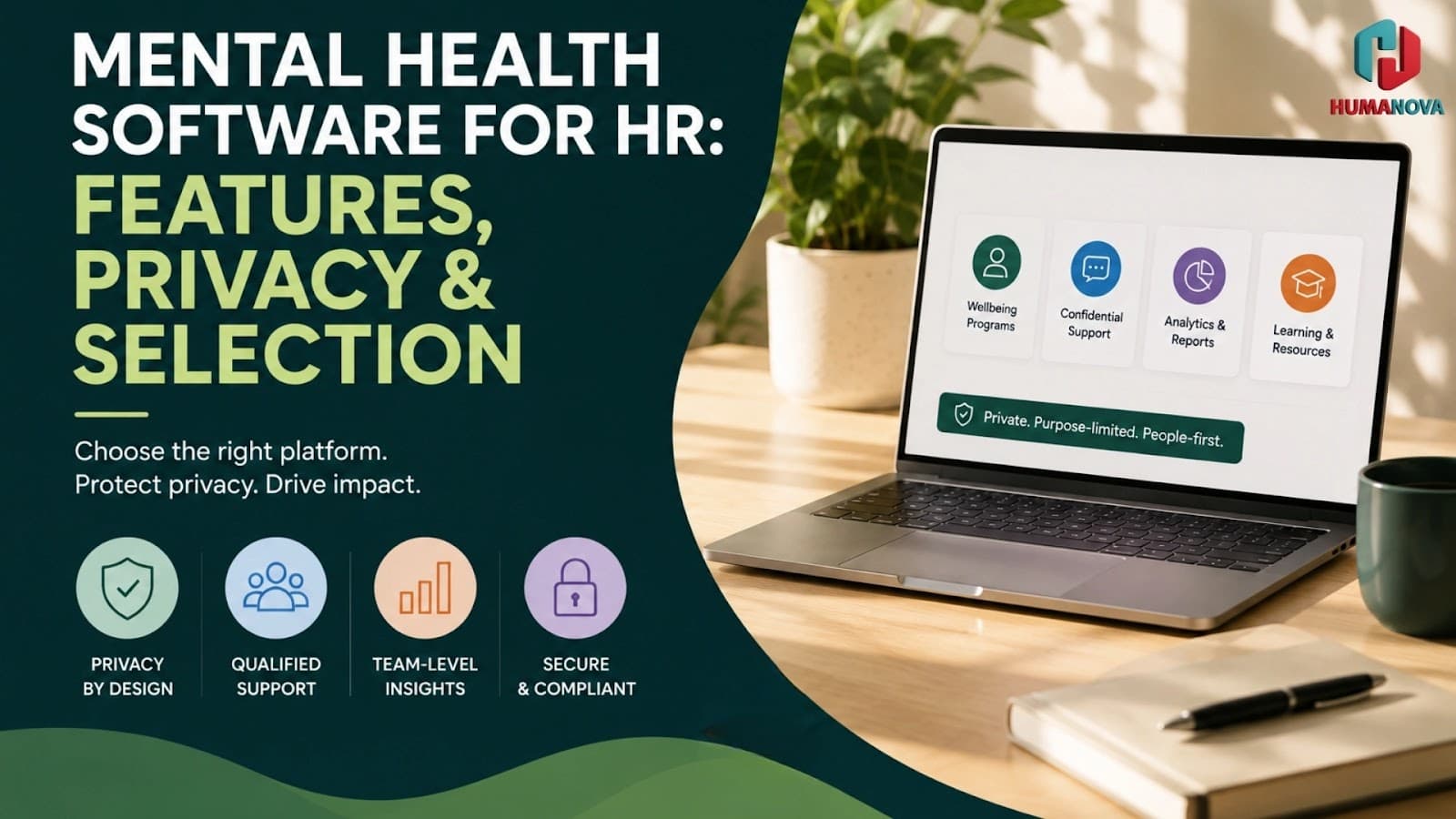
Mental health software for HR can make support easier to find, organise programmes and show team-level trends. It can also create serious trust problems if it exposes sensitive information or presents uncertain signals as facts about an employee.
The right buying question is not 'How many features does it have?' It is 'What decisions will this system support, what data does it need, and what happens when a person needs human help?'
Define the use case before the feature list
A platform for counselling access is different from an engagement survey, learning library or workforce analytics tool. Some products combine these functions, but the boundaries still need to be clear.
Write the priority use cases and the users involved. This prevents procurement from rewarding breadth that employees will never use.
- Confidential support access
- Employee check-ins and reflections
- Manager education
- Programme delivery
- Team-level wellbeing trends
- Referrals and escalation
Features employees need
Employees need a simple experience, clear choices and honest privacy explanations. They should be able to tell whether a service is self-guided, coaching, counselling or emergency support.
Accessibility matters as much as interface polish. Test mobile access, language, disability support, working hours and what happens when an employee has limited connectivity.
- Plain-language consent and notices
- Qualified support pathways
- Control over personal information
- Accessible mobile experience
- Transparent service limits
Features HR and managers need
HR needs programme administration, aggregate reporting and action tracking. Managers need approved team-level information and practical next steps, not access to private reflections or counselling content.
Any score should show its purpose, inputs, limits and appropriate use. A wellbeing score should not become an employee performance rating or an automated employment decision.
- Role-based dashboards
- Minimum cohort thresholds
- Programme reach and waiting time
- Action ownership
- Export and audit controls
- Explainable metric definitions
Privacy questions procurement should ask
Map each data element from collection to deletion. Ask who can access raw responses, whether administrators can re-identify people, how vendors use subprocessors and whether data is used to train models.
India's DPDP framework and other applicable laws should be reviewed by counsel for the specific implementation. A vendor badge does not replace a data-processing agreement, retention schedule or tested access model.
- What is collected and why?
- Where is it stored?
- Who can access it?
- How are small groups protected?
- Can employees delete or correct data where applicable?
- Is data used for product training or advertising?
Security and clinical governance
Security review should cover authentication, encryption, logging, incident response, vulnerability management and vendor access. Verify certification claims against current evidence and scope.
If the platform connects employees to care, review professional credentials, supervision, service boundaries, urgent-risk procedures, quality monitoring and complaint handling.
Implementation and adoption
Software does not create trust by itself. Managers, communications and support teams need a shared explanation of the service. Pilot the full journey with real workforce groups before expanding.
Measure successful connection and experience, not only logins. Low use may mean low need, poor awareness, access barriers or distrust; investigate before drawing a conclusion.
A practical vendor scorecard
Score each vendor on workforce fit, human support, privacy, security, analytics, implementation and evidence. Require written answers and demonstrations using realistic scenarios.
Transform your workforce wellbeing today
Interested in learning how Humanova can elevate your team's wellness and HR metrics? Connect with our team for a personalized walkthrough.
Humanova's platform overview describes role-based experiences, minimum-data thresholds and separation of private reflections from manager views. Treat those as verifiable configuration requirements during a live review, not as assumptions.
Turn the guidance into an operating plan
Start by writing the decision that this mental health software for HR work must improve. Name the affected group, the evidence already available, the owner and the first review date. A clear scope prevents the project from becoming a collection of unrelated activities.
Build the baseline from more than one source. Employee feedback explains experience; operational data shows context; representative conversations reveal barriers that a dashboard can miss. Keep health detail out of general HR reporting and collect only what the approved purpose requires.
Choose one or two changes that the organisation can implement and explain. Give each action an owner, deadline and acceptance check. If a recommendation has no owner or budget, it is an observation rather than a plan.
Communicate the purpose, privacy boundaries and next review in plain language. Then report back on what was heard, what will change and what cannot change yet. That final step is essential because repeated listening without visible action weakens trust.
A practical example
During a vendor demonstration, procurement asks an employee to complete a check-in, request support and then view the resulting manager dashboard. The exercise reveals that one vendor allows administrators to filter a small team by location and tenure, creating a re-identification risk. Another vendor explains exactly which fields are aggregated, what the threshold is and how confidential support is separated. The scenario gives the buying team better evidence than a feature checklist marked 'AI insights: yes.'
Common mistakes to avoid
- Comparing vendors by feature count instead of workforce use cases.
- Assuming an anonymous label means an employee cannot be identified.
- Accepting certification or compliance claims without checking current scope and evidence.
- Allowing private support data to flow into manager or performance systems.
- Treating automated recommendations as clinical or employment decisions.
Most of these mistakes come from treating a human and organisational issue as a communication campaign. The correction is usually to narrow the promise, clarify responsibility and connect data to a decision the employer is prepared to make.
How to measure progress
Use a small scorecard with definitions, owners and review frequency. Combine service measures with employee experience and organisational follow-through. Show uncertainty where it exists, and do not convert an association into a claim of cause or financial return.
- Successful support connection
- Time to service
- Employee trust and clarity
- Administrative access exceptions
- Manager actions completed
- Platform incidents and complaints
Review results at the safest useful level. A monthly operational review can address access or waiting time, while broader employee-experience patterns often need a quarterly view. Major organisational change may justify an additional review.
A 30-day action checklist
- Confirm the owner, audience and business decision for mental health software for HR.
- Review employee feedback, operational context and current support routes.
- Map data collection, access, aggregation, retention and deletion.
- Select one practical intervention and one accountable leader.
- Prepare manager language, employee communication and escalation steps.
- Set a review date and publish how employees will hear about action taken.
How Humanova can support the next step
Humanova connects employee check-ins, confidential support, learning, programmes and role-based team insight. Use the platform only within an approved implementation, with clear privacy boundaries, minimum reporting thresholds and human review of sensitive decisions.
Next step: Book a privacy-first platform walkthrough
Frequently asked questions
1. What is mental health software for HR?
It is software that helps organisations deliver employee support, wellbeing programmes, education or aggregate insight. Products vary widely in purpose and scope.
2. Can managers see individual employee responses?
They generally should not see private reflections, counselling content or restricted health information. Manager views should be purpose-limited and aggregated.
3. What is the most important buying criterion?
Start with the workforce problem and data boundaries. A product must fit the use case, protect privacy and provide a safe route to qualified human support.
4. Should AI diagnose employee mental health?
No. Workplace tools should not present automated outputs as clinical diagnoses or use them alone for employment decisions.
5. How should adoption be measured?
Use awareness, successful access, waiting time, experience and organisational follow-through alongside appropriate aggregate trends.