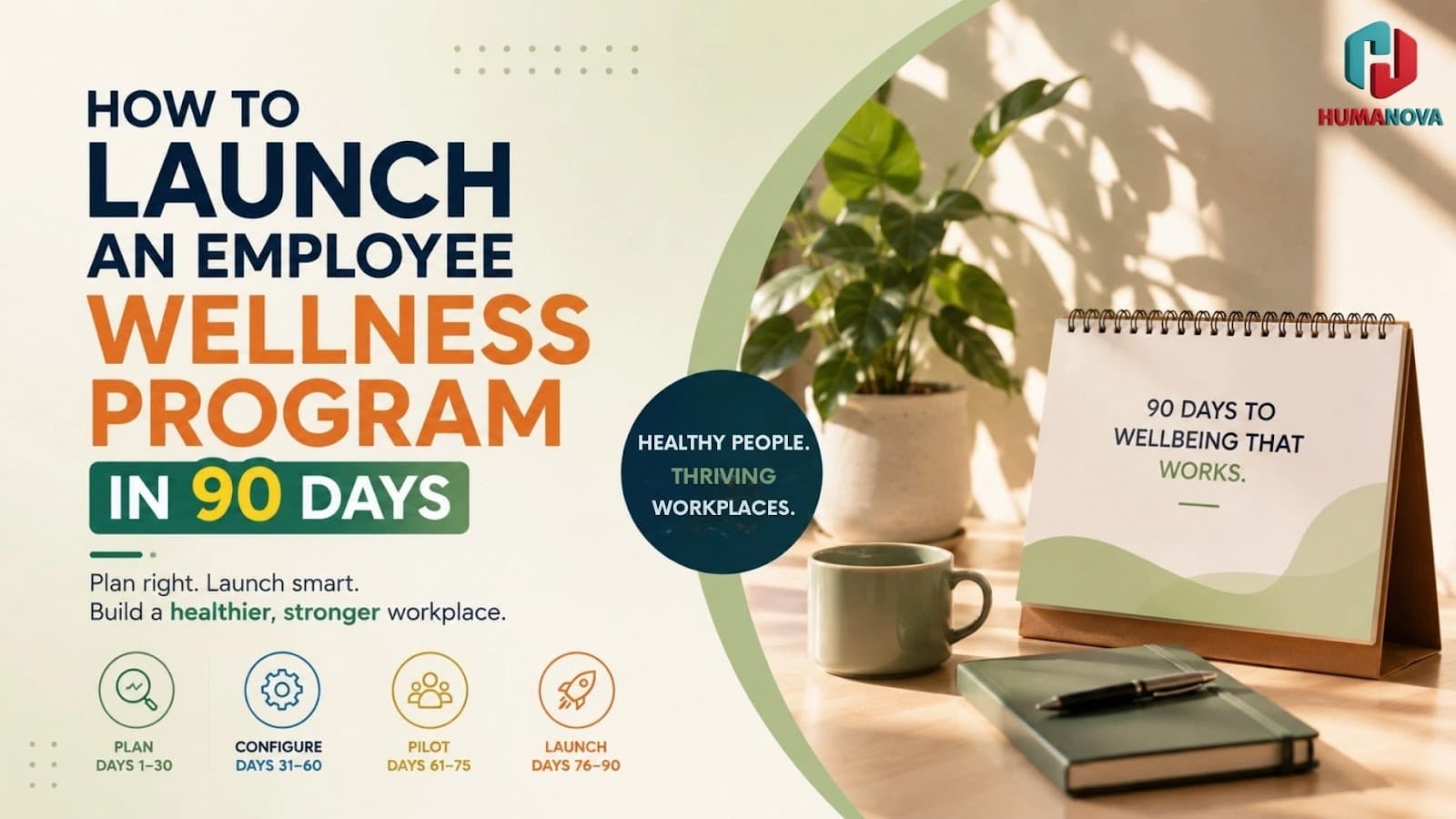
You can launch an employee wellness program in 90 days, but only if the first month is spent making decisions rather than buying activities. The organisation needs a defined problem, clear privacy boundaries, accountable owners and a realistic path from employee feedback to action.
The plan below is designed for a first release. It gives employees a dependable route to support and gives HR enough evidence to improve the programme after launch.
Before day one: name the problem
Write a one-paragraph case for the programme. Identify the workforce group, the evidence of need and the condition the organisation is prepared to change. 'Improve wellbeing' is too broad to guide implementation.
Confirm an executive sponsor and a working owner. HR can coordinate, but operations, managers, privacy, security and qualified support providers may all have responsibilities.
- Problem statement
- Eligible population
- Executive sponsor
- Programme owner
- Initial budget range
- Decision and escalation route
Days 1-30: discover and govern
Use anonymous feedback, operational trends and representative interviews to find access barriers and work-related risks. Do not collect clinical detail to decide whether the programme is needed.
Map the data flow before selecting tools. Define what employees provide, what the provider holds, what HR receives, how small groups are protected and when data is deleted.
- Needs assessment
- Privacy impact review
- Success measures
- Service and inclusion requirements
- Risk register
- Draft communication principles
Days 31-60: select and configure
Evaluate providers against the use case, not a generic feature list. Ask who delivers support, how credentials are checked, how urgent concerns are handled and how the experience works for different roles and locations.
Configure the smallest useful programme. Too many modules create confusion and make it harder to tell what employees value.
- Qualified human support
- Language and channel coverage
- Role-based access
- Minimum reporting thresholds
- Implementation support
- Service-quality reporting
Prepare managers without turning them into counsellors
Managers need a short, practical briefing before employees hear about the programme. They should know how to describe it, where to refer someone, what they can see and what to do if a safety concern is raised.
Include scenarios about overload, changed behaviour, privacy questions and urgent escalation. Test whether managers can use the language, not only whether they completed a module.
Days 61-75: pilot the experience
Run the whole journey with a representative pilot group: invitation, sign-in, privacy notice, support request, referral, feedback and reporting. Include frontline or remote employees rather than testing only with HR.
Fix access, language and trust problems before launch. A pilot is not a marketing preview; it is a service-quality check.
- Can employees explain confidentiality?
- Can they reach support in a reasonable time?
- Does the mobile experience work?
- Do reports protect small teams?
- Do managers know the escalation route?
Days 76-90: launch and respond
Use plain language: what the programme is, why it exists, how to access it, what stays private and what the employer receives. Repeat the message through channels employees already use.
Publish the first update quickly. Tell employees what questions were raised, what was changed and when the next review will happen. Trust grows when feedback produces visible action.
Measure the first quarter
Track reach, access, waiting time, experience, manager readiness and action completion. Avoid setting an arbitrary utilization target that encourages pressure to participate.
Transform your workforce wellbeing today
Interested in learning how Humanova can elevate your team's wellness and HR metrics? Connect with our team for a personalized walkthrough.
At 30, 60 and 90 days after launch, review which groups are not reached, whether privacy concerns remain and whether the original workplace problem is being addressed.
Turn the guidance into an operating plan
Start by writing the decision that this launch employee wellness program work must improve. Name the affected group, the evidence already available, the owner and the first review date. A clear scope prevents the project from becoming a collection of unrelated activities.
Build the baseline from more than one source. Employee feedback explains experience; operational data shows context; representative conversations reveal barriers that a dashboard can miss. Keep health detail out of general HR reporting and collect only what the approved purpose requires.
Choose one or two changes that the organisation can implement and explain. Give each action an owner, deadline and acceptance check. If a recommendation has no owner or budget, it is an observation rather than a plan.
Communicate the purpose, privacy boundaries and next review in plain language. Then report back on what was heard, what will change and what cannot change yet. That final step is essential because repeated listening without visible action weakens trust.
A practical example
A growing company begins with a simple problem statement: employees outside the main office do not know where to find confidential support, and managers are inconsistent when workload concerns are raised. The first release therefore includes one support pathway, manager scenarios, mobile access and team-level reporting. Fitness challenges and a large content library wait until the basics work. After the pilot, HR discovers that the privacy notice is too technical and the evening support hours are unclear. Both issues are fixed before the wider launch.
Common mistakes to avoid
- Buying a platform before agreeing on the programme problem and owner.
- Launching every available module at once.
- Announcing confidentiality without mapping who can access which data.
- Training managers after employees have already asked them for help.
- Declaring success from registrations or event attendance alone.
Most of these mistakes come from treating a human and organisational issue as a communication campaign. The correction is usually to narrow the promise, clarify responsibility and connect data to a decision the employer is prepared to make.
How to measure progress
Use a small scorecard with definitions, owners and review frequency. Combine service measures with employee experience and organisational follow-through. Show uncertainty where it exists, and do not convert an association into a claim of cause or financial return.
- Eligible employees reached
- Successful account or service access
- Waiting time to qualified support
- Manager readiness
- Privacy questions and complaints
- Organisational actions completed
Review results at the safest useful level. A monthly operational review can address access or waiting time, while broader employee-experience patterns often need a quarterly view. Major organisational change may justify an additional review.
A 30-day action checklist
- Confirm the owner, audience and business decision for launch employee wellness program.
- Review employee feedback, operational context and current support routes.
- Map data collection, access, aggregation, retention and deletion.
- Select one practical intervention and one accountable leader.
- Prepare manager language, employee communication and escalation steps.
- Set a review date and publish how employees will hear about action taken.
How Humanova can support the next step
Humanova connects employee check-ins, confidential support, learning, programmes and role-based team insight. Use the platform only within an approved implementation, with clear privacy boundaries, minimum reporting thresholds and human review of sensitive decisions.
Next step: Download the 90-day wellness rollout template
Frequently asked questions
1. Can an employee wellness program launch in 90 days?
Yes, a focused first release can launch in 90 days if ownership, privacy, provider selection and manager readiness are handled early.
2. What should be included in the first version?
Include clear access to support, essential preventive resources, manager guidance, privacy controls and a small set of useful measures.
3. Should the programme begin with a survey?
A short needs assessment can help, but combine it with operational evidence and employee conversations. Do not survey without a plan to respond.
4. How should the launch be communicated?
Explain purpose, access, confidentiality, employer visibility and available help in plain language through several workforce channels.
5. What should HR measure after launch?
Measure reach, access, waiting time, experience, manager readiness and completed organisational actions rather than attendance alone.