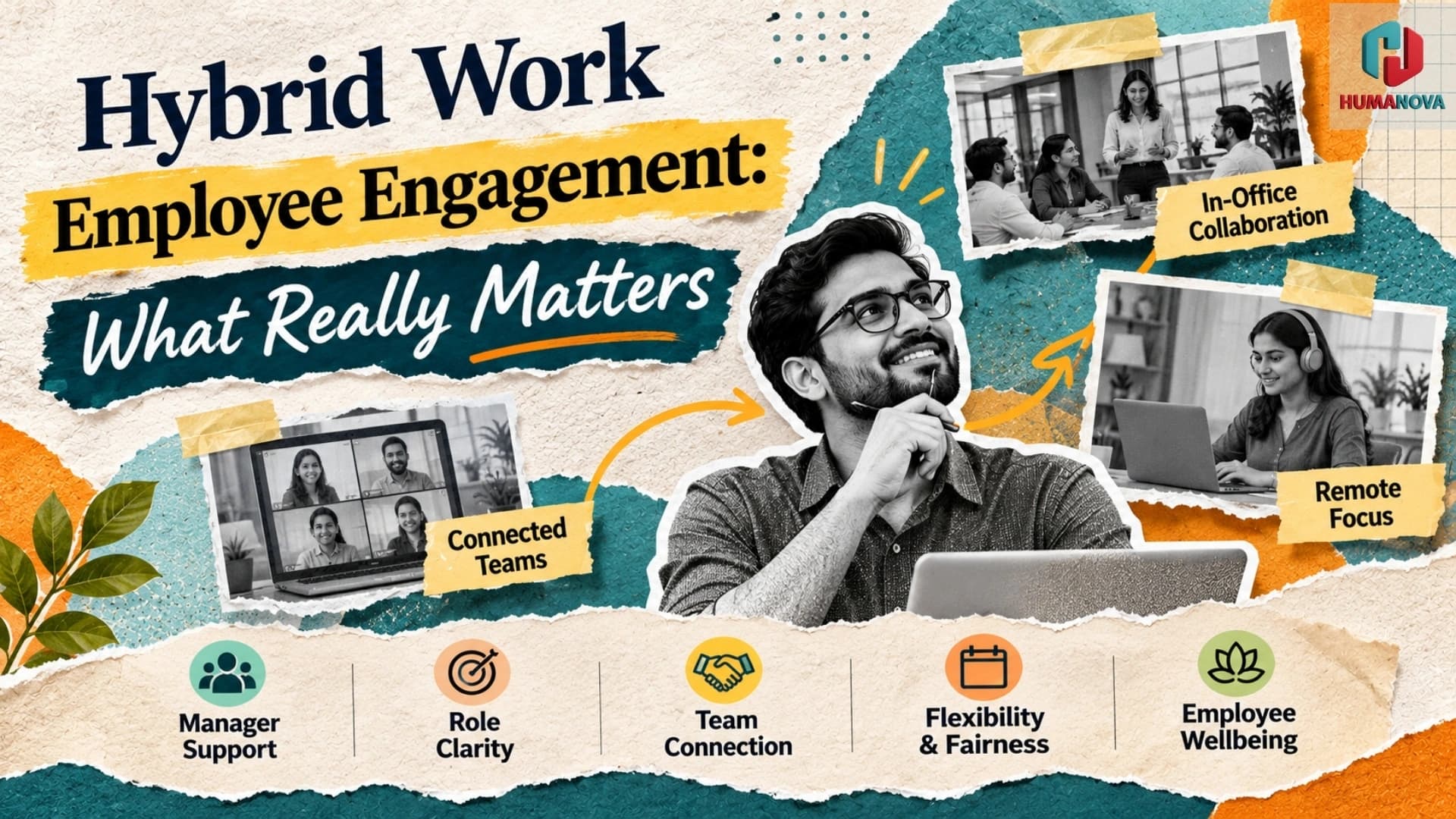
A team comes into the office three days a week because the policy says so. The employees sit at separate desks, join online meetings with colleagues in other locations and leave without having a meaningful conversation with their manager.
Another team meets in person once a week. That day is used for planning, problem-solving, coaching and relationship-building. Focused tasks happen remotely. Managers set clear expectations, employees know when colleagues are available and people can raise concerns without waiting for the next annual survey.
Both teams are hybrid. Their experience of work is very different.
This is why debates about whether hybrid work is “dead” miss the more useful question. What matters is whether the working model helps employees stay connected, supported and engaged.
Hybrid work employee engagement depends on more than the number of office days. It is shaped by management quality, workload, role clarity, employee voice, coworker support, fair access to opportunities and the ability to manage work alongside life outside it.
Employers cannot understand that experience through badge data, attendance reports or an annual engagement survey alone. They need to examine what happens during the ordinary working week.
Why hybrid work employee engagement matters now
Hybrid work has moved beyond its emergency-pandemic phase. It is now a deliberate operating choice for many organisations and a source of continuing debate for others.
Some leaders want greater office attendance to improve collaboration, culture or management visibility. Employees may value flexibility because it reduces commuting, supports caregiving or gives them more control over focused work. Managers are often caught between organisation-wide policy and the different needs of their teams.
Meanwhile, work itself is changing. Employees are adapting to AI tools, tighter budgets, changing roles and pressure to deliver more with fewer resources. Hybrid arrangements can make these pressures easier to manage, but they can also hide them.
A manager may not notice that an employee is overwhelmed because their work is still being delivered. A remote employee may be invited to formal meetings but excluded from informal decisions. A new joiner may understand the tasks yet struggle to build the relationships needed to ask for help.
Recent research reinforces the importance of looking beyond location.
A September 2026 study of 1,002 employees examined workload, role clarity, coping and wellbeing in hybrid work. Higher workload was associated with more anxiety and lower engagement, while role clarity supported better wellbeing. The frequency of remote work did not significantly change those core relationships. The authors concluded that job design matters across work locations. Current Psychology study on hybrid work and wellbeing
For HR leaders, the practical issue is not choosing between flexibility and performance. It is designing a working model in which flexibility, coordination and accountability can coexist.
That affects retention, engagement, wellbeing, productivity and the organisation’s ability to attract employees from a wider range of locations and life circumstances.
Understanding the real hybrid-work problem
Hybrid work usually means employees divide their working time between an employer’s workplace and another location, often their home.
That definition describes where people work. It says very little about how well the arrangement works.
A strong hybrid model answers practical questions:
- Which activities are best done together?
- When should teams be available at the same time?
- How are decisions documented?
- How do remote participants contribute equally?
- How do new employees build relationships?
- How does a manager notice workload or wellbeing concerns?
- How are flexibility decisions made fairly?
- What support is available when an employee is struggling?
Engagement is also frequently misunderstood. An engaged employee is not simply someone who attends office days, appears active online or responds quickly to messages. Engagement concerns the person’s connection to their work, team and organisation.
An employee can be physically present and disengaged. Another can work remotely and remain strongly connected to the team’s goals.
Low engagement does not prove that hybrid work is the cause. It may reflect unclear roles, excessive workload, limited development, poor management, unfair decisions, weak team relationships or personal circumstances.
Likewise, changes in communication patterns or survey scores cannot diagnose burnout or a mental health condition. Workforce data can reveal themes that deserve attention, but it cannot establish what an individual employee is experiencing.
What organisations often get wrong
1. Treating office attendance as evidence of engagement
It is easy to count office days. It is much harder to measure whether people have clear goals, useful relationships and confidence in their managers.
Attendance can support certain business needs, but it should not be used as a substitute for understanding the employee experience.
If people commute to spend the day in video meetings, the organisation has created presence without connection.
2. Applying one schedule to every kind of work
Different roles need different forms of collaboration.
A product team may benefit from regular design sessions. A finance employee may need quiet time for concentrated analysis. A customer-support team may require reliable coverage rather than everyone being in one place.
A consistent policy can help employees plan. Rigid uniformity can ignore the actual work.
Leaders should define the business reason for in-person time and allow teams to decide how to achieve it within fair organisational boundaries.
3. Leaving coordination to individual employees
Hybrid work becomes exhausting when every meeting requires negotiation and employees must constantly work out who is available.
Teams need shared norms covering response times, core collaboration hours, meeting formats, documentation and decision-making.
Without these norms, flexibility can turn into permanent availability.
4. Allowing proximity to influence opportunity
Managers may give more attention to employees they see frequently. Office-based colleagues may hear about projects earlier, receive more informal coaching or gain greater exposure to senior leaders.
This does not always result from deliberate favouritism. It can emerge from ordinary habits.
HR should examine who receives development opportunities, high-visibility work, recognition and promotion. Flexible workers should not have to trade career access for location choice.
5. Using technology to monitor rather than support
Activity tracking, online-status monitoring and attendance dashboards may give managers a sense of control. They rarely explain whether work is meaningful, manageable or effective.
Excessive monitoring can also weaken trust and encourage employees to perform visibility instead of focusing on useful work.
Technology should help people coordinate, find support and contribute their views. It should not become a surveillance system.
What HR leaders and managers can do now
1. Design office time around a clear purpose
Do not start with the number of required days. Start with the work.
Ask teams which activities improve when people are together. These may include:
- complex problem-solving;
- planning and decision-making;
- onboarding;
- coaching;
- relationship-building;
- creative work; and
- sensitive conversations.
Then build office patterns around those activities.
An office day should not become a full calendar of presentations. Leave room for informal connection, peer learning and the short conversations that make it easier to ask for help later.
Some employees may need alternative arrangements because of disability, health, caregiving or distance. Organisations should apply policies fairly while allowing appropriate flexibility.
2. Make hybrid communication explicit
Strong hybrid teams do not rely on employees guessing how communication works.
Agree on which channels are used for urgent requests, routine updates, decisions and social conversation. Clarify expected response times so people do not feel they must remain continuously available.
Important decisions should be documented where all relevant employees can find them. When some participants are remote, design the meeting around equal participation rather than treating remote colleagues as observers.
Managers can also rotate who speaks first, use written input before meetings and send decisions afterwards. These small practices reduce the advantage of being physically closest to the meeting leader.
3. Train managers to manage outcomes and relationships
Hybrid management requires more than checking whether tasks were completed.
Transform your workforce wellbeing today
Interested in learning how Humanova can elevate your team's wellness and HR metrics? Connect with our team for a personalized walkthrough.
Managers need to set priorities, clarify roles, recognise overload and create space for honest conversation. They should discuss development and wellbeing as part of regular one-to-one meetings rather than waiting for an annual review.
Manager training should cover:
- setting clear outcomes;
- reviewing workload;
- facilitating inclusive meetings;
- recognising proximity bias;
- supporting new joiners;
- responding appropriately to distress;
- escalating sensitive concerns; and
- directing employees to professional support.
Managers should not diagnose employees or act as counsellors. Their role is to listen, respond appropriately and help employees reach the right support.
4. Strengthen employee voice and coworker connection
Employee listening should be regular, voluntary and specific.
Instead of asking only, “Are you satisfied with hybrid work?”, ask:
- Can you access your manager when you need support?
- Are important decisions communicated clearly?
- Do you have colleagues you can ask for help?
- Are office days useful?
- Can you disconnect outside agreed working hours?
- Do remote employees receive equal opportunities?
- Is your workload manageable?
Recent Deloitte research on younger employees in India found that workplace relationships were connected with both wellbeing and intention to stay. The finding is a useful reminder that coworker support is not a social extra. It can affect how employees experience the organisation. Deloitte India Gen Z and Millennial Survey 2026
Teams can strengthen connection through peer learning, mentoring, thoughtful onboarding and time for collaboration. Forced social events are less useful when the everyday work still feels isolating.
5. Review workload and work-life boundaries
Flexible work does not automatically create work-life balance.
When home and work share the same space, employees may start earlier, finish later or struggle to disconnect. Meetings can spread across the day because the commute no longer creates a natural boundary.
Managers should review the total volume of work, meeting load and availability expectations. Teams can set quiet hours, protect focus time and avoid treating evening messages as urgent unless the role genuinely requires it.
A September 2026 study of remote and hybrid work examined how technology demands and work-family conflict relate to engagement. It noted that unclear boundaries and continuous technology use can make psychological detachment harder. Sustainability study on remote work and engagement
Wellbeing support can help employees manage personal pressure, but it should not be used to compensate for unrealistic workloads or constant availability.
6. Audit fairness across work locations
Review whether career outcomes differ by location or office frequency.
Look at access to:
- manager time;
- development programmes;
- high-profile assignments;
- client exposure;
- recognition;
- promotion; and
- informal decision-making.
Interpret these patterns carefully. A difference does not automatically prove bias, but it gives HR a reason to investigate.
Where possible, ask employees about their experience before deciding what the data means.
The role of technology in hybrid work
Technology is essential to hybrid work, but adding more software does not automatically create a connected workplace.
A useful workplace platform can support:
- confidential routes to wellbeing support;
- virtual one-to-one sessions;
- manager and employee coaching;
- voluntary wellbeing check-ins;
- anonymous feedback and pulse surveys;
- self-reflection tools;
- accessible learning resources;
- leadership guidance; and
- aggregated workforce-level insight.
The aim should be to reduce friction. Employees should not have to search across several disconnected apps to find coaching, support or a way to share feedback.
Privacy matters. Organisations should explain what data is collected, why it is needed and who can access it. Employees should know whether a response is confidential, anonymous or visible to HR.
Managers should not receive individual wellbeing information simply because they manage the team. Workforce-level reporting should use suitable group sizes so employees cannot be identified indirectly.
Technology can make patterns visible. It cannot replace a supportive manager, a fair policy, a manageable workload or a team that knows how to work together.
How Humanova supports a connected hybrid experience
Humanova can help organisations bring confidential wellbeing support, coaching, employee feedback, leadership development, learning resources and privacy-conscious workforce insights into one connected experience.
A remote employee may need confidential support without visiting a central office. A manager may need guidance before discussing workload or disengagement. HR may need to understand recurring themes across locations without exposing individual employee information.
Bringing these routes together can make support easier to find and help HR respond more consistently.
Humanova does not replace managers, HR teams, qualified counsellors, psychologists, healthcare providers or an existing EAP. It supports the wider system through which employees access help, build skills and share their experience of work.
How to measure whether the hybrid approach is working
Do not judge the model by office occupancy alone.
Track several types of evidence together.
Employee-experience measures may include role clarity, manager support, psychological safety, coworker connection, work-life integration and trust in hybrid-work decisions.
Participation measures may include awareness and use of coaching, learning and confidential support. Low use should be investigated carefully. It may indicate low demand, poor awareness, limited trust or difficulty accessing the service.
Team measures may include the quality of collaboration, clarity of decisions, meeting effectiveness and whether employees can access help from colleagues.
Fairness measures may include development, recognition and promotion patterns across work locations and employee groups.
Organisational measures may include retention, absence, internal mobility and engagement trends. These should be interpreted alongside role, manager, labour-market and business context.
Gallup’s employee-engagement guidance emphasises expectations, development, purpose, voice and connection. These needs remain relevant whether a team works in one place or across several. Gallup employee engagement strategies
Look at patterns over time rather than reacting to a single pulse score. Combine workforce data with team conversations and examples of how work is actually getting done.
FAQs
Is hybrid work ending?
Hybrid work is changing, but it has not disappeared. Some employers are increasing office requirements, while others continue to use flexible models to access talent and support different types of work. The more useful question is whether the chosen arrangement helps employees collaborate, perform and remain engaged. The answer depends on work design and management, not the label attached to the policy.
How does hybrid work affect employee engagement?
Hybrid work can support engagement when employees have flexibility, clear expectations, supportive managers and meaningful connection with colleagues. It can weaken engagement when communication is inconsistent, workloads expand or remote employees are excluded from decisions and opportunities. Work location is one factor. The daily experience of management, fairness, purpose and support often matters more.
How many days should hybrid employees work in the office?
There is no universal number that suits every organisation or role. Office frequency should reflect the work, team dependencies, employee needs and business context. Organisations should define which activities benefit from being together and assess whether office days improve those activities. A fixed schedule without a clear purpose can create commuting costs without stronger collaboration or connection.
How can managers keep hybrid employees engaged?
Managers should set clear priorities, hold useful one-to-one conversations, review workloads and make decisions visible to everyone. They should create equal opportunities for remote and office-based employees and provide regular coaching. Engagement is harder to sustain when employees only hear from their manager about deadlines. Relationship-building, recognition and development still need deliberate attention.
Does remote work reduce coworker connection?
It can, particularly when teams depend on informal office interactions and do not replace them with thoughtful communication practices. Remote work does not automatically create isolation, however. Peer support, mentoring, shared problem-solving and predictable collaboration time can maintain strong relationships. Organisations should ask employees whether they can access help, not assume connection based on office attendance.
What should HR measure in a hybrid-work survey?
HR should measure role clarity, workload, manager support, work-life integration, psychological safety, coworker connection, meeting effectiveness and equal access to opportunities. Questions should be specific enough to guide action. Employees also need to know how their responses will be used. Survey data should be combined with conversations and operational context rather than treated as complete evidence.
Can workplace technology improve hybrid engagement?
Technology can make communication, learning, feedback, coaching and wellbeing support easier to access. It is most useful when it reduces friction and supports human connection. It cannot fix unclear priorities, poor management or excessive workloads. Monitoring tools may damage trust if employees feel that activity is being tracked instead of outcomes and working conditions being improved.
How can Indian SMEs manage hybrid employee engagement?
Start with simple team agreements covering availability, meetings, documentation and office purpose. Train managers to review workload and hold effective one-to-one conversations. Use short, voluntary pulse checks rather than complex surveys. Ensure remote employees can access learning and important assignments. SMEs may have fewer formal systems, but they can still create clarity, fairness and reliable support.
Featured snippet
Hybrid work keeps employees engaged when it provides clear expectations, supportive management, useful in-person collaboration, fair access to opportunities and genuine work-life flexibility. HR should measure employee voice, coworker connection, workload and role clarity, not just office attendance, then use the findings to improve how work is designed.
Conclusion
Hybrid work is not a single employee experience. The same policy can feel supportive in one team and exhausting in another.
Effective hybrid work employee engagement comes from the conditions surrounding flexibility: clear roles, manageable workloads, supportive managers, fair access to development and strong coworker relationships.
Employees are more likely to thrive when the organisation makes support easy to access, listens responsibly, equips managers, addresses avoidable sources of stress and treats wellbeing as part of how work is designed.
Explore how Humanova can help your organisation make employee wellbeing, coaching, feedback, and workforce insight easier to access.