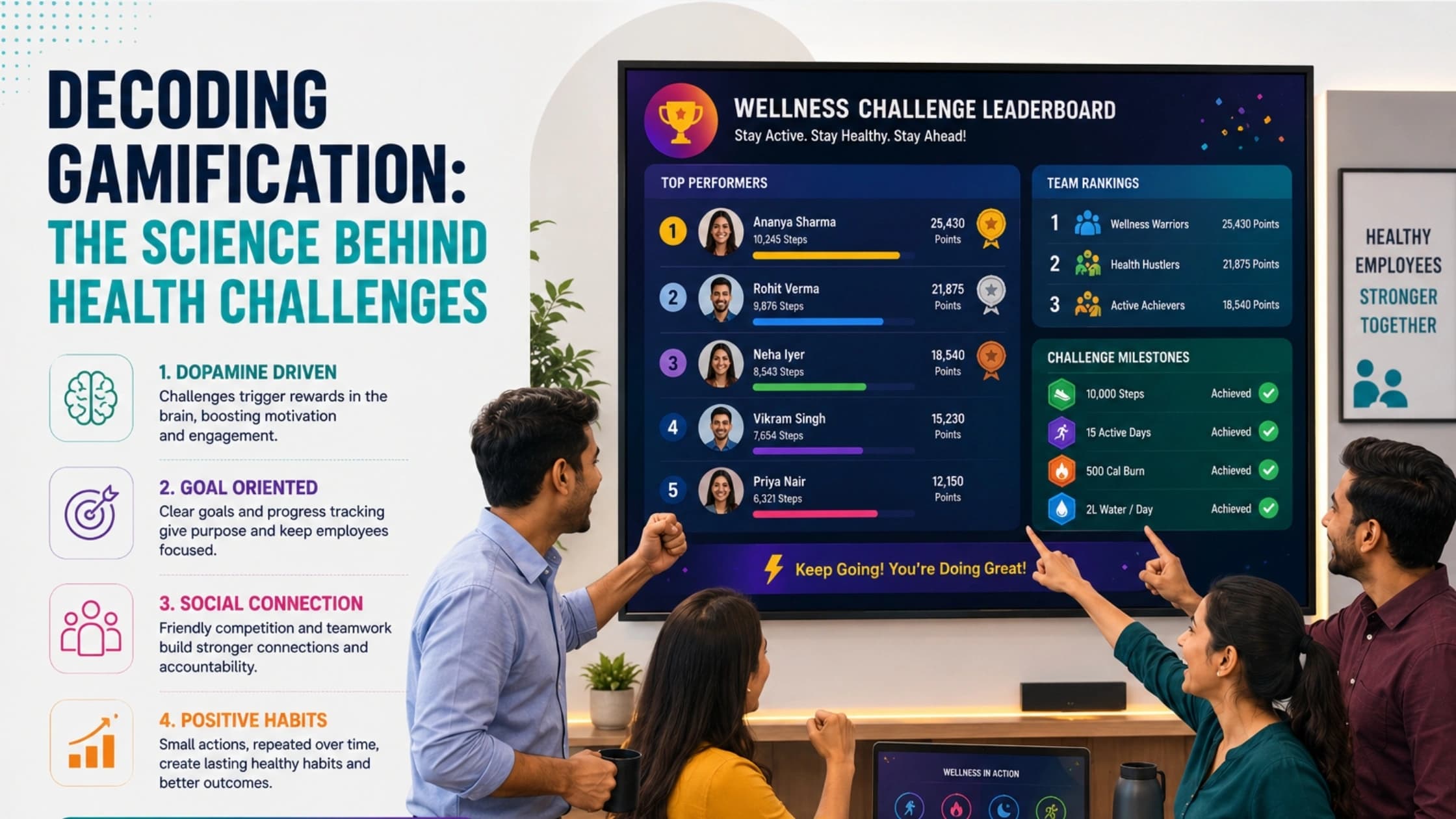
The behavioral science that separates a 65% completion-rate challenge from one nobody finishes.
What Is Gamification in Corporate Wellness?
Gamification in corporate wellness is the application of well-established behavioral science principles, loss aversion, social accountability, progress mechanics, to sustained employee behavior change, rather than a marketing gimmick layered on top of a wellness program.
The wellness challenge completion rate gap between well-designed gamified programs and passive wellness access (35 to 65% versus 8 to 15%) is consistently documented across populations and contexts.
Why Gamification Matters for Wellness Outcomes
Understanding why gamification works is essential for designing challenges that maintain engagement beyond the first two weeks, since most wellness programs lose participants exactly at that point. Gamified design exists to solve that drop-off, not just to add a leaderboard.
The Behavioral Economics Principles at Work
Loss aversion
Research by Kahneman and Tversky found that losses feel roughly twice as powerful as equivalent gains. Wellness challenges that show employees what they stand to lose, points, team position, streak, activate stronger motivation than those focused only on what can be gained. Streak mechanics, which show consecutive days of activity and create anxiety about breaking the streak, leverage loss aversion effectively.
Social accountability
The effect of having observers on behavior is one of the most robust findings in behavioral science. Team-based challenges, where an individual's behavior affects team performance, create social accountability that is more powerful than individual accountability.
A 2023 study in the Journal of Health Psychology found that team-based wellness challenges had 40% higher completion rates and 28% better health outcome improvements than individually-framed equivalent challenges.
The progress principle
Teresa Amabile's research at Harvard found that making progress on meaningful work is the single greatest driver of positive inner work life. Progress mechanics in wellness challenges, progress bars, milestone badges, level advancement, tap into the same motivation architecture.
Team vs Individual Challenges: A Data Comparison
Individual challenges: lower accountability, more prone to silent dropout, and weaker outcome improvement on average.
Team-based challenges: across 18 months of wellness challenges on the Humanova platform, team-based challenges show 62% completion rates versus 23% for individual challenges. This aligns with the broader research finding 40% higher completion rates for team formats.
How to Design a High-Completion Wellness Challenge
Step 1: Set the right team size
Four to seven members is optimal for accountability without diffusion of responsibility. Teams larger than eight tend to have free-rider effects where individual accountability drops.
Step 2: Choose the right duration
21 to 30 days outperforms both shorter (insufficient for habit formation) and longer (motivation decay past 30 days) windows.
Step 3: Keep daily commitment light
Transform your workforce wellbeing today
Interested in learning how Humanova can elevate your team's wellness and HR metrics? Connect with our team for a personalized walkthrough.
Five to ten minutes maximum for daily challenge activity. The greatest single predictor of challenge dropout is daily time commitment exceeding 15 minutes.
Step 4: Add a visible leaderboard
Challenges with visible leaderboards show 47% higher week-three engagement than those without.
Step 5: Combine domains
Challenges combining a physical activity element (steps, movement) with a mental or nutritional element (mindfulness, hydration) show 31% better sustained participation than single-domain challenges.
Avoid these common design mistakes
- Making activities too onerous, requiring 10,000 steps when your sedentary population averages 3,000 sets up immediate failure and dropout.
- Making rewards too delayed, a prize at the end of a 30-day challenge motivates only the final week; interim milestone rewards maintain mid-challenge engagement.
- Designing for average fitness, beginners and advanced participants both disengage when the challenge level matches neither.
Benefits of Gamified Wellness Challenges
- Significantly higher completion rates than passive wellness access (35–65% versus 8–15%).
- Team formats nearly triple individual completion rates on the Humanova platform (62% versus 23%).
- Acts as a high-engagement entry point for employees who would never self-initiate wellness activities.
- Built on learnable, repeatable design principles rather than one-off creative ideas.
What's Next: The Future of Wellness Challenge Design
As more platforms accumulate completion-rate data by team size, duration, and domain combination, challenge design is likely to keep shifting from intuition-based formats toward data-validated defaults — shorter daily commitments, team-based structures, and multi-domain challenges as the standard rather than the exception.
Conclusion
Well-designed wellness challenges are among the highest-engagement tools in the corporate wellness toolkit. The science behind them is robust, the design principles are learnable, and the impact on program activation — getting employees who would never self-initiate wellness activities into a first positive experience, is significant enough to justify making challenge design a core competency for wellness program managers.
FAQs
1. Why do team-based wellness challenges work better than individual ones?
Team-based challenges create social accountability, one of the most robust effects in behavioral science, and have been shown to produce 40% higher completion rates and 28% better health outcomes than individual challenges.
2. What is the ideal team size for a wellness challenge?
Four to seven members. Larger teams tend to produce free-rider effects where individual accountability drops.
3. How long should a wellness challenge run?
21 to 30 days. Shorter challenges don't allow enough time for habit formation, while longer ones see motivation decay past the 30-day mark.
4. Why do some wellness challenges fail despite good intentions?
Common causes include activity targets that are too difficult for the population's baseline fitness, rewards that are too delayed to sustain mid-challenge motivation, and a single difficulty level that doesn't suit both beginners and advanced participants.