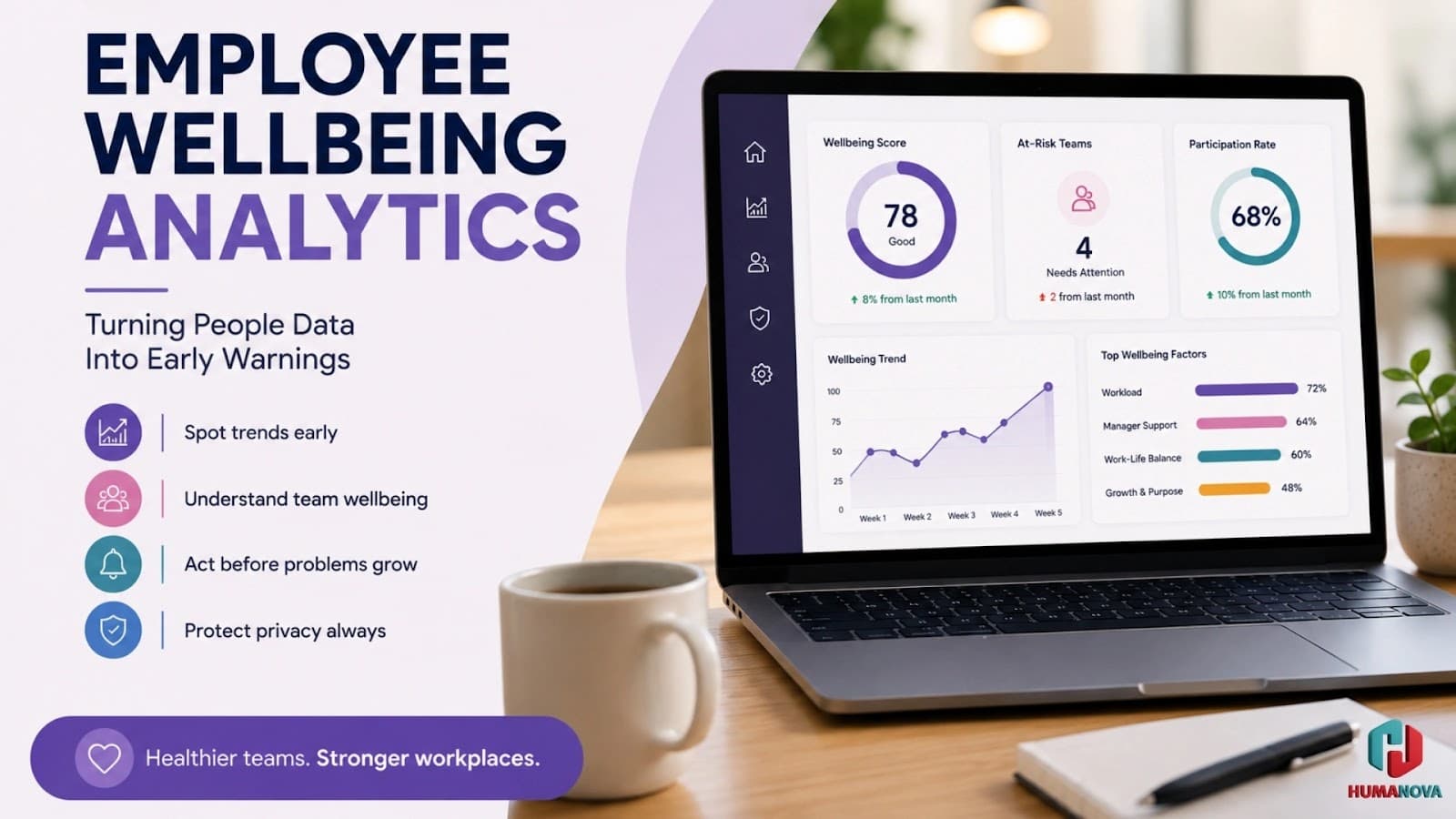
Employee wellbeing analytics is the practice of collecting and interpreting data, mood trends, anonymous survey responses, engagement signals, and behavioral patterns, to understand how employees are really doing, before problems surface as resignations or burnout. Done well, it gives HR teams and managers a continuous, honest picture instead of a once-a-year snapshot.
What Is Employee Wellbeing Analytics?
Employee wellbeing analytics combines multiple data sources, mood check-ins, pulse surveys, engagement scores, absenteeism patterns, and sometimes counseling utilization rates, into a single view of how a workforce is coping. Unlike traditional HR reporting, which tracks outcomes like attrition after they've already happened, wellbeing analytics is designed to catch the conditions that lead to those outcomes while there's still time to act.
The discipline sits at the intersection of people analytics and mental health support. It borrows the rigor of data analysis but applies it to a domain, human emotion and stress, that has historically resisted measurement.
How It Differs from Traditional Employee Engagement Surveys
Annual or biannual engagement surveys give a static picture: how people felt at one point in time. Wellbeing analytics is continuous. It tracks trends week over week or month over month, which means a dip in morale after a reorg or a difficult product launch shows up while managers can still respond, not six months later during an annual review cycle.
India's overall employee engagement recently sat around 14% actively engaged, with the majority either not engaged or actively disengaged, a gap that only becomes visible with regular, structured measurement, not a once-a-year check-in.
Why Wellbeing Data Matters More Than Ever for Indian Employers
Workforce strain is no longer a background concern for HR, it's showing up directly in national productivity numbers. When engagement drops even slightly across a large workforce, the compounding effect on output, quality, and retention is significant enough to show up at the macroeconomic level, not just inside individual companies.
The Business Case for Measuring Wellbeing Continuously
Disengaged and struggling employees don't announce themselves. They show up in subtler patterns first: shorter responses in surveys, more sick days clustered around certain weeks, or a gradual drop in participation in team activities. Wellbeing analytics exists to catch these patterns before they compound into attrition, which remains a persistent cost for Indian employers, with replacement costs for a single mid-level hire often running into several lakhs once hiring, onboarding, and lost productivity are counted.
Why Point-in-Time Surveys Miss the Real Story
A single annual survey captures a mood, not a trend. Two employees can report identical satisfaction scores in an annual survey while one has been steadily declining for months and the other has been steadily improving, the annual snapshot can't tell them apart. Continuous data collection reveals the trajectory, which is usually more useful than the current state.
Core Data Sources for Effective Wellbeing Analytics
A useful wellbeing analytics system pulls from more than one data stream, because any single source has blind spots.
1. Real-Time Mood Tracking
Short, frequent check-ins, often a single question answered in seconds, build a running picture of team sentiment. The value isn't in any one data point; it's in the pattern that emerges when the same question is asked consistently over weeks and months.
2. Anonymous Pulse Surveys
Anonymity fundamentally changes what people are willing to say. Employees who won't voice concerns about workload or management in a named survey often will in an anonymous one, which makes anonymous data meaningfully more accurate than named feedback, not just more comfortable to give.
3. Manager-Level Trend Dashboards
Aggregated, team-level dashboards let HR and leadership see which departments or teams are showing signs of strain, without exposing any individual employee's specific responses. This is the layer that turns raw data into something a manager can actually act on in a one-on-one conversation.
Humanova is built around exactly this model, combining real-time mood tracking, anonymous surveys, and manager dashboards so HR leaders see team-level wellbeing trends clearly while every individual employee's response stays completely confidential.
4. Confidential Support Utilization (Without Individual Identification)
Tracking how often employees access confidential counseling, in aggregate, never by name, tells HR whether support is actually being used, and whether usage spikes correlate with specific events like restructuring or deadline crunches.
How to Act on Wellbeing Analytics, Not Just Collect It
Data without a response mechanism is just a report nobody reads. The organizations that get value from wellbeing analytics build a clear path from signal to action.
Set Thresholds That Trigger a Response
Rather than waiting for someone to notice a downward trend, define specific thresholds, a mood score dropping below a certain level for two consecutive weeks, for
example, that automatically flag a team for HR or manager follow-up.
Give Managers Context, Not Just Numbers
A dashboard that shows "team morale down 15%" is only useful if the manager also gets guidance on what to do next, a suggested check-in conversation, a resource to share, or a prompt to review current workload distribution.
Transform your workforce wellbeing today
Interested in learning how Humanova can elevate your team's wellness and HR metrics? Connect with our team for a personalized walkthrough.
Close the Loop With Employees
When wellbeing data leads to a visible change, adjusted deadlines, a new support resource, a policy tweak, communicating that back to employees (without breaking anonymity) reinforces that the surveys and check-ins are worth their time to complete.
Common Mistakes in Employee Wellbeing Analytics
Collecting Data Without a Follow-Up Plan
Launching a mood-tracking or survey tool without deciding in advance who reviews the data, how often, and what triggers action is one of the most common reasons wellbeing programs stall after an initial burst of enthusiasm.
Treating Aggregate Dips as Individual Problems
A declining team-level score is a signal to examine team conditions, workload, management style, recent changes, not to single out individual employees, which undermines the anonymity that made the data honest in the first place.
Measuring Too Infrequently to See Trends
Quarterly or annual measurement can confirm that a problem exists, but it rarely catches one early enough to prevent an exit. More frequent, lighter-touch check-ins usually reveal more than infrequent, heavier surveys.
FAQ: Employee Wellbeing Analytics
1. What is the difference between employee wellbeing analytics and employee engagement analytics?
Engagement analytics typically measures how invested employees feel in their work and the company, while wellbeing analytics focuses more specifically on stress, mental health, and emotional state. The two overlap significantly and are often tracked together, since declining wellbeing usually precedes declining engagement.
2. How often should companies collect wellbeing data?
Short check-ins work well on a weekly or biweekly cadence, while more detailed anonymous surveys are often run monthly or quarterly. The key is consistency, sporadic measurement makes it hard to distinguish a real trend from normal week-to-week variation.
3. Can wellbeing analytics work without compromising employee privacy?
Yes, when the system is designed correctly. Aggregating data at the team level and never exposing individual responses to managers is what allows employees to answer honestly while still giving HR usable, actionable insight.
4. Is employee wellbeing analytics only useful for large organizations?
No, smaller organizations often benefit even more, since a single struggling team can have an outsized impact on a small company's overall output and culture. Platform-based tools have made this kind of tracking accessible without requiring a dedicated data science team.
5. How do you get employees to actually respond honestly to wellbeing surveys?
Genuine anonymity is the biggest factor, followed by visible proof that responses lead to real changes. Employees who see past feedback result in action are far more likely to engage honestly with future surveys than those who suspect their answers disappear into a report no one reads.
6. What's the biggest mistake companies make with wellbeing data?
Collecting it without a clear process for reviewing and acting on it. A dashboard full of declining trend lines is only valuable if someone is responsible for noticing the decline and doing something about it before it turns into resignations.
Ready to see what your teams' wellbeing data is actually telling you. before it shows up in your attrition numbers?