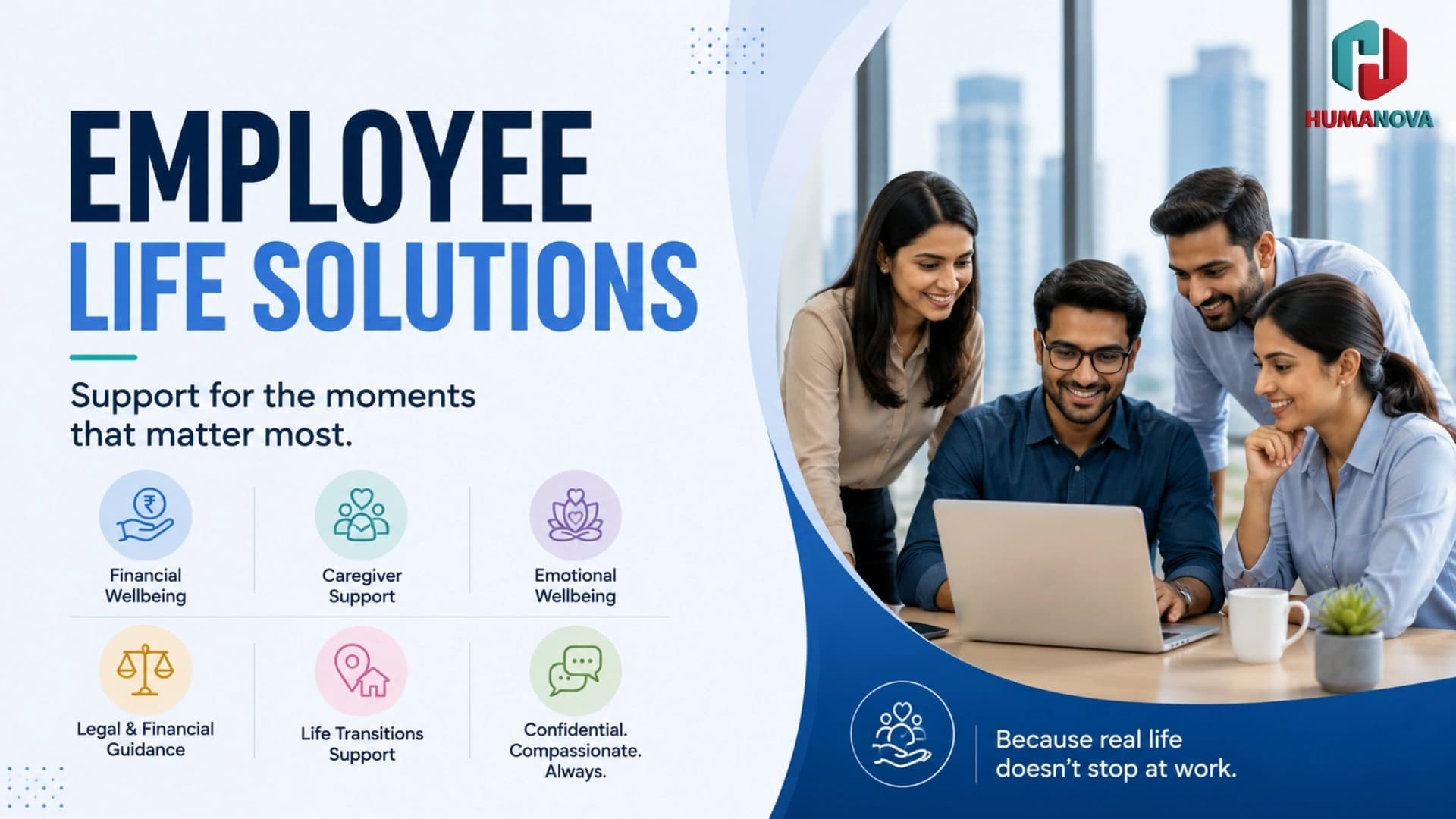
Employee Life Solutions: support for the moments employees cannot leave at home
An employee can be doing well professionally and still be carrying a great deal outside work. A parent may be arranging care for an ageing relative between meetings. A new manager may be trying to understand a mortgage while supporting a young family. Someone else may be dealing with grief, separation, relocation or a sudden change in household income.
These are personal matters, but their effects do not stop when the workday begins. They can make it harder to concentrate, plan, recover or ask for help. They can also collide with deadlines, shift patterns and management practices that leave little room for real life.
Employee Life Solutions gives people a clearer way to find practical support for these moments. It is not a promise that an employer can solve every private difficulty. It is a structured approach that helps employees understand their options, reach the right kind of expert and talk about work adjustments when those are needed.
For HR teams, the aim is equally practical: build support that employees can trust, protect private information and learn where workplace policies may be making a difficult situation harder.
What are employee life solutions?
Employee life solutions are services and workplace practices that help people manage significant personal pressures and life transitions. Depending on the organisation and provider, support may cover:
- Financial wellbeing and money-related stress
- Caregiving for children, older relatives or family members with disabilities
- Grief, bereavement and major family change
- Relocation and adjustment to a new city or country
- Relationships, separation and family responsibilities
- Parenthood, return to work and changing care needs
- Access to vetted legal or financial-information services
- Practical navigation when an employee does not know where to begin
The word navigation matters. Life Solutions should not blur professional boundaries. A wellbeing coach is not automatically a financial adviser, lawyer or clinician. A responsible programme identifies the need, explains the limits of each service and connects the employee with a suitably qualified source of help.
This broader view of wellbeing is grounded in how people actually live. The World Health Organization explains that health is shaped by social and economic conditions, including income, housing, relationships and access to resources. Its guidance on mental health at work also recognises conflicting home and work demands, inadequate pay and job insecurity as psychosocial risks.
Why life outside work belongs in a workplace wellbeing strategy
The employer does not own an employee's private life. It does, however, influence whether a difficult period becomes manageable or overwhelming.
Consider an employee caring for a parent after a hospital discharge. The care itself sits outside the organisation. But the experience is shaped by whether the employee can adjust a shift, take leave without punishment, speak to a manager without revealing private medical details and find reliable guidance without searching across dozens of unverified sources.
The same pattern appears with financial pressure. A company cannot manage an employee's household budget, but it can offer access to credible education, make pay and benefit information easy to understand, avoid predatory providers and create a route for confidential support. The US Consumer Financial Protection Bureau's resource on financial wellness at work notes that financial distress can affect productivity, absence and health, and identifies employee trust as an important part of workplace financial-wellbeing efforts.
Care responsibilities also affect work in uneven ways. The International Labour Organization's work on care-supportive workplaces points to flexible work, care-related leave and inclusive working-time arrangements as important parts of work-life balance and equality.
Life Solutions therefore belongs alongside mental-health support, coaching and good work design. It should never be used to compensate for poor staffing, inflexible policies or an unsupportive manager. The service and the workplace need to work together.
The life challenges employees commonly bring to work
Financial pressure
Money worries are rarely confined to a single category. Rent, debt, medical costs, education expenses and a sudden loss of household income can create uncertainty that follows a person through the day.
A useful financial-wellbeing service might include budgeting education, benefit navigation, debt-information resources or access to an appropriately qualified adviser. It should disclose whether a provider sells financial products, how the service is paid for and what information is shared with the employer.
Generic content has limits. An employee choosing between urgent bills may need a confidential conversation and a safe referral, not another article about saving more each month.
Caregiving responsibilities
Caregivers often coordinate appointments, transport, medication, school schedules or emergency cover while meeting normal work expectations. Some employees care for children and older relatives at the same time. Others become caregivers suddenly and have no idea which services or leave provisions apply.
Support can include care-resource navigation, manager guidance, flexible scheduling and clear information about leave. The organisation should also examine whether employees feel penalised for using the policies that already exist.
Grief and bereavement
Grief does not follow a predictable timetable. The first days may involve practical decisions and family responsibilities; the emotional impact may become more visible weeks later.
Bereavement support should combine humane policy with choice. Employees may need leave, a gradual return, temporary workload changes, counselling or simply a manager who does not expect them to explain more than they wish to share. Where distress is severe or there is a safety concern, the programme needs a clear referral and emergency pathway.
Parenthood and family change
Pregnancy, adoption, returning from parental leave, fertility treatment, separation and changes in family structure can all alter a person's time, energy and sense of stability.
Good support is practical and inclusive. It explains policies in plain language, gives managers a consistent process and makes room for different family structures. It also avoids assuming that every employee wants the same kind of help.
Relocation and major transitions
A move can affect housing, schooling, finances, relationships and a partner's career. International moves add language, cultural and administrative questions. Even a positive promotion can create strain when several changes happen at once.
Life Solutions can help employees organise the transition, find reliable resources and identify which decisions require a specialist. Employers can reduce unnecessary pressure by clarifying relocation benefits, timelines and responsibilities early.
What a strong Life Solutions programme should include
A simple route into support
Employees should not need to diagnose their own problem or know the provider landscape before asking for help. Begin with a clear entry point: a confidential request, guided navigation or conversation with a trained professional.
The first contact should answer four questions:
1. What kind of help is available?
2. Who provides it?
3. What will remain confidential?
4. What happens if the need is outside the service scope?
Qualified specialists and clear boundaries
The programme should verify credentials for any regulated advice or clinical service. It should also distinguish education, coaching, counselling and professional advice in language an employee can understand.
That distinction protects everyone. Employees know what they are receiving, specialists work within their competence and HR does not make claims the service cannot support.
Support that fits the workforce
A desktop-only service offered during office hours will not work equally well for factory, field, shift or distributed teams. Review language, location, disability access, appointment times and whether employees can use the service privately.
Do not assume low use means low need. It may point to weak awareness, inconvenient access, fear about confidentiality or a service that does not reflect the workforce.
Manager guidance without intrusion
Managers need to know how to respond when an employee says life outside work is affecting them. They do not need the details of a family dispute, financial problem or health condition.
Transform your workforce wellbeing today
Interested in learning how Humanova can elevate your team's wellness and HR metrics? Connect with our team for a personalized walkthrough.
A useful response is short: listen, clarify what work is affected, explain available options, agree on the next step and set a time to check in. Managers should know when HR, occupational health or an emergency process needs to become involved.
Work adjustments that address the immediate pressure
Support is more credible when the workplace can change something within its control. Depending on the role and applicable policy, that may mean flexible hours, predictable scheduling, temporary workload changes, leave, remote work or time to attend an appointment.
Adjustments should be consistent enough to be fair and flexible enough to respond to the person. Legal and HR teams should review local requirements before a programme is launched across regions.
Privacy that employees can understand
Privacy should be explained before an employee shares information. State what is collected, why it is needed, who can access it, how long it is kept and when safety or legal obligations may require escalation.
Employers usually need aggregated information about reach, access and service quality, not the private story behind an employee's request. Humanova describes its approach as privacy-first, with programme information used for service delivery and organisational insight while setting boundaries around individual data.
How Humanova can support employee life challenges
Humanova positions Life Solutions as help for employees navigating life's challenges with support from domain experts. It sits within a broader workplace-wellbeing system that brings together employee check-ins, human support, coaching, engagement and workforce insight.
The value of that connected approach is continuity. An employee does not have to decide whether a concern belongs under mental wellbeing, coaching or a life-support category before reaching out. The initial pathway can help clarify the need and guide the person to the right kind of support.
For HR, Humanova's stated model focuses on team- and organisation-level patterns rather than exposing private employee information. This can help an organisation ask better questions: Are employees struggling to reach support outside office hours? Are caregiving pressures concentrated in teams with rigid schedules? Do managers understand the available referral routes? Are repeated requests pointing to a policy gap?
Humanova should be implemented with clearly approved service boundaries, qualified providers, minimum reporting thresholds and human review. Technology can organise access and surface patterns; it should not diagnose an employee or make a sensitive employment decision.
Explore the Humanova services, review the platform approach and read the privacy policy before designing the programme.
How HR can launch Life Solutions responsibly
1. Start with employee needs
Use anonymous feedback, benefits questions, leave patterns, manager themes and representative conversations to understand where employees struggle. Do not collect intimate information simply because it may be interesting.
2. Define the scope
List the needs the programme will cover, the professional boundaries and the hand-off process for anything outside scope. Decide how urgent and non-urgent concerns will be handled.
3. Review policies and working conditions
A referral service cannot repair a policy that makes help impossible to use. Review leave, flexibility, scheduling, workload and manager discretion alongside the service design.
4. Select and verify providers
Check credentials, supervision, regional coverage, conflicts of interest, accessibility, complaints procedures, data processing and referral quality. Test the journey with realistic employee scenarios.
5. Explain privacy in plain language
Tell employees what the employer can and cannot see. Use examples rather than relying only on legal text. Give people a channel for privacy questions before they participate.
6. Train managers on the next step
Managers should know how to respond without investigating. Give them sample language, adjustment options and a simple escalation guide.
7. Measure access and action
Track whether employees know about the service, can reach it and receive an appropriate referral. Review service quality, waiting time and employee experience. At the organisational level, track whether identified workplace barriers lead to action.
Avoid promising a fixed return on investment or claiming that Life Solutions alone caused changes in absence, retention or productivity. Those outcomes have many influences. Use several measures and explain their limits.
A practical example
Imagine a 700-person organisation with office, field and shift-based employees. HR sees more last-minute leave requests and managers report that several employees are struggling with family-care responsibilities. A survey confirms that employees know counselling is available, but many do not see it as relevant to the practical problem they face.
The organisation introduces a Life Solutions pathway with caregiving-resource navigation, manager guidance and access outside standard office hours. It also changes its shift-swap process and publishes a clearer guide to care-related leave. Employees can request help without sharing family details with their manager. HR receives only aggregated information about access, waiting time and common service categories where group sizes are safe.
The success measure is not simply the number of sessions booked. HR also checks whether people can find help, whether shift workers receive equal access, whether managers use the adjustment process correctly and whether the revised policy removes a recurring barrier.
That is what a connected programme looks like: individual support where it helps, organisational action where the workplace has responsibility.
Build support around real life
Employees will continue to experience caregiving, financial pressure, grief and change. The question is whether they have to navigate those moments alone while pretending nothing has changed at work.
A good Life Solutions programme gives people a private, credible place to begin. It equips managers to respond without intruding and gives HR enough aggregated insight to improve access and working practices. The employer does not take over an employee's life. It creates a workplace in which asking for practical help is possible.
Ready to build a more complete employee-support system? Explore Humanova's services.
Frequently asked questions
1. What are employee life solutions?
Employee life solutions are workplace services and practices that help employees manage personal pressures such as financial stress, caregiving, grief, family change and relocation. They combine practical navigation, access to appropriate experts and workplace support where needed.
2. How are Life Solutions different from an employee assistance programme?
An employee assistance programme often provides short-term counselling and referrals. Life Solutions may include those pathways but can extend into practical support for caregiving, financial wellbeing, family transitions and other non-clinical needs. The exact scope depends on the provider.
3. Are employee life solutions confidential?
They should have clearly documented privacy rules. Employees need to know what the provider collects, what the employer receives and when safety or legal duties may require escalation. Employers should normally receive aggregated service information rather than private case details.
4. What life challenges can an employer support?
Common areas include financial pressure, caregiving, bereavement, parenthood, relocation and major family changes. Employers should define the programme's limits and use qualified specialists for regulated financial, legal or clinical advice.
5. Can managers ask employees for personal details?
Managers should ask only what they need to understand the work impact and possible adjustment. They should not investigate an employee's finances, family situation or health, or ask for a diagnosis unless an authorised process specifically requires information.
6. How can Life Solutions support caregivers?
Support may include resource navigation, information about leave, flexible scheduling, manager guidance and referrals to appropriate community or professional services. Employers should also review whether workload and shift practices make existing support difficult to use.
7. What should financial wellbeing support include?
Useful support may include plain-language education, benefit navigation, budgeting resources and access to appropriately qualified advisers. Providers should disclose fees, commercial relationships and whether they sell financial products.
8. How should HR measure a Life Solutions programme?
Measure awareness, access, waiting time, successful referrals, employee experience, service quality and completion of agreed workplace actions. Treat absence, retention and productivity as contextual indicators rather than proof that one programme caused the result.
9. Is Life Solutions a clinical mental-health service?
Not necessarily. It may include referral to counselling or clinical care, but much of the support is practical and non-clinical. The programme should explain which services are clinical, who provides them and how urgent concerns are handled.
10. How does Humanova approach Life Solutions?
Humanova presents Life Solutions as expert-supported help for employees navigating life challenges. It connects this support with a broader wellbeing platform that includes check-ins, coaching and privacy-aware organisational insight. Final capabilities and service boundaries should be confirmed during implementation.