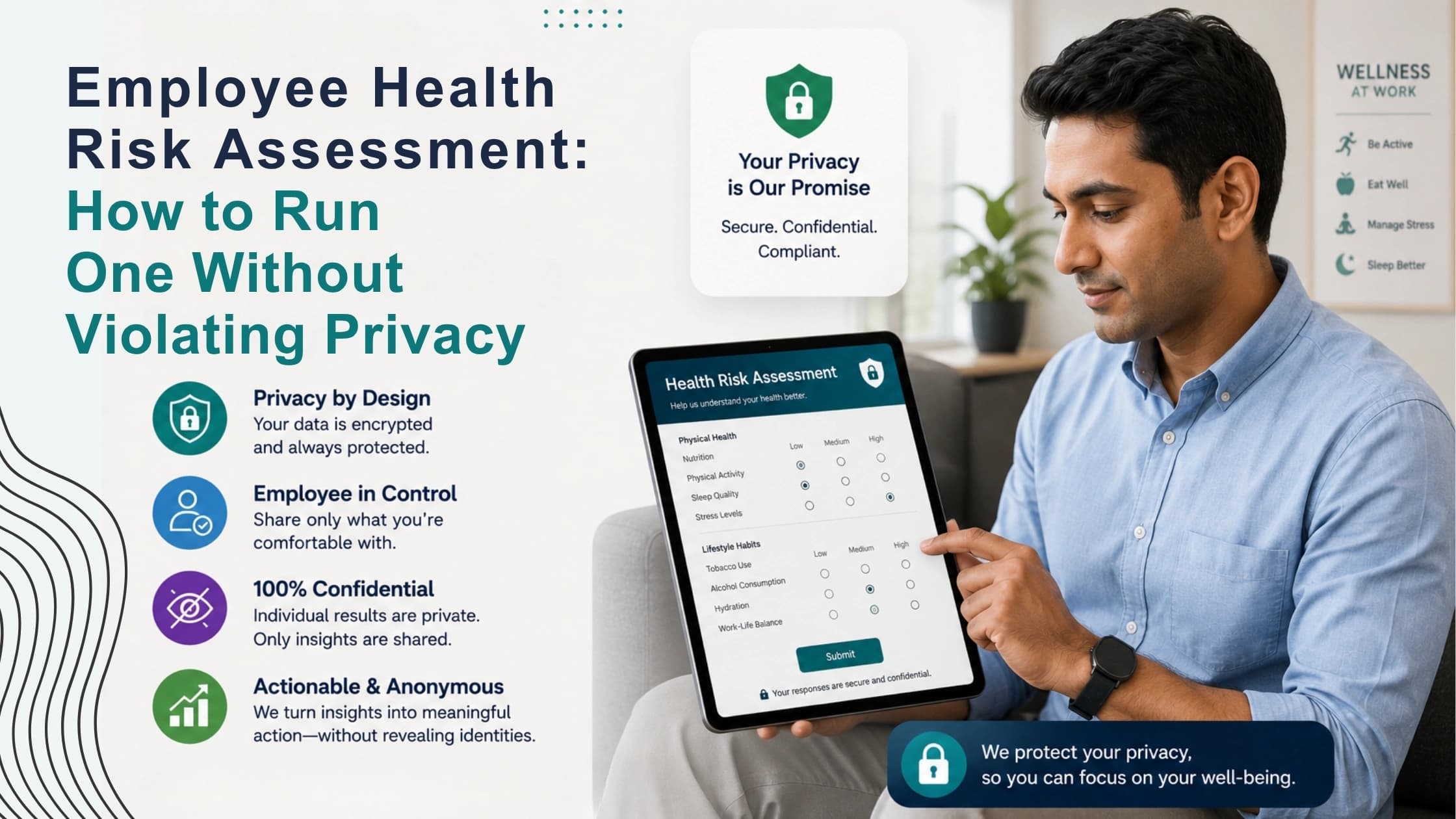
A privacy-compliant approach to collecting the baseline health data your wellness program needs, under India's PDPB 2023.
What Is an Employee Health Risk Assessment?
A health risk assessment (HRA) is the diagnostic foundation of effective wellness programs. Without baseline health data, you cannot design interventions for your population's actual needs or measure whether your program is working.
For Indian organizations, the challenge is running HRAs that are both useful and legally compliant with the Personal Data Protection Bill 2023, since health data falls under a specially protected category.
Why Privacy Compliance Is Non-Negotiable for HRAs
India's Personal Data Protection Bill 2023 classifies health data as 'sensitive personal data' subject to specific requirements. Getting these wrong carries both legal risk and a trust cost that can undermine the entire wellness program.
- Explicit, freely given consent is legally required before collecting health data, an HRA made a condition of employment is not freely given consent.
- The company needs to tell employees what kind of data they collect from employees how they use this employee data how long they keep this employee data and who gets to see this employee data
- Employees should be able to look at their employee data and ask the company to delete this employee data if they want to.
- Health data must not be processed in ways that could affect employment decisions.
Examples: Appropriate vs Inappropriate Uses of HRA Data
Appropriate uses
- Aggregate population health risk reports, showing percentage of population in high/medium/low risk categories by health domain.
- Program design decisions, which wellness pillars to prioritize based on need.
- Intervention targeting, offering high-risk individuals optional deeper support, not mandatory intervention.
Inappropriate uses
- Using individual health data in performance reviews, promotion decisions, or role changes.
- Sharing individual responses with direct managers.
- Using health data to categorize employees for insurance purposes outside of what the group policy legally requires.
Voluntary vs Mandatory Participation: A Comparison
Mandatory Framing: When we talk about participation it is not okay under the law because of the PDPB 2023 rules. The reason is that when people say yes to something just because they must as part of their job it does not mean they are saying yes freely. This can get companies into trouble with the law. Also, make employees not trust them.
Voluntary framing: The only legally sound approach, with the practical challenge being how to reach the 60%+ participation benchmark needed for statistically meaningful population health data.
How to Run a Privacy-Compliant HRA
Step 1: Build trust before you ask for data
You need to tell people that their information is private, and it will not be shared with Human Resources or management. People want to feel safe when they give you their data. So, you must build trust with people before you ask them for data. You must make sure people trust you with their data. When you ask people for data you have to make sure they trust you first with their data.
You should say that only group data, without names, is used.
Step 2: Offer the incentive
Give a good reason for people to complete the HRA. You could offer wellness points, gift cards or an extra day off. Be careful that the incentive doesn't pressure employees who can't afford to give up something.
Step 3: Keep the survey short
The survey should be brief. It should have 12 to 18 questions. Take about seven minutes to complete.
Step 4: Time for the launch carefully
Transform your workforce wellbeing today
Interested in learning how Humanova can elevate your team's wellness and HR metrics? Connect with our team for a personalized walkthrough.
Choose a time to launch the HRA. Avoid periods, like appraisal season or product launches when people may not participate or be honest.
Step 5: Collect the right minimum data set
The minimum useful HRA data set for Indian corporates includes:
- People say how they feel about their health, how much energy they have, how well they sleep and how often they have pain.
- People also say how they feel about their health, how stressed they are, how anxious they feel and what kind of mood they are in and we use special questions like the PHQ-4 to help us understand.
- We look at the kind of life people lead, like how they exercise what they eat and if they smoke or drink alcohol.
- We check if people have health problems that they were born with like diabetes, high blood pressure or heart disease and if it runs in their family.
- We also look at what it's like for people at work, like if they like the amount of work they must do and if they feel like they have a good balance between work and the rest of their life.
For companies that do health checks every year we can also use the results of body mass index, blood pressure, HbA1c and lipid panel tests if the employees agree to let us use that information.
Benefits of Getting HRA Privacy Right
- Access to invaluable diagnostic data that informs program design and intervention targeting.
- Higher long-term participation, since trust in confidentiality is what drives voluntary completion above the 60% benchmark.
- Reduced legal risk under PDPB 2023 by meeting consent, transparency, and data-access requirements.
- Protection of the wellness program's credibility, which all future engagement depends on.
What is Next as PDPB 2023 Enforcement Matures
As the PDPB 2023 enforcement and case law develop we will see expectations around the PDPB 2023 consent documentation. The PDPB 2023 will have rules for data retention timelines. We will also see audit trails for the PDPB 2023. These trails will show who accessed health data and when they accessed the health data for the PDPB 2023. It is an idea to invest in privacy-compliant Health Assessment processes for the PDPB 2023 now. This investment will be a long-term advantage for the PDPB 2023. It is not a one-time task to comply with the PDPB 2023.
Conclusion
Privacy-compliant HRAs are achievable with clear processes and genuine commitment to confidentiality. Organizations that run them well gain invaluable diagnostic data; organizations that violate privacy, intentionally or through poor process design, face legal risk and the collapse of employee trust in the wellness program that makes all future engagement possible.
FAQs
1. Can an employer make a health risk assessment mandatory in India?
No. Under PDPB 2023, consent must be freely given, and an HRA made a condition of employment does not meet that standard. HRAs must be voluntary.
2. What participation rate is needed for useful HRA data?
60% or higher is the benchmark for statistically meaningful population health data.
3. Can HRA data be used in performance reviews?
No. Using individual health data in performance reviews, promotion decisions, or role changes is an inappropriate use and a privacy violation.
4. How long should an HRA survey take to complete?
Around seven minutes, using 12 to 18 questions, to keep completion rates high without sacrificing data quality.