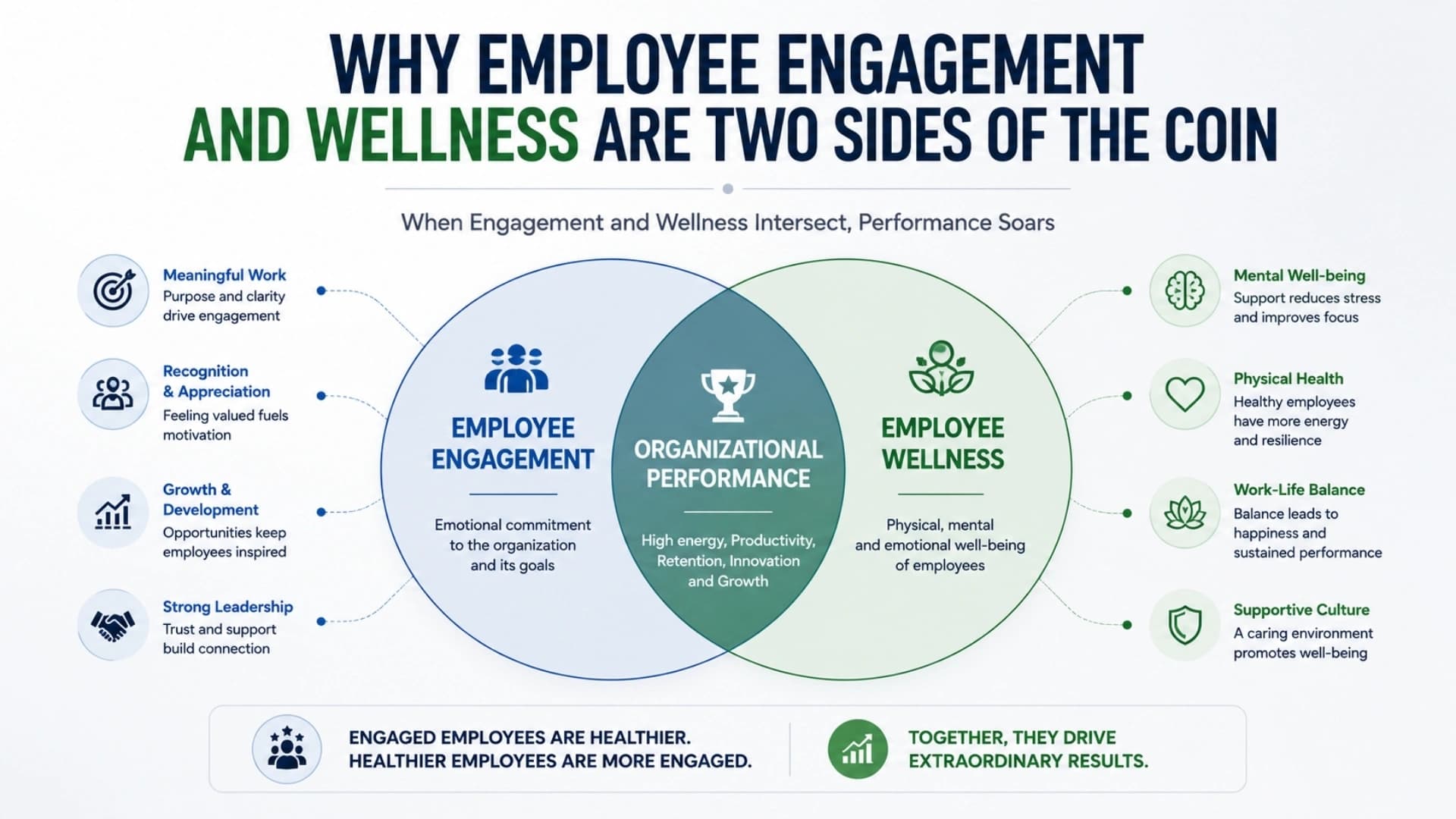
Why do we think employee engagement and wellness are separate things when they are actually connected? This separation is a leftover from the past. Not based on facts. Let's explore how to bring them
What Is the Engagement–Wellness Connection?
Employee engagement and wellness are usually handled as two programs. They have their budgets, teams and ways of measuring success.. Research shows that this separation doesn't make sense and can be expensive. The truth is, employee engagement and wellness are connected in a two-way relationship. When one gets better the other gets better too. Organizations that treat them as one system do better than those that don't.
Improving employee wellness helps improve engagement.. When employees are more engaged their wellness also improves. It's a cycle. Managing them separately gives more results than managing them together.
Why the Engagement-Wellness Divide Is Costing Organizations
The data from both global and India-specific research shows the cost of separation clearly:
- The Gallup 2024 State of the Global Workplace report found that employees with wellbeing scores are more likely to be fully engaged. In fact they are 2.6 times more likely to be engaged than those with low wellbeing scores.
- The Aon 2024 India Engagement Report found that organizations with top-notch employee wellbeing programs have higher engagement scores. They score 19 percentage points higher than those with wellbeing programs.
- These wellbeing organizations also have lower voluntary attrition. They have 14% voluntary attrition rates. They are also more productive with 11% productivity. Additionally they have 23% healthcare claims, per employee.
Examples: Shared Drivers That Move Both Metrics at Once
Engagement and wellness have some things that make them work so when we do something good for one it also helps the other. For example:
- If we make our team feel safe like with a training program for managers it will make our team happy and reduce their stress. We will see the difference in how happy they're at work and how stressed they are in just 90 days.
- If we give people control over their work like letting them decide when and how they do things it reduces their stress and makes them happier at work.
- When we celebrate the progress people make like when they reach a wellness goal it makes them feel good and happy at work.
- If we help people get to know each other like with team challenges it helps them feel connected and happy at work.
- When people know what they are working for like when they have an idea of their career goals it reduces their anxiety and makes them happy and engaged at work. Engagement and wellness are connected. When we do something good for one it also helps the other, like engagement and wellness.
Separate Programs versus Integrated Strategy: A Comparison
Separate programs: engagement and wellness each have their own money, team and way of measuring success. This makes it hard to see how one affects the other. It is also difficult to show finance leaders how both programs work together to give a return on investment.
Integrated strategy: It is a plan that deals with things like structural drivers feeling safe being in control making progress connecting with others and finding meaning. This approach can improve both engagement and wellness at the time. As a result we can make a case for return on investment. Typically this approach also gets a budget approved.
How to Build an Integrated Engagement–Wellness Strategy
Step 1: Identify your shared drivers
Map the structural factors that drive both engagement and wellness in your organization, psychological safety, workload manageability, social connection, and prioritize interventions that address more than one.
Step 2: Design wellness components that directly build engagement
- Team wellness challenges that build social connection alongside health outcomes.
- Wellness milestones celebrated publicly as organizational achievements.
- Manager training that builds wellness-enabling leadership behaviours.
Step 3: Add wellness-relevant elements to engagement programs
- Career development clarity that reduces purposeless anxiety.
- Recognition programs that address social connection needs.
- Workload management practices that protect cognitive recovery time.
Step 4: Put engagement and wellness on one dashboard
Track both quarterly and look for leading and lagging relationships. In most organizations, wellness metrics such as stress scores and absenteeism move two to four months before engagement scores move, making wellness metrics a leading indicator of future engagement, and giving HR teams the intelligence to intervene before engagement declines become visible.
Transform your workforce wellbeing today
Interested in learning how Humanova can elevate your team's wellness and HR metrics? Connect with our team for a personalized walkthrough.
Benefits of Running Engagement and Wellness as One Program
- A stronger combined ROI case that is easier to win budget approval for.
- Interventions that move multiple metrics simultaneously rather than one at a time.
- Wellness as an early-warning system for engagement decline, enabling proactive HR intervention.
- Lower total program cost than running two separate teams, budgets, and vendor relationships.
What's Next: Integrated Measurement as the New Standard
As HR analytics platforms mature, expect integrated engagement-wellness dashboards to become standard rather than exceptional, making the case for treating the two as one program easier to build and easier to defend to CFOs and boards.
Conclusion
The budget and program separation between engagement and wellness is an organizational legacy, not an evidence-based design choice. HR teams that present an integrated business case, showing the combined ROI of engagement and wellness investment from a single integrated program, typically win larger budgets and produce better outcomes than those maintaining artificial program separation.
FAQs
1. Which should be fixed first, engagement or wellness?
Neither in isolation. Both share structural drivers, so integrated interventions that address psychological safety, autonomy, connection, and meaning move both metrics simultaneously.
2. How much higher are engagement scores in top-wellbeing organizations?
According to the Aon 2024 India Engagement Report, organizations in the top quartile for employee wellbeing programs have engagement scores 19 percentage points higher than those in the bottom quartile.
3. How far ahead do wellness metrics predict engagement changes?
In most organizations, wellness metrics such as stress scores and absenteeism move two to four months before engagement scores move, making them a reliable leading indicator.
4. Can a single program budget cover both engagement and wellness?
Yes, and that is typically the stronger approach. An integrated program covering shared structural drivers produces movement in both metrics from one investment, making the combined ROI case easier to build and easier to win budget approval for.