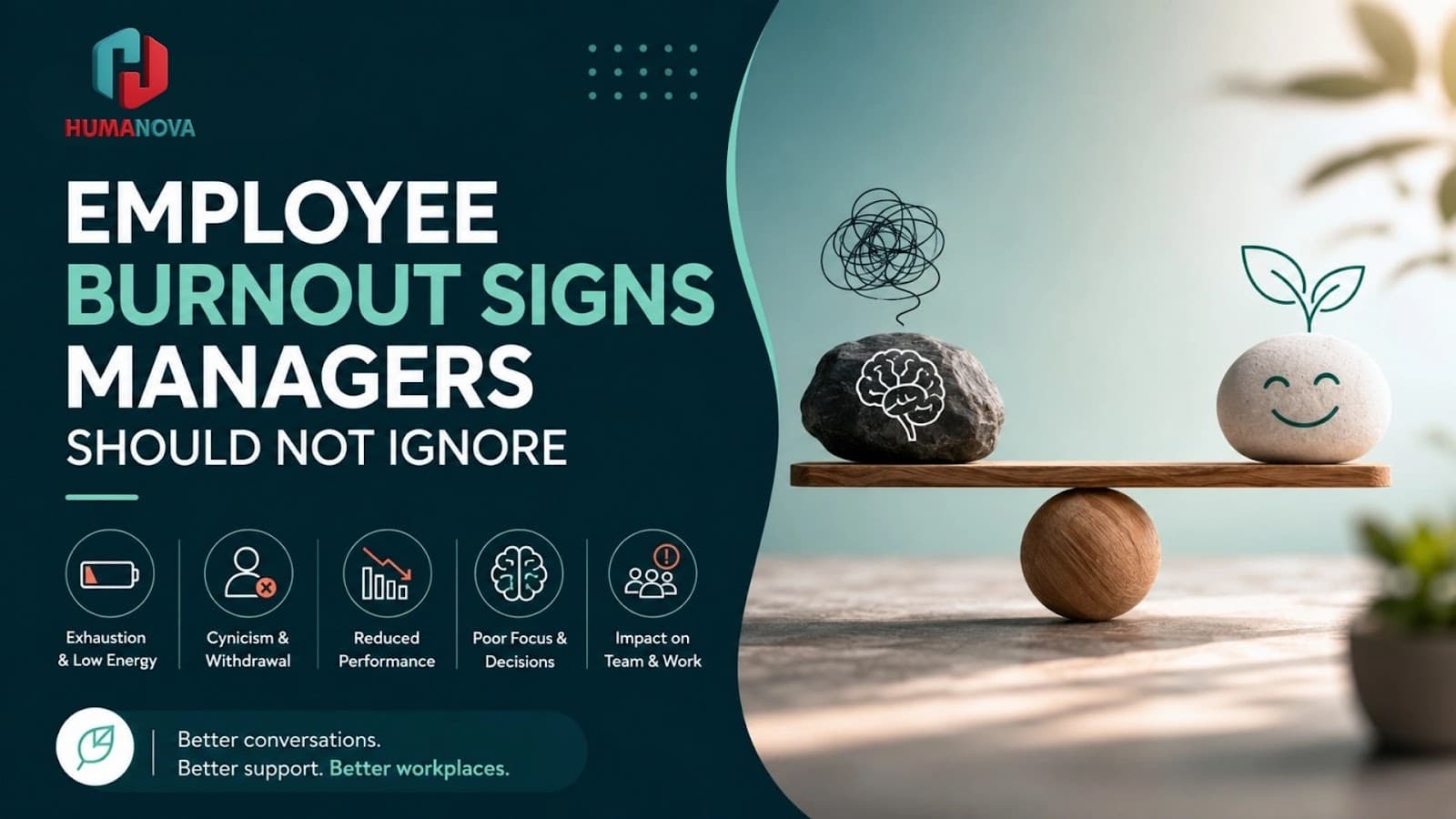
Employee burnout signs rarely arrive as one dramatic event. More often, a manager notices a pattern: work that used to feel manageable now drains the person, small decisions take longer, cynicism grows and recovery never seems to catch up.
Those changes deserve attention, but they are not a diagnosis. Exhaustion, absence or reduced concentration can have many causes. A manager's job is to open a respectful conversation, examine the work and connect the employee with appropriate support.
What burnout is - and is not
WHO describes burnout in ICD-11 as an occupational phenomenon associated with chronic workplace stress that has not been successfully managed. It describes exhaustion, greater mental distance or cynicism towards work, and reduced professional efficacy.
WHO does not classify burnout as a medical condition. Depression, anxiety and physical illness can coexist with work-related burnout, and managers should not try to separate them by observation alone.
Changes in energy and recovery
Persistent depletion is different from ordinary tiredness after a demanding week. The person may start the day without recovering, struggle after routine peaks or use evenings and weekends only to prepare for the next workday.
Ask about demands and recovery conditions. Repeated late work, interrupted leave and permanent on-call expectations are organisational information, not private character flaws.
- Frequent comments about being drained
- Difficulty returning to baseline after busy periods
- Working through breaks or leave
- Visible fatigue combined with sustained workload pressure
Distance, irritability and withdrawal
Someone who was engaged may become detached, unusually blunt or less willing to contribute. That shift can reflect overload, conflict, unfairness, personal circumstances or a health concern. Avoid labels and ask what has changed.
Team-level withdrawal matters too. If a whole group stops speaking up after repeated requests are ignored, the problem may be trust rather than individual resilience.
- Reduced participation in meetings
- Cynical comments that are new or escalating
- Avoidance of colleagues or customers
- Less willingness to propose ideas or take ownership
Reduced confidence and effectiveness
Burnout may show up as slower decisions, difficulty concentrating, more errors or a sense that nothing is good enough. Managers sometimes respond by increasing monitoring, which can further reduce control and trust.
First check clarity, workload and resources. Remove conflicting priorities, agree on the most important output and consider a temporary adjustment while the situation is reviewed.
- Missed details from a previously reliable employee
- Difficulty prioritising
- Repeated rework
- A marked drop in confidence or sense of accomplishment
How to start the conversation
Use observations about work rather than assumptions about health. A useful opening is: 'I've noticed the last few weeks have involved late hours and several changing priorities. How is the workload feeling, and what needs to change?'
Listen before offering advice. Ask what can be stopped, delayed or reassigned, explain confidential support and agree when you will check in again.
- Choose a private setting
- Describe specific changes without judgement
- Do not ask for a diagnosis
- Discuss practical work changes
- Follow approved safety procedures if there is immediate risk
When the pattern is organisational
If several employees show the same signs, examine the system. Vacancies, unrealistic service levels, poor handovers, incivility and constant priority changes can create predictable strain.
Use aggregate feedback, overtime, leave and workflow evidence to identify where the work repeatedly breaks down. The aim is to improve conditions, not to identify a 'burned-out employee' on a dashboard.
What managers should avoid
Do not promise complete confidentiality when safety or legal procedures may require escalation. Do not prescribe therapy, tell the employee to become more resilient or make employment decisions from a wellbeing score.
Transform your workforce wellbeing today
Interested in learning how Humanova can elevate your team's wellness and HR metrics? Connect with our team for a personalized walkthrough.
The most credible response is often practical: reduce demands, clarify decisions, protect recovery and make qualified help easy to reach.
Turn the guidance into an operating plan
Start by writing the decision that this employee burnout signs work must improve. Name the affected group, the evidence already available, the owner and the first review date. A clear scope prevents the project from becoming a collection of unrelated activities.
Build the baseline from more than one source. Employee feedback explains experience; operational data shows context; representative conversations reveal barriers that a dashboard can miss. Keep health detail out of general HR reporting and collect only what the approved purpose requires.
Choose one or two changes that the organisation can implement and explain. Give each action an owner, deadline and acceptance check. If a recommendation has no owner or budget, it is an observation rather than a plan.
Communicate the purpose, privacy boundaries and next review in plain language. Then report back on what was heard, what will change and what cannot change yet. That final step is essential because repeated listening without visible action weakens trust.
A practical example
A customer-support manager notices that a previously steady employee has started working late, avoiding difficult calls and apologising for routine decisions. The manager does not say, 'You are burned out.' She describes what she has seen, asks how the workload feels and learns that two vacancies have doubled the employee's escalation queue. They reassign part of the queue, agree on protected recovery time and schedule a follow-up. The employee also receives the confidential support route. The response addresses the work without pretending the manager knows the employee's diagnosis.
Common mistakes to avoid
- Using a checklist to label an individual instead of opening a conversation.
- Waiting for absence or resignation before reviewing the workload.
- Responding with personal wellbeing advice while deadlines and staffing stay unchanged.
- Increasing surveillance when concentration or confidence falls.
- Sharing a concern more widely than the approved process requires.
Most of these mistakes come from treating a human and organisational issue as a communication campaign. The correction is usually to narrow the promise, clarify responsibility and connect data to a decision the employer is prepared to make.
How to measure progress
Use a small scorecard with definitions, owners and review frequency. Combine service measures with employee experience and organisational follow-through. Show uncertainty where it exists, and do not convert an association into a claim of cause or financial return.
- Recurring overtime and interrupted leave
- Employee reports of manageable priorities
- Manager response and follow-up quality
- Team-level recovery and job control
- Completion of workload or staffing actions
Review results at the safest useful level. A monthly operational review can address access or waiting time, while broader employee-experience patterns often need a quarterly view. Major organisational change may justify an additional review.
A 30-day action checklist
- Confirm the owner, audience and business decision for employee burnout signs.
- Review employee feedback, operational context and current support routes.
- Map data collection, access, aggregation, retention and deletion.
- Select one practical intervention and one accountable leader.
- Prepare manager language, employee communication and escalation steps.
- Set a review date and publish how employees will hear about action taken.
How Humanova can support the next step
Humanova connects employee check-ins, confidential support, learning, programmes and role-based team insight. Use the platform only within an approved implementation, with clear privacy boundaries, minimum reporting thresholds and human review of sensitive decisions.
Next step: Use the manager burnout-conversation checklist
Frequently asked questions
1. What are the first signs of employee burnout?
Possible early signs include persistent exhaustion, cynicism, reduced confidence, concentration problems, repeated late work and difficulty recovering. No single sign confirms burnout.
2. Is burnout the same as stress?
No. Stress can be short-lived. Burnout describes a sustained pattern associated with chronic workplace stress that has not been successfully managed.
3. Can a manager ask if an employee has burnout?
A manager can ask how the person is doing and discuss work, but should not diagnose. Use specific observations and offer practical support.
4. Can time off solve burnout?
Time off can help recovery, but strain may return if workload, low control, conflict or harmful behaviour remain unchanged.
5. When should HR become involved?
Involve HR when adjustments, absence, conduct, safety, accommodation or formal support processes require guidance, while limiting health information to those who need it.