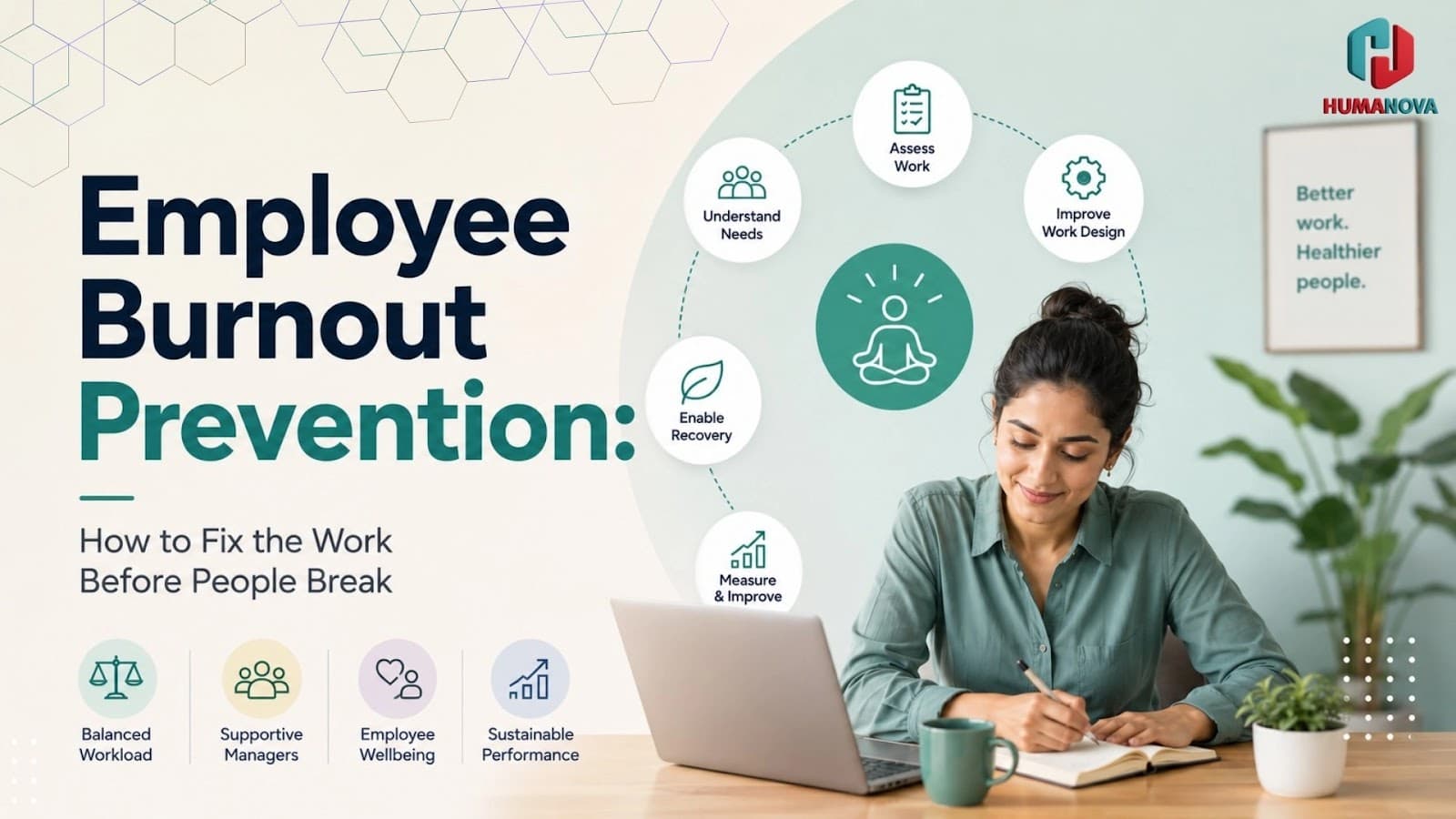
Employee burnout prevention is the work of reducing chronic workplace stress before it turns into exhaustion, detachment and declining professional confidence. It starts with workload, staffing, control, role clarity, manager behaviour and recovery time. Personal wellbeing tools can help, but they cannot repair a job that remains unmanageable.
That is the central mistake in many burnout initiatives. An organisation notices people are depleted, so it adds a resilience webinar or a meditation app. Employees may appreciate the support, yet the deadlines, after-hours messages, unclear priorities and vacant roles stay exactly where they were.
Burnout prevention becomes credible when the organisation is prepared to change the conditions creating the strain. This guide explains what that looks like in practice, how managers can help without acting as therapists and how HR can measure progress without monitoring individuals.
What is employee burnout?
The World Health Organization describes burn-out in ICD-11 as an occupational phenomenon resulting from chronic workplace stress that has not been successfully managed. It identifies three dimensions:
- Energy depletion or exhaustion
- Greater mental distance from the job, or work-related negativism or cynicism
- Reduced professional efficacy
WHO does not classify burnout as a medical condition, and its definition applies specifically to the occupational context. That distinction matters. “Burnout” should not become a casual label for every difficult week, nor should managers use it to diagnose an employee.
In everyday workplace language, burnout often describes a sustained pattern: a person who once had energy and involvement now feels depleted, increasingly detached and less able to do work they previously handled. The change tends to build over time. A weekend away may provide relief, but it does not resolve an excessive workload or a culture of permanent availability.
Burnout, stress and mental-health conditions are not the same thing
Stress is a response to demands or pressures. It can be short-lived, and not every period of stress leads to burnout. Burnout is associated with chronic workplace stress that has not been managed successfully.
Depression and anxiety are health conditions that can affect many parts of life. They can coexist with workplace burnout, but a manager or HR professional should not try to distinguish them through observation alone. If someone is struggling, the appropriate response is a respectful conversation, practical work support and access to qualified professional care where needed.
This also affects how organisations use statistics. WHO estimates that depression and anxiety account for 12 billion lost working days globally each year, at a cost of US$1 trillion in lost productivity. Those figures appear in its mental health at work fact sheet. They are not burnout prevalence or burnout ROI figures, so they should not be presented as if they were.
Signs that work may be creating burnout risk
No single behaviour proves that an employee is burned out. People respond to pressure differently, and changes may have causes unrelated to work. Look for patterns, listen to what employees say and examine conditions across the team.
Possible warning signals include:
- Persistent exhaustion or difficulty recovering between workdays
- Growing cynicism, irritability or emotional distance from the job
- A noticeable drop in confidence or sense of effectiveness
- More mistakes, slower decisions or difficulty concentrating
- Repeated work outside agreed hours
- Unused leave or an inability to disconnect while on leave
- Rising absence, turnover or requests to move away from a team
- Reduced participation, especially from people who were previously engaged
- Recurring employee comments about impossible priorities, understaffing or lack of control
The team-level pattern is often more useful than an attempt to identify a “burned-out employee.” If several people in the same function report exhaustion, work late and struggle with the same bottleneck, the organisation has a work-design problem to investigate.
Treat data as a prompt, not a verdict
Survey results, leave patterns and workload data can point HR towards an area that needs attention. They should not be used to score an individual’s mental state or make employment decisions.
Humanova’s live platform overview describes role-based access, team-level trends, minimum-data thresholds and restrictions on managers viewing private reflections or counselling content. Those are useful principles for any burnout measurement system, whether or not a company uses a wellbeing platform.
Why common burnout initiatives fall short
They treat recovery as the employee’s private task
Sleep, exercise, boundaries and stress-management skills can help people recover. But an employee cannot breathe their way out of a permanently understaffed operation. When the job itself creates repeated overload, prevention requires organisational action.
They confuse perks with working conditions
Yoga, wellness days and healthy snacks may be enjoyable benefits. They do not create role clarity, stop harassment, fix contradictory priorities or give someone control over an impossible schedule.
They reward the behaviour they claim to discourage
A company may talk about balance while promoting the manager who replies at midnight, praises “heroic” overtime and treats leave as a lack of commitment. Employees learn from what leaders reward, not from the wellness calendar.
They wait for a crisis
Support matters when someone reaches a breaking point, but prevention should begin earlier. Workload reviews, manager training, clear escalation routes and confidential check-ins can reveal strain before a person leaves or becomes unwell.
They collect sensitive data without earning trust
Employees will not answer honestly if they think a manager can trace their responses. A survey that asks about stress without explaining access, aggregation and purpose may create anxiety instead of insight.
How to prevent employee burnout step by step
Step 1: Make prevention an operating responsibility
Assign clear ownership. HR can coordinate the programme, but leaders must own staffing, priorities and management practices. Health and safety, operations, occupational health, employee representatives and privacy teams may also have roles.
Agree on what prevention means in the organisation. A useful statement is specific: “We will identify and reduce preventable sources of chronic workplace stress, improve access to confidential support and review progress without monitoring individuals.”
Step 2: Establish a careful baseline
Use several sources rather than relying on one engagement score:
- Anonymous or confidential employee feedback
- Workload, overtime and staffing information
- Leave, absence and turnover trends
- Exit and stay-interview themes
- Manager observations about workflow barriers
- Health-and-safety or employee-relations findings
- Programme awareness, access and waiting-time data
Decide what each measure will change before collecting it. If the organisation cannot explain how a data point will inform action, it may not need that data.
Step 3: Find the pressure points with employees
Ask employees where the work repeatedly becomes difficult. Useful questions include:
Transform your workforce wellbeing today
Interested in learning how Humanova can elevate your team's wellness and HR metrics? Connect with our team for a personalized walkthrough.
- Which tasks or approvals create avoidable delay?
- When does the workload become unsafe or unsustainable?
- Which priorities conflict?
- What stops people from taking leave or disconnecting?
- Where do employees lack the authority needed to do the job?
- What happens when someone raises a capacity concern?
Invite input across locations, roles, seniority levels, genders, working arrangements and shift patterns. People closest to the work often know which changes would help, but they need a safe way to say so.
Step 4: Reduce demands before adding more support content
Start with the work. Possible actions include:
- Stopping or delaying lower-value projects
- Matching staffing to recurring demand
- Setting a limit on simultaneous priorities
- Creating realistic service levels
- Building recovery time after predictable peaks
- Reducing unnecessary meetings and reporting
- Sharing on-call or emotionally demanding work fairly
- Making escalation acceptable before a deadline fails
This is where prevention becomes visible. Employees can tell when an organisation is prepared to remove work, not merely teach them to tolerate more of it.
Step 5: Increase control and clarity
Low control makes high demands harder to manage. Give employees appropriate freedom over sequence, method, focus time, breaks or scheduling. Where flexibility is limited, explain why and invite suggestions within the real constraints.
Clarify which priorities win when two urgent requests compete. A long list in which everything is critical is not a priority system. Managers should record trade-offs so employees are not left to absorb the conflict privately.
What managers should do when an employee may be struggling
A manager does not need to decide whether someone “has burnout.” They need to create space for a useful conversation and act on work issues they can influence.
Try a direct opening:
“I’ve noticed the last few weeks have involved late hours and several changing priorities. How is the workload feeling, and what needs to change?”
Then listen. Avoid asking for a diagnosis or detailed medical information. Focus on work:
- Which demands are causing the most strain?
- What can be stopped, delayed or reassigned?
- Is the employee clear about the top priority?
- Would a temporary adjustment help?
- Does the employee know how to access confidential support?
- When will you check in again?
If the employee raises a health concern, follow the organisation’s occupational-health, accommodation and emergency procedures. Do not promise absolute confidentiality if safety rules require escalation; explain the boundaries honestly.
Burnout prevention for remote and hybrid teams
Remote work can provide flexibility and remove commuting pressure. It can also blur boundaries, hide excessive hours and make it harder to notice when someone is withdrawing.
Useful practices include:
- Agreeing on core collaboration hours and response expectations
- Judging performance by agreed outcomes rather than visible online activity
- Checking workload in one-to-ones instead of relying on status indicators
- Protecting focus time across time zones
- Rotating inconvenient meeting times
- Ensuring remote employees receive the same information and opportunities
- Avoiding digital surveillance that reduces control and trust
Hybrid teams also need fair workload distribution. Employees who are in the office more often can become the default people for urgent requests, while remote colleagues may feel pressure to prove availability. Review who receives interruptions, visibility and development opportunities.
What employees can do without carrying the whole burden
Employees are not responsible for fixing poor work design, but individual actions can still protect recovery and make problems easier to address.
Helpful steps may include:
- Raising capacity concerns early and in concrete terms
- Asking a manager to confirm priorities when demands conflict
- Using leave and agreed breaks
- Setting communication boundaries where the role permits
- Documenting recurring workload or process problems
- Seeking support from HR, occupational health, an employee representative or a qualified professional
- Using emergency or crisis services when there is an immediate risk to safety
Advice about exercise, sleep or mindfulness should be offered as support, not as a way to blame employees for becoming exhausted. If someone’s distress is persistent, severe or affecting daily life, encourage them to speak with a qualified health professional.
How Humanova can support employee burnout prevention
Humanova describes its platform as a system that connects employee check-ins, confidential support, learning and role-based organisational insight. Its corporate mental wellness homepage explains the current employee check-in and aggregated reporting model, while the Humanova platform overview sets out privacy boundaries, team-level trends, minimum-data thresholds and confidential access to qualified support.
Used responsibly, those capabilities can help an organisation listen earlier, identify team-level pressure patterns, connect employees to support and track whether agreed actions happen. They should sit inside a wider prevention programme that also addresses workload, staffing, control, management and recovery.
The best starting question is not “Which wellbeing feature should we launch?” It is “What is making work hard to sustain, and what are we prepared to change?”
Frequently asked questions
1. What is employee burnout?
Employee burnout is an occupational phenomenon associated with chronic workplace stress that has not been successfully managed. WHO describes it through exhaustion, greater mental distance or cynicism towards work, and reduced professional efficacy.
2. Is burnout a medical condition?
WHO does not classify burnout as a medical condition in ICD-11. It is an occupational phenomenon. Employees experiencing persistent or severe distress should speak with a qualified health professional rather than relying on a workplace label.
3. What are the early signs of employee burnout?
Possible signs include persistent exhaustion, growing cynicism, difficulty concentrating, reduced confidence, repeated late work and trouble recovering. No single sign confirms burnout, so managers should ask respectful questions and review the work environment.
4. What causes burnout at work?
Common contributors include excessive workload, understaffing, low control, unclear roles, poor management, bullying, weak support, job insecurity and insufficient recovery time. Causes differ by team and occupation.
5. How can employers prevent employee burnout?
Employers can assess psychosocial risks, reduce unreasonable demands, improve staffing and priority decisions, increase job control, train managers, protect recovery time, provide confidential support and review whether working conditions improve.