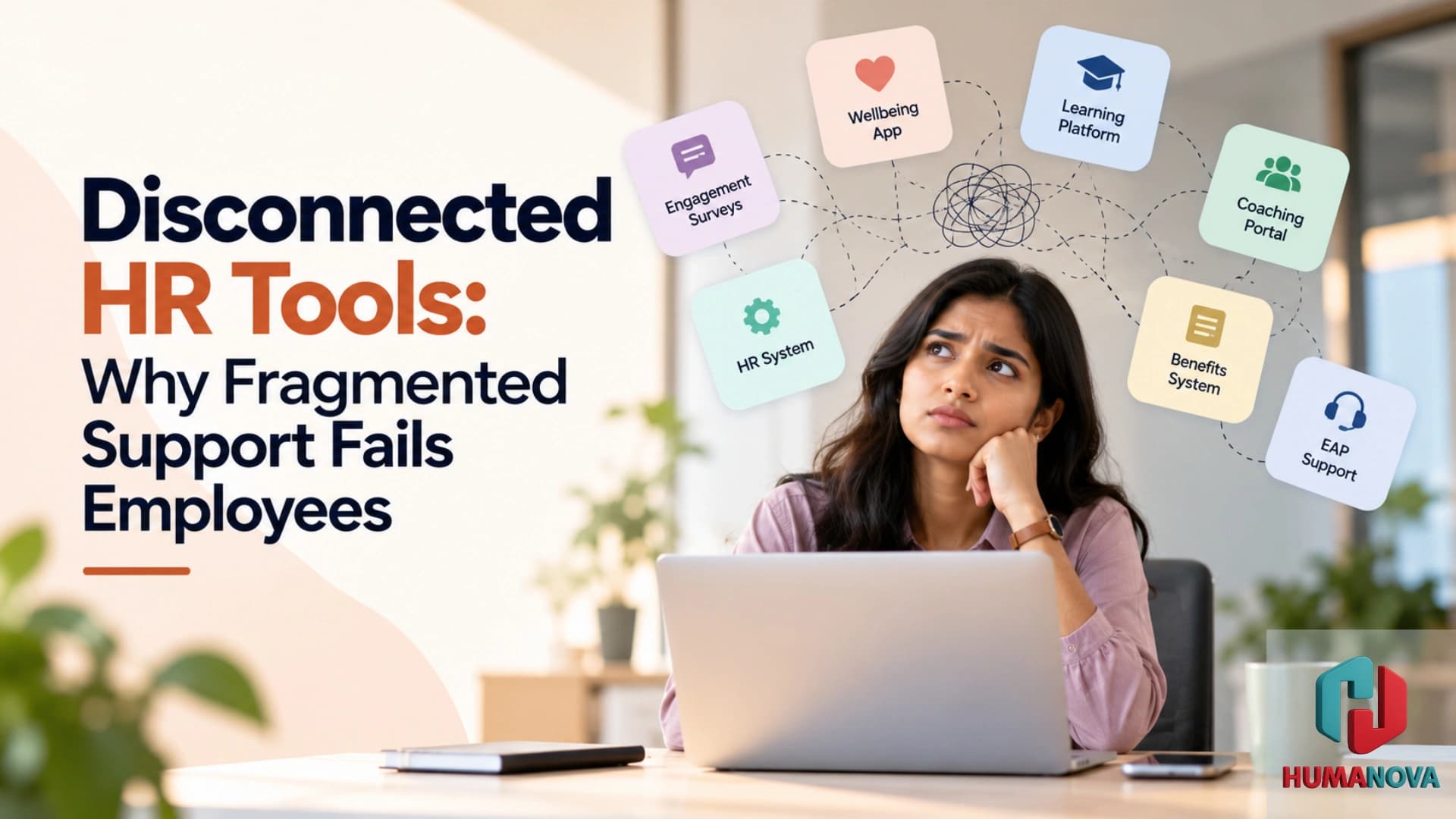
An employee is struggling with a demanding workload and a difficult change in responsibilities. They remember that the organisation provides support, but they are not sure where to find it.
The employee assistance programme sits on one portal. Coaching is booked through another provider. Learning resources require a separate login. The engagement survey arrives by email. Wellbeing check-ins appear in a mobile app, while leave and benefits information sits inside the HR system.
The employee may technically have access to several services. In practice, the path to help is difficult to understand.
This is the problem with disconnected HR tools. Each system may perform its intended function, but the overall experience can feel fragmented. Employees must work out which service they need, remember how to access it and decide what information is safe to share.
HR teams face a similar problem. They may receive participation data from one provider, survey results from another and absence or attrition data from internal systems. Because the information is separated, it becomes harder to identify recurring workforce concerns or understand whether support is reaching the people who need it.
The answer is not simply to buy a larger platform or place every people process inside one application. Better employee wellbeing still depends on manageable work, capable managers, psychological safety, clear roles, fair policies and access to professional care.
The practical goal is a more connected experience: employees should be able to find appropriate support without navigating an obstacle course, while HR receives enough privacy-conscious insight to improve how work is designed.
Why disconnected HR tools matter now
HR technology has often grown one need at a time.
An organisation introduces a learning management system, followed by an engagement platform, a benefits portal, an employee assistance programme, a coaching provider and a wellbeing application. New tools may then be added for performance management, recognition, workforce analytics and AI-readiness training.
Each purchase can make sense on its own. The problem appears when nobody reviews how the services work together.
Employees may encounter:
- Different logins and access processes
- Overlapping notifications and surveys
- Unclear boundaries between confidential and employer-visible information
- Repeated requests for similar information
- Resources that are difficult to find at the moment of need
- Support that feels separate from everyday work
This friction matters during organisational change. Employees may already be adapting to AI, revised job expectations, hybrid working arrangements and pressure to deliver more with limited resources. Adding more portals and communications can increase the effort required to get help.
Microsoft’s research on the “infinite workday” found that 48% of employees surveyed described their work as chaotic and fragmented. Its workplace telemetry also showed how meetings, messages and notifications repeatedly interrupt focused work. Although this research is not specifically about HR applications, it illustrates the environment into which employee tools are being introduced.
Another app, notification or login may look small from an implementation perspective. For an overloaded employee, it can become one more decision to manage.
Fragmentation also affects HR priorities. It can weaken awareness of available support, reduce participation, make consistent manager guidance harder and leave leaders with an incomplete view of workforce needs.
Understanding the problem with disconnected HR tools
A fragmented HR technology environment is one in which employee services, data and workflows are spread across systems that do not work together from the user’s point of view.
Technical integration is part of the issue, but it is not the whole issue. Two systems may exchange data and still create a confusing experience. Conversely, some tools may remain separate for valid privacy or specialist-care reasons while still being easy for employees to navigate.
The real test is whether the overall system helps people answer four questions:
- Where do I go?
- Which type of support is right for me?
- What will happen after I use it?
- Who can see my information?
If employees cannot answer these questions, the organisation does not have a connected support experience, regardless of how many tools it has purchased.
Fragmentation creates different risks for different groups.
For employees, it may make support feel inaccessible or impersonal. For managers, it can create uncertainty about where to direct someone. For HR, it can lead to duplicate administration, inconsistent reporting and gaps in workforce insight.
The CIPD’s examination of HR information systems notes that organisations can accumulate systems across business units that do not communicate with one another, making even basic workforce information difficult to consolidate.
Data from separate tools must also be interpreted with care. Low use of a wellbeing app does not prove that employees are well. It may mean they do not know about the service, do not trust its confidentiality or prefer another form of support. High use does not prove that a programme is resolving the underlying issue.
Likewise, a pattern in aggregated wellbeing data cannot diagnose an individual employee. It should prompt questions about workload, management, role clarity or access to support—not conclusions about a person’s health.
What organisations often get wrong
1. Buying a tool before defining the employee need
A platform may have attractive features, but features are not the same as an effective support journey.
Before buying anything, HR should define the problem. Are employees unable to find confidential support? Are managers unsure where to escalate concerns? Does HR lack insight into recurring workload themes? Are learning and coaching disconnected from changing job requirements?
Without a clear need, new technology can duplicate an existing service and add another login without improving the employee experience.
2. Treating every wellbeing need as an app-based problem
An app can provide resources, check-ins or access to a professional. It cannot correct an unmanageable workload, unclear priorities or consistently poor management.
If employees repeatedly report that deadlines are unrealistic, directing them to resilience content is not an adequate organisational response. HR and business leaders must examine staffing, decision-making, job design and expectations.
The World Health Organization’s guidelines on mental health at work recommend organisational interventions alongside manager and worker training. This is an important distinction: individual support matters, but the conditions creating avoidable pressure must also be addressed.
3. Assuming more choice always improves access
A long catalogue of services can look generous. It can also make employees responsible for diagnosing their own need and selecting the correct provider.
Someone experiencing sustained work pressure may not know whether they need coaching, a manager conversation, workload adjustment, counselling or help with a company process. A clear starting point and simple explanation of each route are often more helpful than a large directory.
Choice works best when employees can understand it.
4. Connecting data without setting privacy boundaries
Integration should not mean that every manager or HR administrator can view every employee interaction.
Confidential counselling information, voluntary wellbeing responses, learning records and operational HR data have different purposes. They require appropriate access controls and retention rules.
Employees should be told what information is collected, whether participation is voluntary, who can see individual-level data and what HR receives in aggregated form. The CIPD’s guidance on responsible workplace technology stresses the importance of understanding data provenance, access and use, as well as setting formal governance for how systems communicate.
5. Measuring activity instead of employee experience
Logins, clicks, course completions and session bookings are easy to count. They show whether a service is being used, but not whether it is trusted, accessible or useful.
A wellbeing programme can have high participation because attendance was strongly encouraged. Another service may have modest use but provide essential confidential support to employees who choose it.
Usage data needs context. HR should combine it with voluntary feedback, accessibility questions, manager observations and broader workforce patterns.
What HR leaders and managers can do now
1. Map the employee support journey
List every tool and service employees may encounter across wellbeing, learning, coaching, engagement, performance, benefits and confidential support.
Then map a few realistic situations.
For example, what happens when a distributed employee feels overwhelmed by changing responsibilities? Where do they begin? How many screens, logins or referrals are involved? Is the distinction between coaching and professional mental health support clear? Can the employee access help outside office hours?
Repeat the exercise for a manager who needs guidance after an employee raises a sensitive concern.
This process often reveals duplicated services, broken links and unclear ownership that a vendor list will not show.
Transform your workforce wellbeing today
Interested in learning how Humanova can elevate your team's wellness and HR metrics? Connect with our team for a personalized walkthrough.
2. Create a clear front door to support
Employees should not need to understand the organisation’s vendor structure.
Provide one familiar starting point that directs them to the appropriate service. This might be an integrated platform, an employee portal or a clearly maintained support hub.
Use plain descriptions. Explain what each option is for, whether it is confidential, how quickly an employee can access it and what to do in an urgent situation.
A connected front door does not require every service to share all its data. It requires a coherent experience and responsible handoffs.
3. Review the work before adding another wellbeing intervention
When a workforce concern appears, examine the working conditions around it.
Ask:
- Have responsibilities changed without a review of workload?
- Are employees receiving conflicting priorities?
- Do teams have enough staffing, time and authority?
- Do managers know how to respond to concerns?
- Are policies applied consistently?
- Is the technology itself creating duplicate work?
If the main problem is work design, another wellbeing tool may distract from the action employees need.
4. Equip managers without turning them into counsellors
Managers need a simple view of the support available and clear boundaries around their role.
They should know how to listen, respond without judgement, discuss reasonable work adjustments and refer employees to appropriate internal or professional support. They should also understand what not to do, including attempting to diagnose a condition or requesting confidential information.
Give managers short conversation guides, escalation routes and access to coaching. Review their own workloads as well. An overloaded manager will find it difficult to provide consistent support to others.
5. Simplify, connect and govern the technology portfolio
Review each tool against a common set of questions:
- What employee need does it address?
- Who uses it, and how often?
- Does it duplicate another service?
- Can employees find it easily?
- What data does it collect?
- Who can access that data?
- Can aggregated insight be combined responsibly?
- Is the tool still worth the effort required to maintain it?
The goal is not to force every function into one system. Specialist tools may provide important expertise or confidentiality. The aim is to remove unnecessary duplication and create clear connections between services.
Include employees, managers, IT, information security, legal or privacy specialists and relevant care providers in the review. HR should not make these decisions in isolation.
The role of technology in connected employee support
A well-designed workplace wellbeing platform can reduce friction by bringing related support routes closer together.
Depending on the organisation’s needs, it may provide access to:
- Confidential support and virtual one-to-one sessions
- Coaching and group programmes
- Voluntary wellbeing check-ins
- Anonymous feedback and pulse surveys
- Self-reflection tools and assessments
- Learning and AI-readiness resources
- Guidance for managers and leaders
- Privacy-conscious workforce-level insights
The value comes from the connections between these services.
An employee completing an AI-readiness programme might also need coaching to apply the learning confidently. Feedback may show that the main barrier is not skill but unclear job expectations. Aggregated themes might then help HR improve communication or manager support across several teams.
Technology should make this journey easier without collapsing necessary privacy boundaries.
Role-based access is essential. Employees, managers, HR teams and service providers should see only the information required for their responsibilities. Sensitive individual information should not become visible simply because services sit within the same digital environment.
The CIPD’s research on workplace technology and employee experience recommends considering productivity, work-life balance, engagement and wellbeing when introducing technology. That principle applies equally to HR’s own technology decisions.
A connected system should reduce effort. It should not become a new source of monitoring, notifications or administrative work.
How Humanova supports a more connected approach
Humanova helps organisations bring employee wellbeing, confidential support, coaching, feedback, leadership development, learning and workforce insight into a more connected experience.
For employees, this can mean a clearer route to relevant support. A distributed employee can access resources or confidential sessions without having to identify which internal team or external provider owns the service.
Managers can find guidance for difficult conversations and development needs. HR can review aggregated themes related to workload, engagement or support access without exposing confidential individual information.
For organisations implementing AI, Humanova can also connect skills development with employee listening and support for confidence. This helps HR see whether the barrier is a capability gap, unclear communication, work design or concern about change.
The platform does not replace good management, HR judgement, counsellors, psychologists, healthcare providers or an EAP. It supports a broader approach in which technology, human care and responsible organisational action work together.
How to measure whether a connected approach is working
Start with the employee experience rather than the size of the technology portfolio.
Useful measures include:
- Awareness of available services
- Employees’ ability to find the right support
- Time and steps required to access help
- Feedback on trust, privacy and accessibility
- Participation in relevant coaching or learning
- Manager confidence in signposting support
- Repeated questions or failed referrals
- Team-level engagement and workload themes
- Appropriate use of confidential support
- Absence and attrition trends, interpreted alongside other evidence
Track duplication as well. Look for employees entering the same information more than once, HR teams reconciling conflicting reports or managers directing people between services without a clear handoff.
Do not interpret one measure in isolation. Falling use could indicate that a problem has reduced, but it could also reflect poor awareness or low trust. Rising use might indicate successful communication rather than worsening wellbeing.
Employee conversations and voluntary feedback are needed to understand what the numbers mean.
FAQs
1. What are disconnected HR tools?
Disconnected HR tools are systems that support different people processes but do not create a coherent employee or HR experience. They may have separate logins, duplicate information, inconsistent privacy rules or limited data exchange. The issue is not simply the number of tools. It is whether employees can navigate them easily and whether HR can use the resulting information responsibly.
2. How do disconnected HR tools affect employee wellbeing?
Fragmented tools can make support harder to find, particularly when an employee is already under pressure. People may abandon the process, use the wrong service or avoid sharing concerns because they do not understand who can see their data. Tool fragmentation can also add notifications and administrative work, although it should not be assumed to cause a mental health condition.
3. Does an organisation need one platform for every HR function?
Not necessarily. Some specialist services should remain distinct because they require specific expertise, confidentiality or governance. A connected approach means employees have a clear route into support, services can make responsible handoffs and data boundaries are understood. The aim is a coherent experience, not unrestricted access to every system from one database.
4. What is an integrated employee wellbeing platform?
An integrated employee wellbeing platform brings related services such as confidential support, coaching, feedback, learning resources and workforce insights into a more accessible experience. It should complement good management and safe work design. It should also use clear consent, role-based access and privacy safeguards rather than sharing sensitive employee information across the organisation.
5. How can HR reduce app and survey fatigue?
Review every notification, survey and check-in from the employee’s perspective. Remove duplicated questions, coordinate communication schedules and ask only for information the organisation can use responsibly. Keep surveys short, explain why the data is needed and report what action followed. Employees are more likely to participate when listening feels purposeful rather than repetitive.
6. What should HR consider before buying another wellbeing tool?
Define the employee need, check whether an existing service already addresses it and map how the new tool will fit into the support journey. Review accessibility, privacy, data ownership, integration requirements, manager responsibilities and the administrative burden. HR should also consider whether the underlying issue requires changes to workload, policy or management rather than new software.
7. Can HR combine data from different wellbeing systems?
Data can sometimes be combined at an aggregated level, but the purpose, consent, confidentiality requirements and access controls must be clear. Counselling or sensitive wellbeing information should not automatically be linked with individual performance data. HR should involve privacy, legal and information-security specialists and explain data use to employees before connecting systems.
8. How can small businesses create connected employee support?
Small businesses can begin without a complex technology programme. Create one clearly communicated support page, remove outdated resources and give managers a current referral guide. Choose tools that solve defined needs and minimise duplicate administration. As the organisation grows, establish ownership for employee data, privacy, vendor reviews and the overall support journey.
Featured snippet
Too many disconnected HR and wellbeing tools create extra logins, duplicate communication, unclear privacy boundaries and fragmented employee data. HR can reduce the problem by mapping support journeys, simplifying access, removing duplicated services, training managers and using privacy-conscious workforce insight alongside better workload and management practices.
Conclusion
Disconnected HR tools can leave an organisation with many services but no clear support experience.
The solution is not integration for its own sake. HR should make support easier to find, protect confidential information, equip managers and use aggregated insight responsibly. It must also address the everyday conditions affecting wellbeing, including workload, role clarity, management quality and psychological safety.
Employees are more likely to use support when they understand where to go, what will happen and who can see their information. They are more likely to thrive when the organisation listens, acts on avoidable sources of pressure and treats wellbeing as part of how work is managed.
Explore how Humanova can help your organisation make employee wellbeing, coaching, feedback, and workforce insight easier to access.