A leadership team approves a new AI platform. IT manages security and integration. Business heads identify use cases. Finance tracks the investment.
HR is invited after the main decisions have been made, to organise training and explain the change to employees.
By then, some of the most important questions have already gone unanswered. Which roles will change? What decisions can AI support? When must a person remain accountable? Do employees have enough time to learn? Will automation remove work or simply add more review tasks? How will managers address concerns about capability, workload or job security?
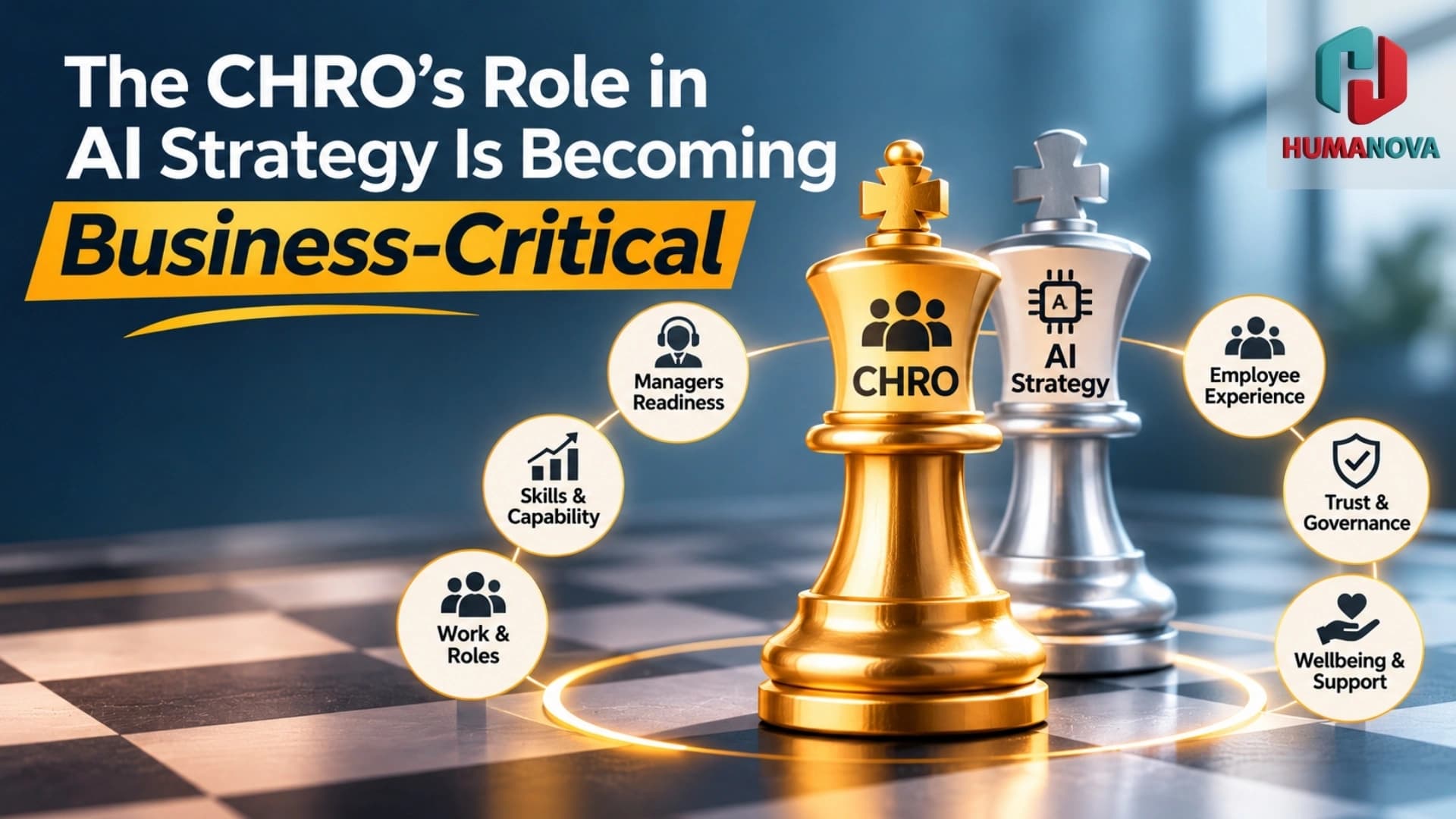
This is why the CHRO role in AI strategy can no longer begin at implementation. AI changes jobs, skills, decision rights, team structures and the employee experience. Those are business issues as much as technology issues.
IBM’s 2026 global CHRO study found that 46% of organisations did not involve the CHRO while defining AI strategy. The same research found that organisations were placing greater importance on judgment, critical thinking and the ability to supervise AI output. That disconnect should concern any business trying to move from AI experiments to dependable performance. IBM’s CHRO study
The CHRO does not need to own every technical decision. But HR must help shape how AI changes work, what employees need to succeed and which safeguards protect trust, wellbeing and responsible judgment.
Why the CHRO role in AI strategy matters now
AI adoption is moving quickly across Indian workplaces.
Microsoft’s 2025 Work Trend Index reported that 93% of Indian business leaders intended to use AI agents to extend workforce capacity within the following 12 to 18 months. It also found that 51% identified upskilling as a leading priority. These figures reflect an important reality: organisations cannot scale AI without changing how people learn, work and make decisions. Microsoft India Work Trend Index
Yet many AI programmes are still organised mainly around tools, data and deployment milestones.
That approach can miss the effect on daily work. An AI assistant may draft reports faster, for example, while creating new responsibilities for checking accuracy, protecting confidential information and correcting weak outputs. A customer-service agent may handle more cases with AI but face higher work intensity because expected response volumes increase. A manager may be asked to support AI adoption without knowing what good use looks like.
These are not minor implementation details. They influence productivity, quality, engagement and risk.
The CHRO brings questions to the strategy table that other functions may not be equipped to answer alone:
- How will tasks and roles change?
- Which skills will become more important?
- Where could workloads increase?
- How will employees learn safely through practice?
- What will managers need to explain and reinforce?
- Which decisions require human review?
- How will the organisation listen to employees during adoption?
- How will it protect fairness, privacy and psychological safety?
Involving HR early also helps companies connect AI investment with workforce planning. Leaders can decide whether a capability should be developed internally, recruited, sourced through contractors or supported by technology. They can assess productive capacity instead of relying only on headcount.
For Indian organisations operating across offices, remote teams, languages and different levels of digital confidence, this people perspective is especially important. A single communication or training programme will rarely meet every team’s needs.
Understanding the problem: AI strategy changes the system of work
AI strategy is often treated as a decision about which technology to buy. In practice, it is a decision about how work will be divided between people and machines.
That includes deciding:
- which tasks AI may complete;
- which outputs employees must verify;
- who remains responsible for the final decision;
- what employees should do when an output appears unreliable;
- how performance expectations will change;
- which capabilities people will need next; and
- how the organisation will respond when the new workflow creates unintended pressure.
The CHRO’s contribution is therefore wider than training administration. HR can help the business redesign roles, build capability, prepare managers, protect employee voice and identify workforce risks before they become adoption problems.
This does not mean that HR should make technical, legal or security decisions alone. Effective AI governance needs input from business leaders, IT, data specialists, legal teams, risk functions, HR, managers and employees who understand the actual work.
It also requires careful distinctions.
Concern about AI or job security is not the same as a clinical mental health condition. A lower engagement score does not prove that AI caused distress. Changes in wellbeing can reflect workload, management quality, unclear priorities, personal circumstances or several factors at once.
Similarly, workforce data cannot establish that an individual employee is burned out or resistant to change. Aggregated patterns may reveal where HR should ask better questions, but they should not be used as a shortcut to judging people.
What organisations often get wrong
1. Bringing HR in after the strategic decisions
When HR joins only during rollout, the organisation may already have selected use cases, timelines and productivity targets without assessing workforce consequences.
HR is then expected to make employees “ready” for a model it did not help shape.
The better approach is to involve the CHRO while the organisation is choosing use cases and redesigning workflows. This allows workforce capacity, job quality, capability and employee trust to influence the business case from the beginning.
2. Treating AI readiness as tool training
A demonstration can teach an employee where to click. It cannot prove that the employee can recognise a weak output, apply context, protect sensitive information or decide when not to use AI.
AI readiness involves judgment, critical thinking, domain knowledge and responsible escalation. Employees also need opportunities to practise with realistic work, receive feedback and learn from mistakes without being punished for every unsuccessful experiment.
3. Setting productivity targets before redesigning workloads
Leaders may assume that time saved by AI will immediately translate into more output. In reality, new tools can add setup, verification, correction and reporting work.
Before raising targets, organisations should study the full workflow. They need to ask whether AI actually removes work, moves it to another person or creates a new layer of review.
If every saved hour is filled with more tasks, employees may experience the transformation as work intensification rather than support.
4. Leaving managers without clear answers
Employees usually take their practical questions to their manager:
- Will my role change?
- Which tools can I use?
- Is my work being monitored?
- How will AI use affect performance reviews?
- What happens if the system is wrong?
- Which skills should I build?
Managers cannot respond well if senior leaders have not agreed on the answers. Vague reassurance can damage trust, especially when leaders cannot promise that roles will remain unchanged.
Managers need clear boundaries, escalation routes and permission to say when an answer is not yet known.
5. Measuring adoption instead of experience and outcomes
Logins, licences, prompts and training attendance show activity. They do not establish that work has improved.
An organisation can have high tool usage while employees spend more time correcting outputs. It can complete training while managers remain unsure how to redesign roles. It can report faster task completion while quality or trust declines.
Adoption data needs context from employee feedback, work-quality measures, manager observations and operational outcomes.
What HR leaders and managers can do now
1. Give the CHRO a formal role in AI governance
The CHRO should participate in the group that sets AI priorities, approves workforce use cases and reviews risks.
This role should be defined rather than assumed. HR’s responsibilities might include workforce-impact assessment, job redesign, skills planning, employee consultation, change communication, manager preparation and wellbeing safeguards.
For each proposed AI use case, ask:
- Which tasks will change?
- Who gains or loses decision authority?
- What new checking work will be required?
- Which employees will be affected first?
- What training and practice will they need?
- What could happen to workload, autonomy and role clarity?
- How will employees report problems safely?
This turns workforce considerations into design inputs rather than post-launch corrections.
2. Map tasks before rewriting jobs
Avoid deciding that a complete role will disappear or transform based only on what a tool appears capable of doing.
Break the role into tasks. Identify which tasks are repetitive, judgment-heavy, relationship-based, regulated or sensitive. Then classify the future workflow:
- human-led;
- AI-assisted;
- AI-executed with human review; or
- automated with defined exception handling.
Employees who perform the work should be involved. They often know where context, tacit knowledge and unusual cases make an apparently simple task difficult to automate.
Transform your workforce wellbeing today
Interested in learning how Humanova can elevate your team's wellness and HR metrics? Connect with our team for a personalized walkthrough.
Job redesign should also preserve learning pathways. If AI takes over every entry-level task, junior employees may lose the experience through which they develop judgment.
3. Build capability around decisions, not products
Tool-specific instruction has a short shelf life. A stronger AI-readiness programme develops capabilities that transfer across systems.
Employees should learn how to:
- define the problem before using AI;
- assess whether a task is appropriate for AI support;
- verify facts, logic and calculations;
- identify bias or missing context;
- protect private and confidential information;
- document important decisions;
- escalate doubtful outputs; and
- retain responsibility for the final result.
Training should reflect the role. A recruiter, finance analyst, sales manager and software developer will face different risks and require different practice scenarios.
4. Prepare managers for honest conversations
Managers should not be asked to diagnose distress, provide therapy or promise that jobs will never change.
They should be able to explain what is changing, listen without dismissing concerns, clarify immediate expectations and direct employees towards appropriate support. They also need a route to raise recurring issues with HR and business leaders.
Give managers concise guidance before major announcements. Include known decisions, open questions, prohibited claims, available learning support and escalation contacts.
Where workloads are affected, managers should review priorities and deadlines instead of simply encouraging employees to become more resilient.
5. Create continuous employee-listening loops
Annual surveys are too slow for a changing AI programme.
Use short, voluntary pulse surveys, team discussions, anonymous feedback routes and structured pilot reviews. Ask specific questions:
- Is the tool removing or adding work?
- Do employees understand when human review is required?
- Are expectations clear?
- Do people feel safe reporting an AI error?
- Is training relevant to real tasks?
- Has the workflow affected autonomy, collaboration or work quality?
Explain how responses will be used and what HR can see. Then report back on decisions. Listening without visible action can deepen cynicism.
6. Review wellbeing through work design
AI-related pressure cannot be addressed through wellness content alone.
Review workloads, staffing, deadlines, job control, role clarity, meeting demands and the availability of manager support. The World Health Organization recommends organisational interventions that address working conditions, including employee participation and changes to workloads or schedules where needed. WHO mental health at work policy brief
Provide confidential support and professional care where appropriate, but do not use those services to compensate for avoidable organisational stress.
The role of technology in a people-led AI strategy
Technology can make learning, support and employee feedback easier to access. It can provide virtual one-to-one sessions, coaching, group programmes, voluntary check-ins, anonymous pulse surveys, self-reflection tools and practical manager resources.
It can also help HR see aggregated themes across locations or functions. Recurring concerns about workload, confidence or role clarity may show where the organisation should investigate further.
Those insights require safeguards.
Employees should know:
- what information is collected;
- whether participation is voluntary;
- who can access individual or aggregated information;
- why the data is being used;
- how long it will be retained; and
- whether it will influence employment decisions.
Access should follow clear role-based controls. Wellbeing responses should not be exposed to line managers when employees have been told they are confidential. Small-group reporting should be designed carefully so individuals cannot be identified indirectly.
The International Labour Organization has warned that intrusive AI monitoring, loss of autonomy, work intensification and unclear data practices can create psychosocial risks. Workplace technology must not become a surveillance system disguised as employee support. ILO analysis of AI and workplace psychosocial risks
Technology can connect support. It cannot replace fair policies, manageable work, responsible leadership, professional care or a manager who has time to listen.
How Humanova supports a more connected approach
Humanova can help organisations bring employee wellbeing, confidential support, coaching, feedback, leadership development, learning and workforce-level insight into a more connected experience.
That matters during AI transformation because employee needs rarely fit within one programme.
A distributed employee may need a confidential route to support. A manager may need guidance before a difficult conversation. An L&D team may need to build AI confidence alongside critical thinking and responsible use. HR may need aggregated insight into recurring concerns without exposing individual employee information.
Bringing these elements together can reduce friction and help HR respond more consistently. It does not replace the CHRO’s strategic role, responsible managers, qualified professionals, healthcare providers or an organisation’s existing EAP. It supports the wider system through which people access help, develop capability and make their experience visible.
How to measure whether the approach is working
Start by defining what the AI initiative is supposed to improve. Measures should connect employee experience with operational results.
Useful indicators may include:
- employee understanding of approved AI use;
- confidence in reviewing and challenging AI outputs;
- manager confidence in supporting affected teams;
- participation in role-relevant learning and coaching;
- reported clarity about responsibilities and escalation;
- employee trust in data and privacy safeguards;
- recurring feedback themes about workload or work quality;
- error, rework and exception rates;
- awareness and accessibility of support;
- team-level engagement patterns; and
- absence or attrition trends, interpreted alongside wider context.
Avoid treating any single measure as proof of success.
Training completion does not establish capability. Tool usage does not establish value. Lower turnover does not necessarily mean that employees trust the transformation. Combine quantitative patterns with conversations, workflow reviews and direct feedback from the people doing the work.
Measures also need time boundaries. Review early pilot signals, post-launch patterns and longer-term changes separately. This helps leaders distinguish temporary learning friction from persistent design problems.
FAQs
1. Why should the CHRO be involved in AI strategy?
AI affects job design, skills, workforce capacity, management practices and employee trust. The CHRO can help leadership assess these effects before tools are selected and targets are set. This does not make HR the sole owner of AI. It makes workforce expertise part of a cross-functional strategy involving business, technology, legal, risk and employee representatives.
2. What is the CHRO’s responsibility in AI governance?
The CHRO should help govern how AI affects people and work. This may include workforce-impact assessments, job redesign, skills planning, manager preparation, employee consultation, fair-use policies and privacy safeguards. HR should also help define when human judgment is required and how employees can report errors or concerns without fear of unfair consequences.
3. How can HR support AI adoption without making false promises?
HR should communicate what is known, what remains undecided and when employees can expect further information. Leaders should avoid guaranteeing that no roles will change if they cannot support that claim. Honest communication can include clear current expectations, learning opportunities, decision principles and support routes while acknowledging genuine uncertainty about longer-term workforce changes.
4. What skills should organisations prioritise for AI readiness?
Employees need role-specific AI literacy, but prompting alone is not enough. Priority capabilities include critical thinking, domain knowledge, quality control, ethical judgment, data awareness and the ability to challenge or override unreliable outputs. Employees also need clear rules for privacy, documentation and escalation. Training should use realistic work scenarios and include practice, feedback and manager reinforcement.
5. How should HR assess the workforce impact of an AI project?
Begin with tasks rather than job titles. Identify which activities may be assisted or automated, which require human judgment and where new review work may appear. Consult employees who understand the workflow. Assess possible effects on workload, autonomy, skills, learning pathways and staffing, then revisit the assessment during pilots because actual workplace effects may differ from initial assumptions.
6. Can employee wellbeing data show whether AI is causing burnout?
No single dataset can establish that AI caused burnout or determine an individual employee’s mental health. Voluntary, aggregated feedback can reveal patterns such as rising workload concerns or falling role clarity. HR should treat those patterns as prompts for investigation, combine them with operational context and conversations, and avoid profiling individual employees.
7. What should managers do when employees are anxious about AI?
Managers should listen, clarify immediate expectations and avoid dismissing concerns. They should explain how AI will be used, what remains under human control and where employees can find training or confidential support. Managers should escalate repeated concerns about workload, role security or unclear policies. They should not diagnose employees or make promises about future jobs without authority.
8. How can smaller organisations involve the CHRO without creating heavy governance?
A smaller organisation can use a simple cross-functional review involving the business owner, HR lead, technology representative and employees familiar with the work. Before approving an AI use case, the group can review task changes, risks, training, workloads, privacy and accountability. The goal is not a large committee; it is to prevent technology decisions from being separated from workforce reality.
Featured snippet
The CHRO’s role in AI strategy is to connect technology decisions with job design, workforce skills, employee trust, leadership capability and wellbeing. Involving the CHRO early helps organisations assess how AI will change work, prepare managers and employees, protect human accountability, and address workload or capability risks before deployment.
Conclusion
The CHRO role in AI strategy is becoming business-critical because AI implementation depends on much more than technical capability.
An organisation can choose a powerful system and still struggle if employees do not understand it, managers cannot support it, work has not been redesigned or trust has been overlooked. AI strategy must account for the people who will use, review, challenge and live with the technology every day.
Employees are more likely to thrive when the organisation makes support easy to access, listens responsibly, equips managers, addresses avoidable sources of stress and treats wellbeing as part of how work is designed.
Explore how Humanova can help your organisation make employee wellbeing, coaching, feedback, and workforce insight easier to access.