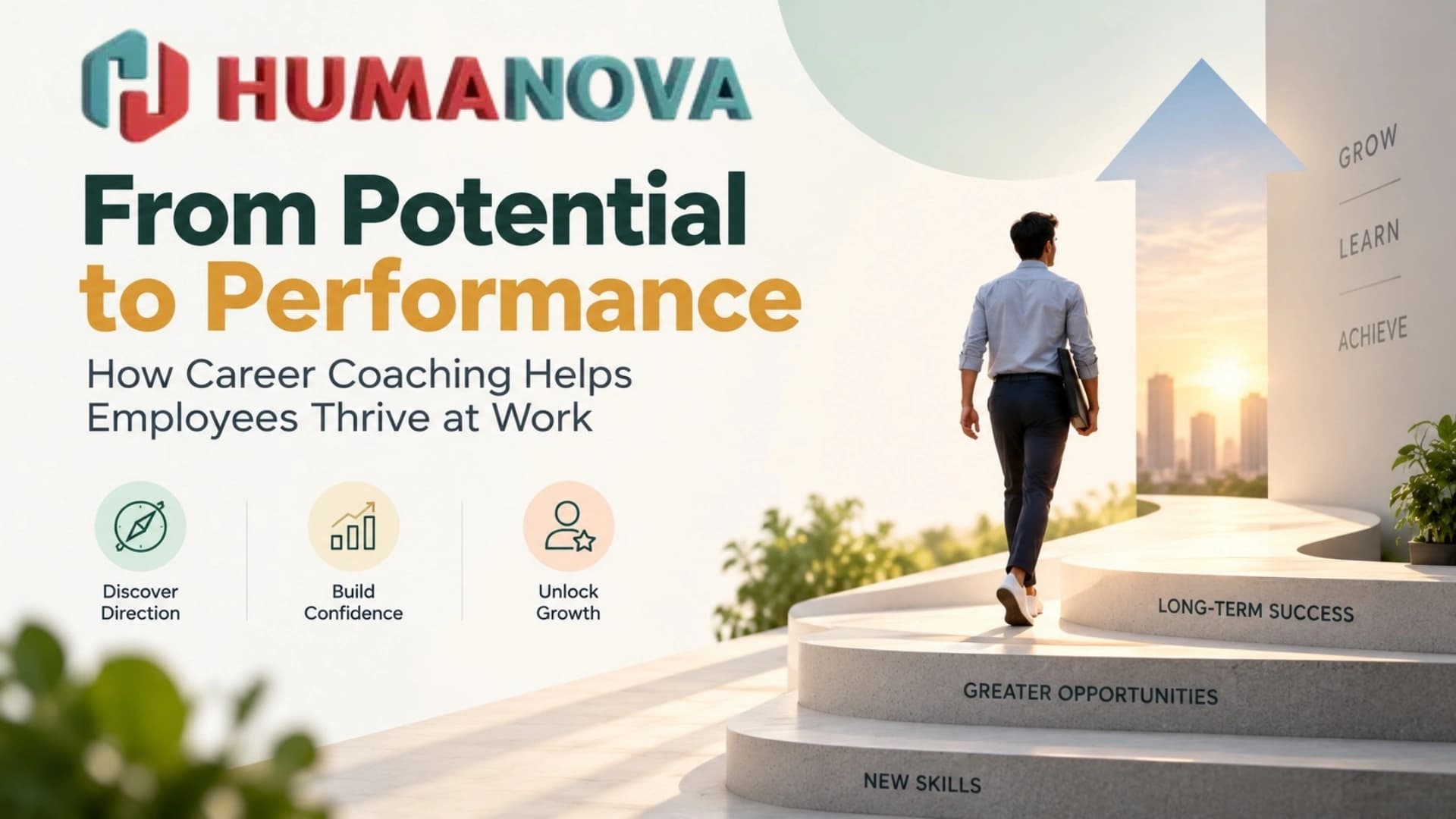
A capable employee is promoted. Six months later, their performance looks uneven. They know the work, but they hesitate in difficult meetings, hold on to tasks they should delegate and are unsure what senior leaders expect. Their manager tells them to “be more strategic,” then moves on to the next deadline.
This situation is common because potential does not develop on instruction alone. People need useful feedback and a plan to practise new behaviour. Annual reviews rarely provide that depth, and a generic course cannot address every person’s role, confidence or career direction.
Career coaching for employees fills that gap. It gives an employee a structured conversation about where they want to go, what is getting in the way and what they will do next. It can connect employee development with skills the business needs. Coaching is not a guaranteed answer to performance or retention problems, but research reviews suggest that well-designed workplace coaching can support learning, behaviour and work-related outcomes.
What career coaching means in the workplace
Workplace career coaching is a goal-focused development process. A coach helps an employee examine career options, recognise patterns, test assumptions and turn a broad ambition into specific action. The coach asks questions, offers observations and keeps the employee accountable. The employee decides what fits and does the work between conversations.
Career coaching is different from mentoring. A mentor usually shares advice from experience in a role or industry, while a coach guides the employee’s thinking, feedback and follow-through. Training teaches shared skills to a group. Counselling addresses personal or psychological concerns. A performance review is an employer-led assessment. Coaching may follow that review, but it should not be described as confidential if the conversation will become formal evidence.
The CIPD coaching and mentoring factsheet makes a similar distinction and recommends connecting coaching with the wider learning and development strategy. That connection matters. Coaching works best when employees can act on it through real projects, learning resources, internal opportunities and manager support.
Why employee potential does not always become performance
Potential is a forecast, not a finished capability. An employee may have the judgment to take on more responsibility but lack experience in delegation. A technically strong specialist may want to lead a team without knowing whether people management suits them. Someone else may be ready to contribute at a higher level but cannot see a path inside the company.
The barriers are often practical: unclear career direction, a skill gap, limited feedback, changing job expectations or a weak relationship with a manager. Confidence can also drop after a promotion or a visible mistake. Burnout and sustained overload can make a capable person look disengaged when the immediate problem is depleted energy. In each case, telling the employee to “take ownership” is incomplete. They need enough clarity and support to decide what ownership looks like.
These problems affect the business. Decisions are escalated, new managers avoid difficult conversations and employees may leave to find development they cannot see internally.
How career coaching for employees improves performance
Creating clear career goals
Many career goals begin as a job title: “I want to become a director.” A coach helps the employee look underneath the title. What work do they want more of? What decisions would they own? Which relationships and skills does the role require? A clearer goal gives the employee and manager something useful to discuss.
Identifying strengths and development areas
Employees often receive fragments of feedback without seeing the pattern. Coaching brings together examples from recent work, assessment results, manager input and the employee’s own reflection. A coach can help separate a genuine skill gap from a confidence issue or an unclear expectation. Assessments can support the conversation, but they should not become a label that defines the employee.
Turning goals into action
“Improve executive presence” is too vague to guide behaviour. A useful plan might involve leading the next quarterly review, asking a senior colleague to observe, practising the opening with a coach and reviewing what changed after the meeting. Career development coaching turns intention into a small set of actions that can happen within normal work.
Improving confidence and decision making
A coaching conversation gives employees room to think before they act. They can examine a difficult relationship, prepare for a decision or rehearse a conversation without the pressure of solving it in public. The coach should not make the decision for them. Good coaching improves the employee’s ability to make the next decision independently.
Building accountability
Development plans often disappear beneath urgent work. Regular coaching creates a simple rhythm: agree on an action, try it, review the result and adjust. This accountability is useful because it is tied to the employee’s own goal, not a generic compliance task.
Supporting employees through role changes
Promotions, new managers, restructures and technology shifts change the job before a person has fully adapted. Coaching can help an employee decide what to stop doing, which skills need practice and where to ask for help. During AI adoption, for example, professional development coaching can connect tool training with the harder questions about judgment, role boundaries and how the employee continues to add value.
The research base is encouraging but should be read with care. A 2023 meta-analysis of 37 randomised controlled studies covering 2,528 participants found a statistically significant overall effect across leadership and personal outcomes. Another 2023 workplace coaching meta-analysis also reported positive organisational outcomes while noting that coaching research still needs stronger methods and clearer measures. HR teams should therefore define the result they expect and evaluate their own programme rather than assuming coaching will fix every problem.
Performance coaching and career coaching
Performance coaching focuses on effectiveness in the current job. The starting point may be a target, behaviour or skill that needs to improve. Career coaching looks further ahead. It helps the employee understand strengths, career direction, future roles and the experiences needed to progress.

The two forms of coaching often work better together. An employee preparing for promotion may need to improve delegation now while also deciding what kind of leader they want to become. The connection prevents career plans from becoming abstract and keeps current performance from becoming the only measure of potential.
Career coaching supports engagement and retention
Employees are more likely to invest in their work when they can see how today’s effort connects with a future they value. Coaching can improve that visibility. It can also produce better conversations with managers because the employee arrives with clearer goals and a more specific request for experience, feedback or learning.
Career coaching does not always reduce attrition. It may help someone realise that their preferred path is unavailable. It can also show HR where internal mobility or role design could retain capability.
Transform your workforce wellbeing today
Interested in learning how Humanova can elevate your team's wellness and HR metrics? Connect with our team for a personalized walkthrough.
LinkedIn’s 2025 Workplace Learning Report surveyed 937 L&D and HR professionals and 679 learners. It found that career development, internal mobility and learning remain central concerns for talent teams. This is survey and platform research, not proof that coaching alone causes retention, but it supports the practical case for making career growth visible inside the organisation.
Career coaching for managers and future leaders
First-time managers often discover that the skills that earned the promotion are not the skills the new role demands. They must delegate, set standards, handle conflict and make decisions with incomplete information. Leadership coaching gives them a place to work through live situations and practise a different response before habits harden.
The same support helps emerging leaders, high-potential employees and experienced managers entering a broader role. Topics may include communication, delegation, stakeholder management and executive presence. The coach should connect each topic to real work so the employee can test a change and review what happened.
Why personalised coaching matters
Two employees can attend the same programme and need very different help. One may understand the concept but struggle to use it under pressure. Another may need a chance to practise. A third may be pursuing a career path that no longer fits their interests.
Personalised employee coaching adapts the conversation to the person’s role, career stage and goals. Group training still teaches shared skills efficiently. Coaching helps each employee apply that learning to their own work, so organisations can use both.
How technology is changing workplace coaching
Digital platforms can make coaching easier to access across locations and time zones. Employees can meet a coach virtually, record goals, complete an assessment, reflect between sessions and use learning resources linked to their development plan. HR teams can review participation and programme trends without needing access to private conversations.
Technology also introduces risks. Matching should allow employee choice where possible, and progress tracking must not turn confidential reflection into surveillance. AI can suggest resources, but it should support the coaching relationship rather than replace human judgment and context.
The need for adaptable development is real. The World Economic Forum Future of Jobs Report 2025 gathered responses from more than 1,000 employers representing over 14 million workers. Employers expected major changes in jobs and skills through 2030. Coaching can help employees interpret those changes while formal learning builds the skills they choose to pursue.
How Humanova supports career and performance coaching
Humanova helps organisations give employees access to confidential one-to-one coaching, group coaching and development resources through one platform. An employee can work on a career goal, use assessments and reflections to understand development needs, and access relevant learning. Managers and HR teams can support the programme through aggregated participation and workforce insights without reading private coaching conversations.
Humanova connects professional and career coaching with leadership support, learning resources, employee wellbeing and privacy-conscious insights. This makes it easier for employees to act on what they discover. The platform supports the process; the coach and employee still do the human work.
How HR leaders can build an effective career coaching programme
1. Identify the development need
Review business priorities, employee feedback, succession plans, performance themes and skill gaps. Define which problems coaching can reasonably address and which require changes to roles, pay, workload or management.
2. Set clear programme goals
Choose a small set of outcomes such as stronger manager capability, readiness for internal moves or progress on agreed development goals. Avoid claiming that one programme will solve engagement, retention and performance at once.
3. Offer access beyond senior leadership
Executive coaching may remain appropriate for complex roles, but employees earlier in their careers also face decisions where focused support can prevent drift and build capability.
4. Match employees with the right coach
Consider coaching credentials, relevant context, language, availability and the employee’s preference. Give employees a way to request a different match without penalty.
5. Protect confidentiality
Explain what stays between coach and employee, what is reported in aggregate and what happens when a serious safety or legal concern arises. Keep performance management separate and explicit.
When organisations should consider career coaching
Career coaching is most useful when an employee faces a meaningful change or a decision that benefits from structured thinking. Common examples include preparing for promotion, moving into management, returning after a career break, taking on a larger role, navigating career uncertainty or adapting during a reorganisation.
It can also support succession planning, AI adoption and a carefully managed performance improvement effort. In a performance case, the organisation must be honest about the purpose and any consequences.
Career coaching questions from HR teams
1. What is career coaching for employees?
Career coaching for employees is a structured, personalised process that helps people clarify career goals, understand strengths and development needs, make work-related decisions and follow a realistic action plan. A coach uses questions, feedback and accountability rather than deciding the employee’s career for them.
2. How does career coaching improve employee performance?
Coaching can improve performance by turning broad feedback into clear behaviour and practice. Employees identify what is blocking progress, choose an action, test it in real work and review the result. Outcomes depend on coaching quality, employee effort, manager support and whether the workplace allows the employee to apply what they learn.
3. What is the difference between career coaching and performance coaching?
Performance coaching focuses mainly on effectiveness in the current role, such as a skill, behaviour or target. Career coaching focuses on longer-term direction, strengths, opportunities and future roles. They can overlap when an employee needs to improve today’s performance while preparing for a larger responsibility.
4. Can career coaching improve employee retention?
Career coaching may support retention by helping employees see growth options, prepare for internal moves and have better development conversations. It does not guarantee that people will stay. Coaching may also clarify that an employee’s preferred path is unavailable, which gives the organisation useful and honest information.
5. Who should receive career coaching at work?
Access can include first-time managers, emerging leaders, high-potential employees, people changing roles, employees returning from career breaks and anyone facing a genuine career decision. Restricting coaching to executives can leave development gaps in the wider workforce.
6. How often should employees meet with a career coach?
Frequency depends on the goal and programme. A session every two to four weeks often gives an employee enough time to act between conversations while maintaining momentum. Short transition programmes may meet more often. The schedule should follow the work required, not an arbitrary session count.