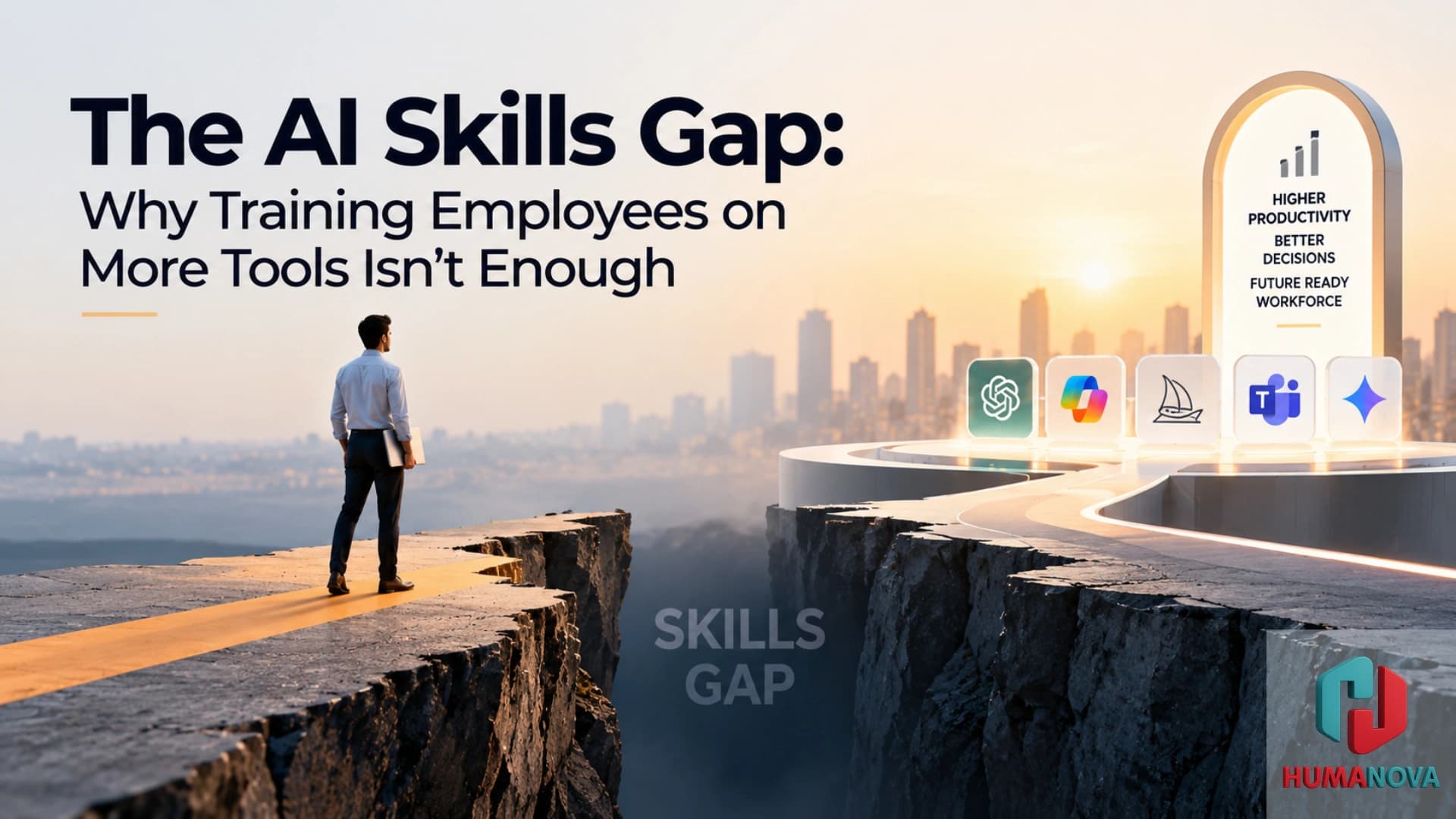
A company introduces an AI assistant and gives employees a short training session. A few months later, another platform arrives. Then individual teams begin using their own tools, some approved and some not.
Employees attend more demonstrations, collect more certificates and learn more prompt formats. Yet many still do not know when they should use AI, how to check its work or what to do when a tool produces a confident but unreliable answer.
The organisation has invested in training, but its AI skills gap remains.
Gartner reports that 95% of CHROs have active AI initiatives. At the same time, 51% of CIOs and senior IT leaders believe the skills they need are changing faster than the available talent. Gartner’s recommendation is to focus on capabilities that can evolve with work, instead of continually adding new tool-specific skills. Gartner
This does not make tool training irrelevant. Employees still need to understand the platforms they use. But tools change quickly. Interfaces are updated, features are replaced and new providers enter the market.
The more durable capabilities are human: learning quickly, understanding work processes, exercising judgment, checking quality, handling uncertainty and knowing when to involve another person.
Annual surveys and occasional courses will not tell HR whether employees can apply these capabilities under real working conditions. Organisations need ongoing listening, practical learning, capable managers and work designed to make responsible AI use possible.
Why the AI skills gap matters now
AI adoption is moving faster than many organisations’ ability to redesign roles and learning.
Employees are being asked to use unfamiliar tools while meeting existing targets. Managers may be expected to guide AI-enabled work even when they have received little training themselves. L&D teams can struggle to update courses before another product release changes what employees need to know.
The challenge is particularly relevant to Indian organisations with varied workforces. An employee in a technology function may use AI every day, while a frontline manager, plant employee or customer-service worker may have limited access. Digital confidence, language preferences and the relevance of AI to each role can vary widely.
A single company-wide course will rarely address all these needs.
There is also pressure to demonstrate quick productivity gains. If leaders define success as the number of licences activated or courses completed, employees may learn to use a tool without learning how to improve the work.
That affects more than productivity. It can influence service quality, employee confidence, data protection, decision-making, engagement and trust.
When expectations are unclear, employees may worry that they are falling behind or that AI will make their roles less secure. That concern is not proof of a clinical mental health condition. It is a workplace issue that calls for honest communication, role clarity and accessible support.
Understanding the AI skills gap
The AI skills gap is the difference between what employees need to do effective, responsible AI-assisted work and what they can currently do in practice.
This includes technical knowledge, but it extends well beyond it.
An employee may know how to generate a presentation and still be unable to judge whether its analysis is sound. A manager may understand the features of an AI assistant but not know how to redesign a team process around it. A recruiter may use AI to summarise applications without understanding how bias or missing context could affect the result.
For most organisations, workforce AI readiness includes several layers:
- Basic AI literacy and an understanding of limitations.
- Data privacy, security and acceptable-use knowledge.
- Role-specific application of approved tools.
- Critical thinking and verification.
- Business and process knowledge.
- Human judgment and ethical awareness.
- Confidence in learning unfamiliar systems.
- Communication, collaboration and change agility.
- Awareness of when human or specialist review is required.
The most important capabilities will differ by role. A finance team, sales team and HR team may use the same AI platform but face very different risks.
The CIPD’s AI skills-planning guidance recommends connecting skills development to the organisation’s stage of AI adoption. Early users may need basic literacy and safety rules. More advanced teams may need stronger verification, quality control and the ability to manage work shared between people and AI.
This is more useful than creating one expanding list of “AI skills” for everyone.
What organisations often get wrong
1. Training employees on every new tool
Tool-by-tool training creates a permanent race against product updates.
Employees may learn where to click but remain dependent on instructions for each new platform. When the interface changes, much of the learning loses value.
Training should include the tool, but it should also develop transferable capabilities such as problem framing, experimentation, verification and process thinking.
2. Treating course completion as evidence of readiness
Attendance shows that an employee joined a session. A quiz may show that they remember basic information.
Neither proves that they can use AI responsibly in a real task.
Workforce readiness should be assessed through practical exercises. Can the employee choose an appropriate use case, protect sensitive information, identify a weak output and explain the final decision?
3. Separating AI training from the work itself
Generic examples can help employees understand a concept, but capability develops through relevant practice.
A marketing employee needs different scenarios from a people manager. An experienced analyst needs different support from an early-career employee who is still building basic business knowledge.
If employees cannot connect training to their work, the learning is unlikely to change behaviour.
4. Expecting employees to adapt without changing workloads
Learning takes time. So does checking AI-generated work.
If employees must complete training on top of full workloads, they may rush through it. If leaders raise output targets immediately after introducing AI, teams may have no time to experiment, reflect or verify results.
Work design matters as much as course design.
5. Ignoring managers
Managers decide what good work looks like, how priorities are set and whether employees can admit uncertainty.
Without manager capability, employees may receive mixed messages: use AI more, make no mistakes, work faster and take full responsibility for every output.
Managers need their own learning, clear policies and access to coaching. They should not be left to translate enterprise AI strategy for their teams without support.
What HR leaders and managers can do now
1. Start with work, not with the tool catalogue
Identify where AI is already affecting tasks, decisions and workflows.
Speak with employees and managers about where AI saves effort, where it creates rework and where people remain uncertain. Include both formal systems and approved experimentation in this review.
Then separate tasks into practical categories:
- Tasks where AI can assist with low risk.
- Tasks that require mandatory human verification.
- Decisions that need specialist or senior approval.
- Activities where AI should not be used.
- Developmental tasks employees still need to practise independently.
This gives HR and L&D a clearer basis for deciding what employees actually need to learn.
2. Build a common foundation of adaptable capabilities
Most employees need a shared base before role-specific training begins.
That foundation can include:
Transform your workforce wellbeing today
Interested in learning how Humanova can elevate your team's wellness and HR metrics? Connect with our team for a personalized walkthrough.
- Understanding how generative AI produces answers.
- Recognising that fluent language is not proof of accuracy.
- Protecting personal, client and company information.
- Defining a problem before asking AI to solve it.
- Checking sources, assumptions and calculations.
- Explaining the reasoning behind a final decision.
- Escalating uncertain or high-risk work.
- Learning a new tool through structured experimentation.
Gartner describes change agility and digital dexterity as capabilities that help employees keep adapting as work and technology evolve. This shifts the focus from mastering a product to becoming capable of learning and applying new technology responsibly.
3. Use role-based, practical learning
After establishing the shared foundation, build practice around real work.
Give employees scenarios that reflect decisions they make. A people manager might review an AI-generated performance message. A customer-service employee might examine a suggested response containing an incorrect policy interpretation. An analyst might receive a polished summary built on incomplete data.
Ask participants to find the problem, improve the output and explain what they would do next.
Peer learning can also help. Employees can discuss useful applications, errors they have found and situations where a human approach worked better. Experienced colleagues should be involved so important professional knowledge is transferred rather than lost.
The ILO’s research on generative AI and jobs indicates that job transformation is more likely than complete replacement across much of the labour market because human input remains necessary. That makes task-level learning and responsible transition especially important.
4. Equip managers to support learning and wellbeing
Managers need enough AI knowledge to guide work without pretending to be technical experts.
They should be able to ask:
- Why is AI suitable for this task?
- Which information should not be entered into the tool?
- What did you check independently?
- What expertise is needed to review the result?
- Did AI reduce effort, or did it create additional work?
- Where do you need more support?
Managers should also watch for workload pressure, falling confidence and confusion about changing roles. They need clear routes for referring employees to HR, L&D, coaching or professional support when appropriate.
Manager training should not ask supervisors to diagnose or treat mental health conditions. The World Health Organization’s workplace guidance recommends organisational interventions, manager training and worker support as connected measures.
5. Create a continuous learning and listening cycle
AI capability cannot be addressed through a one-time rollout.
Use short, voluntary check-ins, manager feedback and practical assessments to understand what is changing. Ask employees where they feel confident, where work is becoming harder and whether they have enough time to use AI safely.
Review the results at team or workforce level rather than using them to make unsupported judgments about individuals.
Update learning priorities when tasks, risks or technologies change. Retire courses that no longer reflect the work. Keep core principles stable so employees are not starting from zero with every new platform.
Clear communication matters throughout. Tell employees why a tool is being introduced, how their role may change, which decisions remain human and what support is available. Where the organisation does not yet have an answer, say so.
The role of technology
Technology can make AI readiness and employee support easier to access.
A workplace platform might provide role-specific learning, self-reflection tools, coaching, manager resources, voluntary wellbeing check-ins and anonymous feedback. It can also help HR identify aggregated themes, such as teams reporting low confidence, unclear policies or insufficient time for verification.
These insights should guide conversations, not replace them.
Employees need clear information about what data is collected, why it is collected and who can see it. Role-based access and appropriate aggregation are important, particularly when learning and wellbeing information sit within the same environment.
Technology should not become a way to monitor every prompt or rank employees by presumed AI competence. Usage data cannot show whether someone exercised good judgment, understood a customer or improved a flawed process.
No platform can compensate for unclear expectations, unsafe workloads or managers who discourage questions.
How Humanova supports a more connected approach
Humanova can help organisations connect AI-readiness learning with coaching, leadership development, confidential wellbeing support, employee feedback and privacy-conscious workforce insights.
A distributed employee may need flexible access to learning and coaching. A manager may need help leading a conversation about changing roles. HR may need aggregated insight into whether employees require better guidance, more practice or relief from workload pressure.
Bringing these routes together can make support easier to find while keeping people responsible for decisions. The platform does not replace HR, managers, counsellors, psychologists, healthcare providers or an EAP.
How to measure whether the approach is working
Measure whether employees can apply what they have learned.
Useful indicators include:
- Performance in realistic, role-based exercises.
- Ability to identify unreliable or inappropriate AI outputs.
- Appropriate handling of confidential information.
- Quality of human review and escalation.
- Employee confidence with approved AI use cases.
- Participation in experiential learning and coaching.
- Manager confidence in guiding AI-assisted work.
- Rework, error and compliance patterns.
- Employee feedback on workload, trust and access to support.
- Team-level engagement and retention trends, interpreted alongside other factors.
Do not use the number of tools adopted, prompts entered or courses completed as standalone evidence of capability.
Business measures can also help when they are tied to a defined use case. These might include cycle time, service quality or reduced rework. Review quality and employee effort alongside speed so poor work is not mistaken for productivity.
FAQs
What is the AI skills gap?
The AI skills gap is the difference between the capabilities employees need for responsible, effective AI-assisted work and the capabilities they currently have. It includes technical knowledge, but also covers critical thinking, data awareness, process knowledge, judgment, adaptability and the ability to validate outputs. The gap will differ between roles, teams and stages of AI adoption.
Why isn’t training employees on more AI tools enough?
Tool training teaches employees how to use a particular product, but tools and features change quickly. Employees also need transferable capabilities that help them learn unfamiliar systems, choose suitable use cases and check the quality of AI-generated work. Without these capabilities, an employee can use a tool confidently while still producing inaccurate, unsafe or irrelevant results.
What AI skills should every employee learn?
Most employees need basic AI literacy, privacy awareness, critical thinking and an understanding of organisational rules. They should know that AI can generate inaccurate information, recognise when verification is required and understand when to seek human approval. After that shared foundation, learning should reflect the employee’s role, responsibilities, risk level and actual workflow.
How should HR assess AI readiness?
Use practical, role-relevant scenarios. Ask employees to decide whether AI is appropriate, review an imperfect output, explain what they checked and identify when escalation is necessary. Combine these exercises with voluntary self-assessment, peer input and manager observation. Avoid relying only on attendance, certificates, tool usage or a single standardised test.
How often should AI training be updated?
Review training when tools, policies, tasks or risk conditions change. Core principles such as privacy, verification and human accountability can remain stable, while role-specific examples may need frequent updates. A six-month review cycle may provide a useful checkpoint, but high-change functions may need shorter intervals. Employee and manager feedback should guide the timing.
What role should managers play in closing the AI skills gap?
Managers connect learning to daily work. They clarify expectations, protect time for practice, review how AI is being used and help employees learn from mistakes. Managers should also recognise when workload, role uncertainty or job-security concerns are affecting confidence. They need suitable training and escalation routes; they should not be expected to act as technical or mental health specialists.
Can AI itself help employees develop AI skills?
Yes, when it is used within a structured learning process. AI can support simulations, generate practice scenarios, offer alternative explanations and help employees test assumptions. However, learning still needs human oversight, clear objectives and opportunities for reflection. Completing an AI-generated exercise does not prove readiness unless the employee can explain and apply what they learned.
How can smaller organisations build AI capability with limited L&D resources?
Start with a small number of relevant use cases. Establish clear safety rules, identify experienced employees who can support peer learning and use realistic team scenarios. Focus on a shared foundation rather than buying multiple courses. Managers should create regular opportunities to discuss what is working, where errors occur and which skills employees need next.
Featured snippet
Closing the AI skills gap requires more than teaching employees to use new tools. Organisations need adaptable capabilities such as AI literacy, critical thinking, digital dexterity, process knowledge and human judgment. Learning should be role-based, practical and supported by managers, manageable workloads, clear policies and ongoing employee feedback.
Conclusion
The AI skills gap will not close by adding another course every time a new tool appears.
Employees need enough technical knowledge to work with approved systems, but they also need capabilities that last beyond one product: judgment, curiosity, verification, collaboration and the confidence to keep learning.
HR and L&D should begin with the work, identify where human capability matters and give employees relevant opportunities to practise. Managers need guidance and time to support that learning. Employees need clear expectations, psychological safety and honest communication about how their roles may change.
People are more likely to adapt when the organisation makes support easy to access, listens responsibly, equips managers and addresses avoidable sources of stress. AI readiness is part of how work is designed, not a separate technology initiative.
“Explore how Humanova can help your organisation make employee wellbeing, coaching, feedback, and workforce insight easier to access.”