A company gives employees access to an AI assistant, runs a two-hour training session and records a healthy activation rate. The implementation dashboard looks encouraging.
Inside the business, the picture is less clear.
Some employees use the tool confidently. Others are unsure which information they can enter. Managers give different instructions about checking outputs. People complete tasks faster, but spend more time correcting errors. Employees who need extra support stay quiet because they do not want to appear resistant to change.
The organisation has achieved AI adoption. It has not necessarily achieved AI readiness.
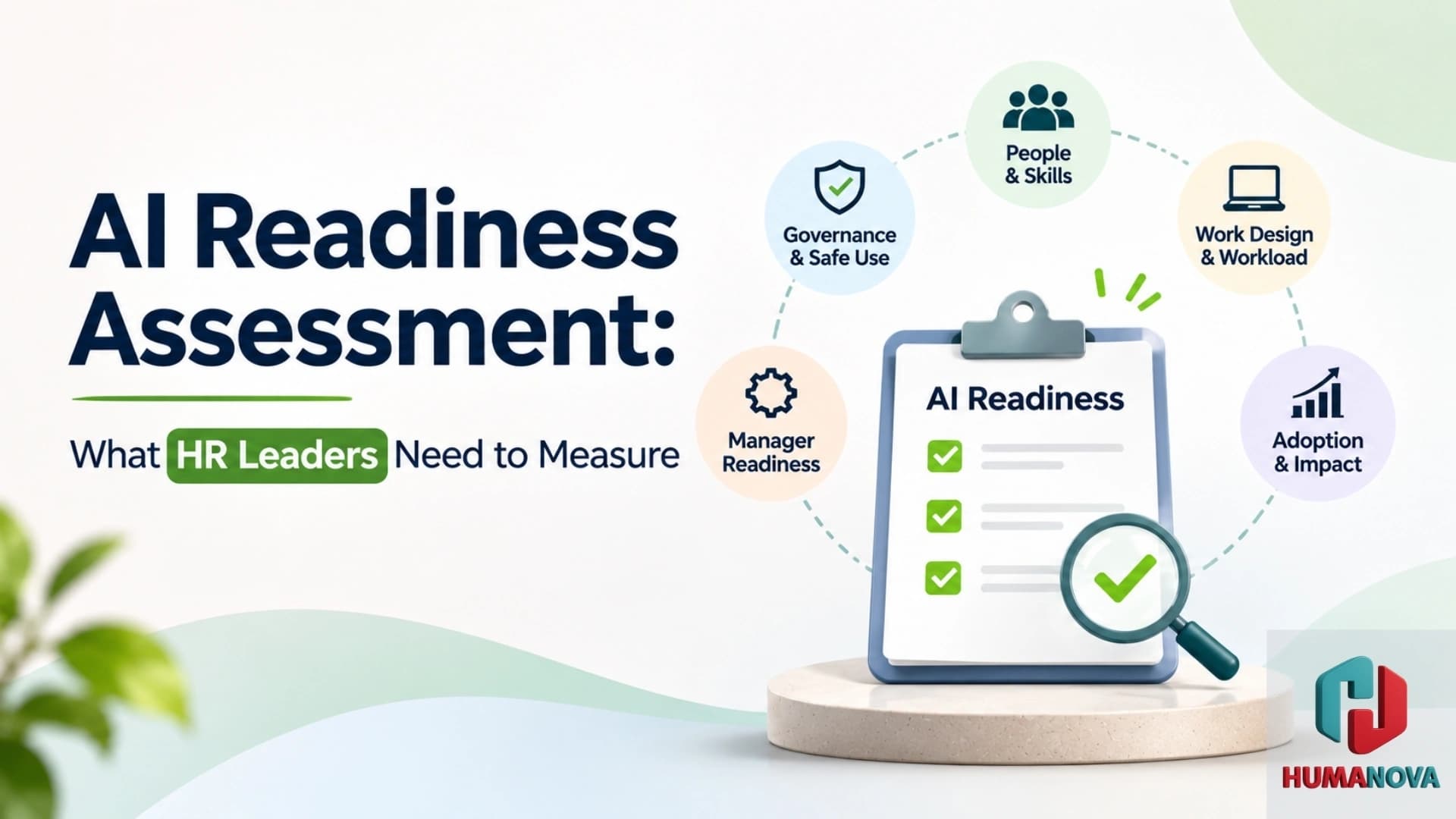
An AI readiness assessment helps HR understand whether employees, managers and the organisation are prepared to use AI safely, confidently and productively. It looks beyond licences, logins and training attendance to examine work design, human judgment, governance, employee trust and the support people receive during change.
For HR leaders, this distinction matters. AI readiness is not a test of whether employees are enthusiastic enough. It is an assessment of whether the organisation has created the conditions in which people can use AI responsibly.
Why AI readiness matters now
India is investing heavily in AI literacy and workforce preparation.
The Government of India’s Skilling for AI Readiness, or SOAR, programme was introduced through the Skill India Digital Hub to build foundational AI awareness. It includes learning pathways for students, educators, professionals and other learners. The programme has also expanded towards workplace applications and sector-specific skills. Press Information Bureau: Integration of AI into the skill-development ecosystem
In September 2026, NIELIT and Intel India launched an Agentic AI Skilling Initiative. Its programmes cover AI agents, workflow automation, multi-agent systems and the design and governance of AI-enabled work. Press Information Bureau: Agentic AI skilling programmes
These initiatives show that AI readiness is becoming a workforce priority, not a specialist concern limited to technology teams.
Organisations face the same challenge at a smaller scale. Employees are being asked to learn new tools while meeting existing targets. Roles are changing before job descriptions catch up. Managers may be expected to lead AI adoption without clear policies or enough practical experience.
At the same time, employees may have reasonable concerns about accuracy, privacy, workload, performance expectations and job security.
Training has an important role, but training alone cannot resolve these issues. Readiness also depends on whether work has been redesigned, managers can provide useful guidance, employees understand the rules and the organisation is willing to listen when a tool creates problems.
That makes AI readiness relevant to retention, engagement, leadership effectiveness, productivity and employee trust.
Understanding the difference between AI adoption and AI readiness
AI adoption tells you whether people have started using the technology.
AI readiness tells you whether they can use it appropriately within real work.
Adoption measures may include:
- licences assigned;
- accounts activated;
- training completed;
- prompts submitted;
- features used; and
- frequency of use.
These figures can help an implementation team understand reach. They do not show whether employees are using AI safely, checking its work or gaining meaningful value.
A ready workforce needs more than access. Employees need enough knowledge to recognise an unsuitable use case, protect confidential information, question an output and take responsibility for the final result.
The organisation must also be ready. It needs clear policies, relevant learning, capable managers, workable processes and trusted channels through which employees can raise concerns.
This distinction prevents HR from placing the full burden of change on individuals. An employee may appear hesitant because the approved use cases are unclear. Low use may reflect poor workflow integration rather than a lack of motivation. Heavy use may indicate confidence, but it may also hide unsafe practices.
AI-related worry is not the same as a clinical mental health condition. Nor can a readiness survey determine whether an employee is burned out. Responses about pressure, confidence or workload should be treated as prompts for further conversation and organisational review.
AI readiness assessment: Eight areas HR should measure
A useful assessment combines employee feedback, manager input, practical exercises and workflow evidence. It should not rely on one self-reported score.
1. Understanding of approved AI use
Employees need to know which tools are approved, which tasks are suitable and which information must not be entered.
Measure whether people can answer practical questions:
- Can I use AI with client information?
- Do I need to disclose that AI helped create this work?
- Who is accountable for the final output?
- When is human approval compulsory?
- How should I report an error or concern?
A policy may exist without being understood. Ask employees to respond to realistic scenarios instead of only confirming that they have read a document.
2. Role-specific AI capability
General AI awareness is a starting point. Workplace readiness depends on whether people can apply AI within their actual role.
A finance employee may need to verify calculations and data sources. A recruiter may need to recognise bias and protect applicant information. A customer-service employee may need to know when a case requires human escalation.
Assess performance through role-relevant tasks, supervised practice and examples of completed work. Training attendance is evidence of participation, not competence.
3. Critical thinking and human judgment
Employees must be able to assess whether an AI output is accurate, relevant and appropriate.
Microsoft’s 2026 India Work Trend Index found that Indian AI users placed strong emphasis on quality control and critical thinking. It also reported that many users viewed AI output as a starting point rather than a final answer. Microsoft India Work Trend Index 2026
Measure whether employees can:
- identify unsupported claims;
- check important facts and calculations;
- notice missing context;
- recognise a biased or unsuitable recommendation;
- explain why they accepted or rejected an output; and
- override the system when professional judgment requires it.
This is better assessed through realistic exercises than multiple-choice questions.
4. Workflow and job-design readiness
A tool can be easy to use and still be poorly integrated into the work.
Map where AI enters the workflow, what it changes and where responsibility sits. Identify whether it removes work, shifts work to another team or introduces new review tasks.
Questions should include:
- Has the process become clearer or more complicated?
- Is time genuinely being saved?
- Who checks AI-generated work?
- Have hand-offs increased?
- Are employees doing more correction and documentation?
- Are performance targets based on realistic experience?
CIPD research on responsible AI adoption recommends examining AI through a job-design lens and involving employees in how work is changed. CIPD guidance on responsible AI adoption
5. Manager readiness
Employees often judge an organisational change through the quality of their manager’s response.
Assess whether managers can explain approved use, discuss role changes, coach employees through early mistakes and escalate concerns. Managers should also understand what they cannot promise.
A manager does not need to be a technical expert. They do need consistent guidance and enough practical knowledge to respond to common questions.
Useful measures include manager confidence, completion of scenario-based learning, quality of team conversations and the number and type of questions managers escalate.
What organisations often get wrong
Measuring completion instead of capability
A learning-management system can show who finished a course. It cannot establish whether they can handle a difficult, ambiguous or high-risk situation.
Use practice tasks, observation and work samples to assess applied capability.
Treating low adoption as employee resistance
Low use can result from poor access, unclear policies, weak relevance or lack of manager support.
Before labelling employees resistant, examine the conditions around them.
Transform your workforce wellbeing today
Interested in learning how Humanova can elevate your team's wellness and HR metrics? Connect with our team for a personalized walkthrough.
Assuming frequent users are ready
A confident user may still share inappropriate data or accept inaccurate outputs. Frequency and readiness are different measures.
Look at quality, judgment and responsible behaviour alongside use.
Running one assessment for every role
The risks faced by a sales employee differ from those faced by someone in finance, HR, legal or software development.
Start with a common foundation, then assess role-specific use cases and responsibilities.
Collecting employee data without clear safeguards
An assessment can undermine trust if employees do not know who will see the results or how the information will be used.
Explain the purpose, access rules and retention period. Use aggregated reporting where individual identification is unnecessary. Do not quietly turn readiness data into performance monitoring.
What HR leaders and managers can do now
1. Establish a baseline before expanding access
Assess current knowledge, confidence, approved-tool awareness, manager capability and workflow readiness before a large rollout.
Segment the findings by function or role where privacy thresholds allow. The goal is to find common needs, not rank individuals.
2. Pilot assessments with real work
Choose a contained process and observe how employees use AI within it.
Document the original workflow, introduce the tool, then review output quality, time saved, correction work, employee confidence and workload. Ask employees what changed that leaders may not have anticipated.
A small pilot provides better evidence than an organisation-wide opinion survey about a tool people have barely used.
3. Combine self-reporting with demonstrated capability
People may overestimate or underestimate their readiness.
Combine confidential surveys with scenario exercises, manager discussions and quality reviews. For example, ask an employee to identify errors in an AI-generated response and explain how they would verify it.
4. Give managers their own readiness pathway
Managers need help translating organisation-wide policy into team-level practice.
Provide scripts for common conversations, examples of approved and prohibited use, escalation routes and guidance on reviewing workloads. Give them a place to raise questions before they are expected to answer employees.
5. Connect assessment findings to action
Do not assess readiness unless the organisation is prepared to respond.
If employees understand AI but lack time to practise, revise workloads. If managers are inconsistent, provide coaching. If people distrust data collection, clarify privacy controls. If a workflow produces excessive rework, redesign it before expanding the tool.
Repeat the assessment after meaningful action, not simply on a fixed calendar.
The role of technology
A workplace platform can make readiness support more accessible by bringing together learning resources, coaching, voluntary check-ins, anonymous feedback and manager guidance.
It can also help HR identify aggregated themes. For example, one function may report strong technical confidence but poor role clarity. Another may understand the policy yet struggle with workload after implementation.
Technology should support these conversations, not decide whether an employee is ready.
Privacy, consent and access controls matter. Employees should understand what HR can see, what managers can see and whether their responses are confidential. Individual wellbeing information should not be repurposed for performance decisions.
A platform must not become a surveillance tool. It cannot replace safe workloads, clear roles, supportive managers, professional care or fair organisational policies.
How Humanova supports a connected approach
Humanova can help organisations connect AI-readiness learning with employee feedback, confidential wellbeing support, coaching, manager development and privacy-conscious workforce insight.
An employee adapting to an AI-enabled role may need practical learning as well as a confidential support route. A manager may need help responding to uncertainty or redesigning team routines. HR may need to see recurring themes around confidence, workload or access without exposing individual employee information.
A connected approach makes it easier to respond to the whole experience of change. Humanova does not replace HR, responsible managers, qualified counsellors, psychologists, healthcare providers or an existing EAP. It helps make relevant support and insight easier to access.
How to measure whether AI readiness is improving
Track progress across four levels.
Capability measures may include demonstrated use of approved tools, output-verification skills, policy understanding and role-specific competence.
Organisational measures may include workflow clarity, manager capability, access to learning, governance maturity and the availability of escalation routes.
Employee-experience measures may include trust, confidence, psychological safety, learning accessibility and reported workload effects.
Business measures may include work quality, rework, error rates, cycle times, customer outcomes and the responsible completion of selected use cases.
Review patterns together. Faster completion is not a clear success if errors rise. High participation is not enough if employees remain unsure how to challenge AI. Increased usage may not be positive if employees feel pressured to use a tool where it adds little value.
Absence, engagement and attrition trends can provide context, but they should be interpreted carefully. None proves that an AI initiative caused a particular outcome.
FAQs
1. What is an AI readiness assessment?
An AI readiness assessment examines whether employees, managers and the organisation can use AI safely and effectively. It typically covers AI literacy, role-specific capability, human judgment, policies, work design, manager support, employee trust, workload and access to learning. It should identify support needs and organisational barriers, not simply produce a score or label employees.
2. How is AI readiness different from AI adoption?
AI adoption shows whether people have access to and use an AI tool. AI readiness examines whether they understand when and how to use it, can verify its output and receive appropriate organisational support. A company may have high adoption but low readiness if employees use AI frequently without clear rules, reliable checking or suitable manager guidance.
3. What should HR measure before AI training?
Before training, HR should assess employees’ current knowledge, role-specific use cases, confidence, understanding of data rules and ability to evaluate AI output. HR should also examine manager readiness, workload, learning access and workflow clarity. This baseline helps the organisation design learning around actual needs instead of providing the same generic course to everyone.
4. Can training attendance prove AI readiness?
No. Attendance shows that an employee joined or completed an activity. It does not show whether they can apply the learning, identify unreliable output or make a sound decision in a real workplace situation. Readiness should include practical exercises, work-based evidence, feedback and observation, with assessment designed around the employee’s role and level of responsibility.
5. Should AI readiness scores be used in performance reviews?
Readiness assessments are generally more useful for identifying learning and organisational needs than judging individual performance. Using confidential or self-reported results for performance decisions may reduce honesty and trust. If capability becomes a formal job requirement, the organisation should define expectations clearly, provide fair access to learning and use transparent, job-relevant assessment methods.
6. How often should an organisation assess AI readiness?
Assess before a major rollout, during a controlled pilot and after employees have had enough time to use the technology in real work. Review again when tools, policies or roles change significantly. The right frequency depends on the pace of change, but constant surveying can create fatigue. Each assessment should have a clear purpose and lead to visible action.
7. How can SMEs assess AI readiness with limited HR resources?
Start with one important workflow rather than assessing the entire organisation. Interview the employees and manager involved, map the tasks, review relevant policies and use a short practical exercise. Track output quality, time, correction work and employee feedback. This focused approach can reveal useful gaps without requiring a complex assessment platform or a large HR team.
8. Does AI readiness include employee wellbeing?
Yes, because readiness depends partly on whether people have the time, clarity and support needed to adapt. HR should review workload, role expectations, psychological safety and access to confidential support. Wellbeing information should remain voluntary and privacy-conscious. It should inform better work design and support, not be used to diagnose employees or identify supposed resistance.
Featured snippet
An AI readiness assessment should measure employee knowledge, role-specific capability, critical thinking, manager support, work design, governance, trust, workload and access to learning. HR should combine confidential feedback with practical exercises and workflow evidence, then use the findings to improve training, policies, management practices and employee support.
Conclusion
Moving from adoption to readiness changes what HR measures.
Licences, logins and course completion remain useful operational data. They do not show whether employees can use AI well, whether managers are prepared or whether the organisation has designed safe and manageable work.
A responsible AI readiness assessment looks at capability and context together. Employees are more likely to thrive when support is easy to access, leaders listen responsibly, managers are equipped, avoidable sources of pressure are addressed and wellbeing is treated as part of how work is designed.
Explore how Humanova can help your organisation make employee wellbeing, coaching, feedback, and workforce insight easier to access.