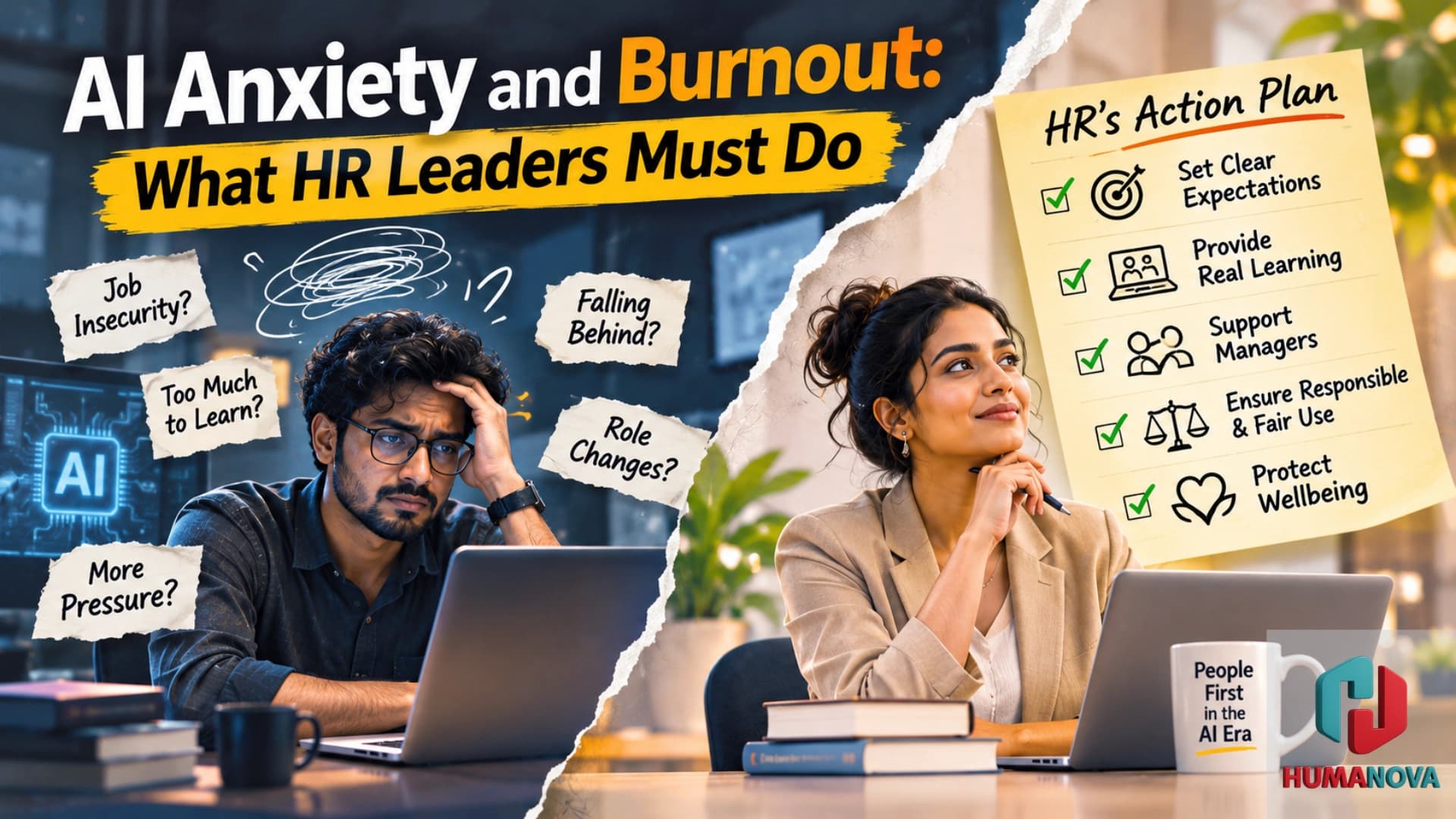
An employee is told that AI will make their work faster. A new tool arrives, followed by a short demonstration and ambitious productivity targets.
The employee now has to learn the system while meeting existing deadlines. They are expected to use AI, but they are not sure which data can be entered or how thoroughly its output must be checked. They wonder whether becoming more efficient will eventually make part of their role unnecessary.
They do not raise these concerns. Everyone else appears enthusiastic.
This is how AI anxiety and burnout can remain hidden until engagement falls, mistakes increase or people start leaving.
Recent reporting has described intense pressure even inside organisations developing advanced AI. Employees and leaders have spoken about the pace of competition, demanding work and the ethical weight of building systems whose wider effects remain uncertain. The Atlantic’s reporting on leading AI organisations
Those accounts should not be treated as proof that everyone working with AI is in distress. They do show that technical confidence does not make employees immune to workload pressure, moral conflict or uncertainty.
The risk also extends beyond AI companies. Employees in finance, technology, healthcare, professional services, customer support, manufacturing and other sectors may face a combination of job insecurity, rapid learning demands, unclear rules and pressure to produce more.
Employers cannot address this through an annual survey, an occasional wellness session or a reminder to “embrace change.” Workplace wellbeing is shaped by the system of work: what people are expected to do, the resources available to them, how managers respond and whether employees feel safe raising concerns.
Why AI anxiety and burnout matter now
AI adoption is happening during a period of wider organisational pressure.
Many businesses are changing roles, reducing costs, restructuring teams and asking employees to adapt quickly. Hybrid work can make strain less visible. Managers may also be learning the technology at the same time as the people they supervise.
Microsoft’s 2026 Work Trend Index described a tension between pressure to adopt AI and the organisational conditions employees need to redesign their work. In its international study of AI users, 65% said they feared falling behind if they did not adapt quickly, while only 13% said they were rewarded for reinventing work when immediate results were uncertain. Microsoft Work Trend Index 2026
This matters for Indian employers because AI adoption is moving across sectors and levels of seniority. Employees may believe that they must become proficient immediately, even when training, policies and role expectations remain unclear.
Some employees worry about job replacement. Others fear that their skills will become less valuable or that younger, more technically confident colleagues will move ahead. People may also feel pressure to use AI for tasks where they have doubts about accuracy, fairness or confidentiality.
Gallup’s September 2026 research found that greater AI-related job anxiety was associated with lower engagement and job satisfaction, as well as higher reported burnout and intention to look for another job. It also found that supportive management could reduce displacement concerns. Gallup research on AI-related job anxiety
For HR leaders, this makes AI anxiety relevant to retention, manager capability, workforce readiness and employee trust. It is not simply an emotional reaction that employees should manage on their own.
Understanding AI anxiety and burnout
AI anxiety is a broad term for worry or unease connected with artificial intelligence.
At work, it may involve concerns about:
- losing a job or important responsibilities;
- falling behind colleagues;
- being unable to learn quickly enough;
- making a mistake with an unfamiliar tool;
- being monitored or evaluated by an algorithm;
- losing professional judgment or valued skills;
- using AI in a way that conflicts with personal or professional ethics; or
- being held accountable for an output the employee cannot fully explain.
These concerns do not automatically indicate a mental health condition. Some are reasonable responses to genuine uncertainty or poorly managed change.
Burnout also needs to be discussed carefully. The World Health Organization classifies burnout as an occupational phenomenon, not a medical condition. It describes burnout as resulting from chronic workplace stress that has not been successfully managed, with dimensions involving exhaustion, greater mental distance or cynicism towards work, and reduced professional efficacy. WHO definition of burnout
An HR dashboard cannot determine that an individual is burned out. Nor should managers try to diagnose employees.
What organisations can do is identify workplace conditions that may increase strain. These include excessive workload, unclear priorities, low job control, poor management support, job insecurity, inadequate training and a lack of safe routes for raising concerns.
AI may contribute to those conditions, but it is rarely the only factor.
How AI can create different forms of workplace pressure
Pressure to keep up
AI tools change quickly. Employees may finish one course only to hear that a new model, feature or workflow has replaced what they learned.
If leaders communicate every development as urgent, employees may feel they are permanently behind.
This is especially difficult when learning has to happen outside normal working hours or alongside unchanged targets.
Pressure to produce more
AI may shorten part of a task without removing the need for human review, correction and accountability.
An employee might draft a report faster but spend additional time verifying facts. A recruiter may review more applications but carry greater responsibility for checking bias. A customer-service employee may handle more cases while managing complicated exceptions.
When leaders count the visible time saved but ignore the new checking work, productivity expectations can become unrealistic.
Job and skill insecurity
Employees may wonder whether using AI well will strengthen their position or help automate their role.
They may also fear losing the tasks through which they developed expertise. If junior employees no longer complete foundational work, they may have fewer opportunities to build the judgment required for more senior responsibilities.
Vague reassurances rarely solve this. Employees need honest information about how work is likely to change and how the organisation will support skill development.
Ethical strain
Some employees face difficult questions about bias, misinformation, privacy, intellectual property or the wider consequences of an AI-enabled decision.
Ethical concern is not evidence that an employee is resistant to innovation. It may reflect professional responsibility.
Problems arise when employees are expected to resolve these questions alone or feel unsafe challenging a business decision.
Continuous monitoring and reduced autonomy
AI can support planning and decision-making. It can also make more intensive workplace monitoring possible.
The International Labour Organization has warned that AI-enabled surveillance, work intensification, reduced autonomy and concerns about data use can create psychosocial risks. ILO analysis of AI and workplace psychosocial risks
When employees feel constantly observed, they may focus on appearing busy rather than doing thoughtful work.
What organisations often get wrong
1. Treating anxiety as a communication problem
More communication is not always the answer.
If workloads are excessive or job changes remain undefined, a polished presentation about the benefits of AI will not resolve the underlying problem. Communication must be paired with decisions about priorities, staffing, learning time and role design.
2. Promising that nobody’s job will change
Leaders may want to reassure employees. Promises that AI will not affect jobs can damage trust if the organisation cannot guarantee them.
A better approach is to explain what is known, what remains undecided and what principles will guide workforce decisions.
Employees can cope with uncertainty more effectively when leaders are honest and provide meaningful support.
3. Offering training without learning time
An extensive training catalogue is of little use if employees are expected to learn during evenings or between urgent tasks.
Learning time should be treated as work. Managers may need to adjust deadlines or reduce other commitments while employees build capability.
4. Raising targets before reviewing the workflow
Do not assume that a task completed faster means the employee has spare capacity.
Review preparation, prompting, verification, correction, documentation and exception handling. AI can remove one step while adding work elsewhere.
5. Expecting managers to provide mental health care
Managers should know how to listen, respond appropriately and direct employees to support. They should not diagnose, counsel or carry sensitive concerns alone.
They also need support for their own workload. A manager who is overwhelmed by implementation demands will struggle to create psychological safety for the team.
6. Using employee listening as surveillance
Monitoring messages, analysing individual sentiment or inferring wellbeing from behaviour can undermine trust.
Employees should have confidential, voluntary ways to share their experience. Aggregated data may help HR notice themes, but it should not be used to label individuals as anxious, disengaged or resistant.
What HR leaders and managers can do now
1. Listen before deciding what employees need
Use confidential pulse surveys, small-group discussions and voluntary check-ins to understand the sources of pressure.
Transform your workforce wellbeing today
Interested in learning how Humanova can elevate your team's wellness and HR metrics? Connect with our team for a personalized walkthrough.
Ask specific questions:
- Are AI expectations clear?
- Do employees know which tools and use cases are approved?
- Is enough time available for learning?
- Has AI reduced or increased workload?
- Do people feel safe questioning an AI-generated answer?
- Are employees worried about role or skill changes?
- Can they access confidential support easily?
Tell employees who will see the information and what action may follow.
Listening should lead to visible decisions. If employees repeatedly raise workload concerns and nothing changes, another survey will not build trust.
2. Review the complete workload
Map work before and after AI implementation.
Include time spent checking output, correcting errors, documenting decisions, learning new processes and helping colleagues. Review whether meeting demands, staffing or productivity targets have changed at the same time.
If AI creates capacity, decide deliberately how that capacity will be used. Filling every saved minute with additional tasks may increase work intensity and remove the recovery time people need.
3. Communicate honestly about jobs and skills
Employees need more than general statements about innovation.
Explain which tasks are changing, which human capabilities remain important and how performance will be assessed. If the long-term impact on roles is uncertain, say so.
Pair the message with specific commitments. These may include paid learning time, role-based training, internal mobility, coaching or advance notice of substantial job changes.
Do not make promises the organisation cannot keep.
4. Build practical AI readiness
Good AI-readiness training covers more than prompts.
Employees need to understand privacy, acceptable use, verification, bias, human accountability and escalation. They should practise with examples from their own work.
Managers should receive separate preparation. They need to answer questions, model responsible use, recognise when expectations are unrealistic and raise recurring issues with senior leaders.
AI readiness should increase employee confidence without implying that every task requires AI.
5. Create safe routes for ethical concerns
Employees should know where to raise questions about harmful, unfair or inappropriate AI use.
A clear process might include a manager, designated AI-governance contact, ethics committee, legal or risk team, and a confidential reporting route.
Employees should not face retaliation for raising a good-faith concern. The organisation should also explain what happens after an issue is reported.
This reduces the chance that employees carry ethical responsibility alone.
6. Make professional and confidential support accessible
Some employees will benefit from coaching, peer support or practical resources. Others may need help from a qualified mental health professional.
Make the available routes easy to find and explain confidentiality clearly. Support should be accessible to remote, frontline and distributed employees, not only people based near a head office.
Professional support matters, but it must accompany improvements to workload, management and work design.
The role of technology
A workplace wellbeing platform can make support, learning and feedback easier to access.
Useful capabilities may include:
- confidential one-to-one support;
- virtual coaching;
- group learning programmes;
- voluntary wellbeing check-ins;
- anonymous pulse surveys;
- self-reflection tools;
- manager resources;
- AI-readiness learning; and
- privacy-conscious, workforce-level insights.
These tools can help HR identify recurring themes. One function may be concerned about job security, while another is struggling with workload or unclear data rules.
The insight should lead to conversation and review. It should not be treated as proof of an individual problem.
Employees must understand what data is collected, whether participation is voluntary and who can access the results. Role-based access and minimum reporting thresholds can help protect confidentiality.
Technology should never become a surveillance tool or a substitute for human support, professional care, manageable work and responsible management.
How Humanova supports a more connected approach
Humanova can help organisations connect confidential wellbeing support, coaching, employee feedback, leadership development, AI-readiness learning and workforce insight in one place.
For example, an employee concerned about changing job expectations may need a private support route and access to practical learning. A manager may need guidance for a difficult conversation. HR may need aggregated insight into recurring concerns about workload or confidence without seeing an individual employee’s confidential information.
Connecting these elements can help organisations respond earlier and more consistently.
Humanova does not replace HR teams, responsible managers, qualified counsellors, psychologists, healthcare providers or an existing EAP. It supports the wider system through which employees find help, build capability and make their experience of change visible.
How to measure whether the approach is working
Use a combination of leading and longer-term measures.
Leading measures may include:
- employee understanding of the AI strategy;
- confidence in approved tools and use cases;
- perceived access to relevant training;
- manager confidence in supporting teams;
- psychological safety around questioning AI;
- employee trust in privacy safeguards;
- awareness and accessibility of professional support; and
- recurring feedback themes about workload or job security.
Programme measures may include participation in learning, coaching or group sessions. Interpret participation carefully. Low use may reflect low need, but it can also indicate poor awareness, access barriers or concerns about confidentiality.
Organisational patterns may include engagement, absence, internal mobility and attrition. These should be viewed alongside wider business and labour-market conditions.
Do not claim that one metric proves AI has caused burnout. Look for repeated themes across data, conversations and workflow reviews.
Deloitte’s 2026 Human Capital Trends research found that many workers said their organisations rarely evaluated AI’s effect on people. Its analysis argues that unanswered questions about fairness, accountability and job value can create cultural strain. Deloitte: AI and cultural debt
Measurement is only useful when the organisation is prepared to respond.
FAQs
1. What is AI anxiety at work?
AI anxiety is worry or unease related to the use and effect of artificial intelligence in the workplace. It may involve job security, changing skills, privacy, monitoring, ethical concerns or pressure to keep up. AI anxiety is not itself a clinical diagnosis. HR should examine both the employee’s concerns and the working conditions that may be contributing to them.
2. Can AI cause employee burnout?
AI alone does not establish that an employee is burned out. However, poorly managed implementation can contribute to chronic workplace stress through heavier workloads, unclear expectations, reduced autonomy and continuous learning pressure. Organisations should review how AI changes the entire workflow and address avoidable stressors. Burnout should not be inferred from a dashboard or a few behavioural signals.
3. What are common signs of AI-related workplace stress?
Employees may report feeling overwhelmed, unclear about expectations, worried about job security or reluctant to use a tool. Managers might also notice reduced engagement, repeated requests for reassurance, more errors or difficulty switching off. These observations are not a diagnosis. They are reasons to start a supportive conversation and review workload, role clarity and available resources.
4. How can HR reduce workplace AI anxiety?
HR can communicate honestly, provide role-relevant learning, give employees time to practise and create confidential feedback routes. It should also review workload, job design and manager capability. Reassurance works best when it is supported by clear policies and visible investment in employees. HR should not promise that roles will never change if the organisation cannot guarantee that outcome.
5. How should managers discuss AI-related job fears?
Managers should listen without dismissing the concern or making unsupported promises. They can explain what is known, clarify immediate expectations and discuss relevant development opportunities. If the employee raises a sensitive wellbeing concern, the manager should direct them towards appropriate confidential or professional support. Recurring concerns should be escalated so the organisation can review its communication and workforce plans.
6. What is ethical anxiety about AI?
Ethical anxiety can arise when employees worry that an AI system or use case may be unfair, harmful, misleading or inconsistent with professional values. Organisations should give employees clear standards and safe escalation routes. Ethical questions should not be left to individuals to resolve alone, especially when business pressure may conflict with responsible practice.
7. Can employee wellbeing technology detect burnout?
Workplace technology should not claim to diagnose burnout or a mental health condition. Voluntary check-ins and aggregated feedback may reveal patterns such as rising workload concerns or falling role clarity. HR can use those signals to investigate working conditions and improve support. Individual information should remain confidential and should not be repurposed for performance management.
8. What should smaller Indian businesses do about AI stress?
Start with the basics: define approved AI use, explain how roles may change, give employees learning time and review workloads after implementation. Train managers to hold supportive conversations and provide a confidential route for concerns. A smaller company may not need a complex programme, but it still needs clear expectations, fair decisions and access to appropriate professional help.
Featured snippet
AI anxiety and burnout risks increase when employees face unclear job changes, pressure to learn quickly, heavier workloads or unresolved ethical concerns. HR can reduce these risks through honest communication, safe workloads, role-based training, supportive managers, confidential feedback and accessible professional support, not through technology or resilience programmes alone.
Conclusion
AI anxiety and burnout should not be dismissed as resistance to change.
Employees may be responding to real uncertainty about their skills, workload, job security or professional responsibilities. Organisations should take those concerns seriously without assuming that every worried employee has a mental health condition.
Employees are more likely to thrive when support is easy to access, leaders listen responsibly, managers are equipped, avoidable sources of stress are addressed and wellbeing is treated as part of how work is designed.
Explore how Humanova can help your organisation make employee wellbeing, coaching, feedback, and workforce insight easier to access.