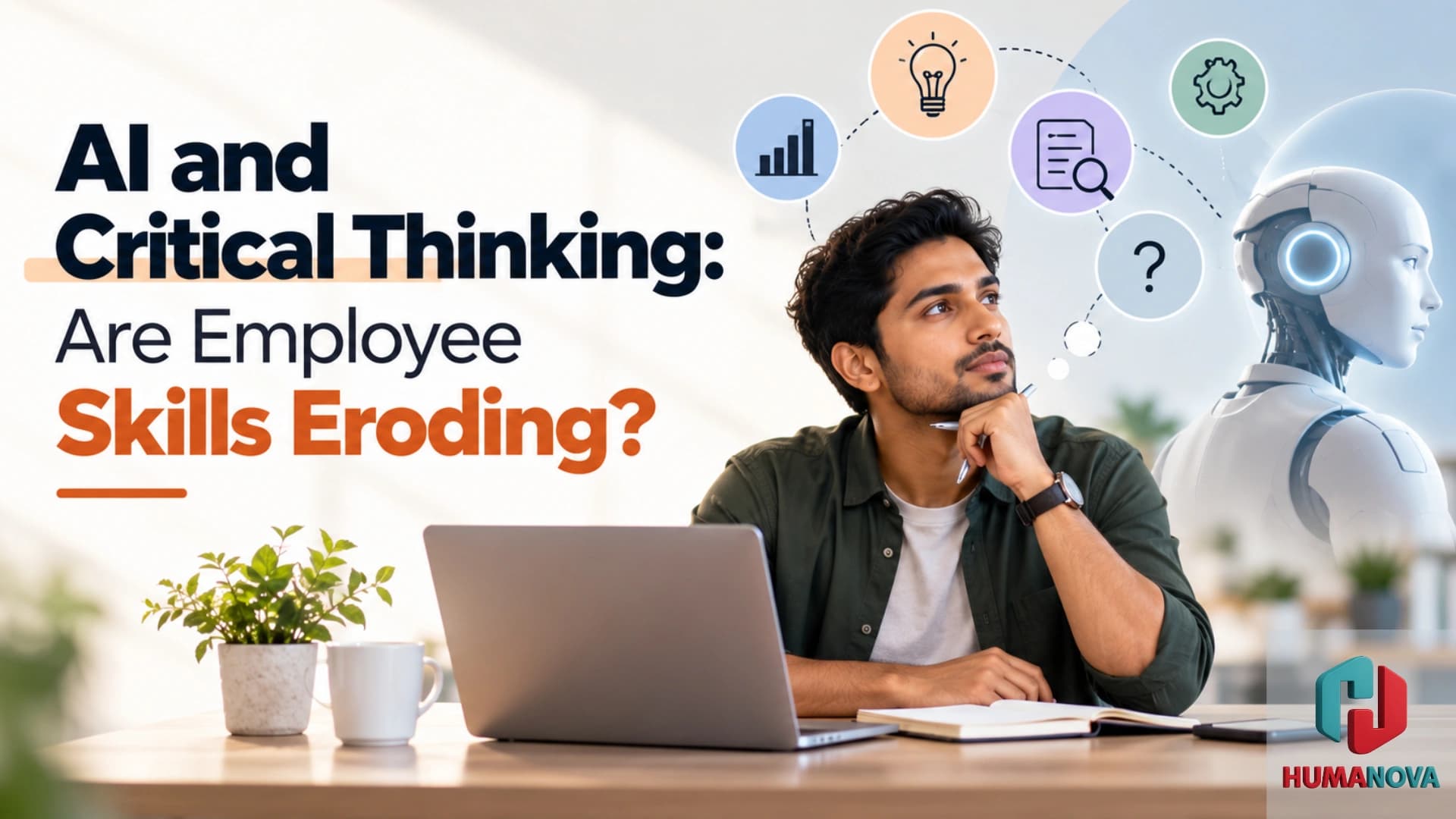
An employee receives a complex brief on Monday morning. Instead of reviewing the background, identifying the central problem and forming an initial view, they paste the brief into an AI tool.
Within seconds, the tool produces a confident, well-structured response.
The employee edits a few sentences and sends it to their manager. The work is completed faster, but important questions remain. Were the assumptions correct? Were the sources reliable? Did the recommendation reflect the organisation’s actual circumstances? Could the employee explain why one option was better than another?
This is the emerging challenge around AI and critical thinking. The concern is not simply that employees are using AI. It is that some may gradually stop practising the reasoning skills they need to question, verify and improve AI-generated work.
IBM’s 2026 CHRO study found that 60% of employees surveyed were concerned that AI was eroding their skills, with critical thinking the capability most often identified as declining. However, this finding describes employee concern and self-reported experience. It does not prove that AI inevitably causes skill loss. IBM’s global research points to a risk that organisations need to examine, not a predetermined outcome.
Annual engagement surveys, occasional AI workshops and wellness events will not resolve this issue on their own. Organisations need to look at how work is designed, what employees are expected to verify, how managers evaluate good judgment and whether people have enough time and psychological safety to challenge an AI-generated answer.
The central question for HR is not, “Are employees using AI?” It is, “Are employees still thinking well when they use it?”
Why AI and critical thinking matter now
AI is becoming part of everyday work. Employees use it to draft emails, analyse information, summarise meetings, prepare presentations, generate code and develop recommendations.
At the same time, many organisations are asking teams to work faster, manage organisational change and meet demanding targets. When speed becomes the main measure of success, employees may feel pressure to accept AI-generated work without sufficient review.
This creates several connected risks.
First, a polished answer can create an illusion of quality. Generative AI can produce clear and convincing language even when the underlying reasoning is incomplete, inaccurate or inappropriate for the situation.
Second, employees may receive fewer opportunities to practise foundational skills. A junior analyst who always asks AI to interpret data may struggle to develop the pattern recognition needed to notice unusual results. A new manager who delegates difficult messages to AI may miss opportunities to learn how tone, context and trust affect communication.
Third, employees can become accountable for decisions they do not fully understand. Telling people to “check the output” is not enough if they lack subject knowledge, review time or clear standards for deciding what good work looks like.
Research involving 319 knowledge workers found that greater confidence in generative AI was associated with less self-reported critical-thinking effort, while greater confidence in one’s own ability was associated with more. The researchers also found that AI did not simply eliminate critical thinking: it shifted it towards verification, integration and oversight. As this was a survey-based study, it identifies patterns and associations rather than proving that AI caused a decline in capability. Microsoft Research
For Indian employers, this issue affects more than productivity. It influences workforce readiness, leadership capability, service quality, employee confidence and trust.
Teams may also have very different levels of AI access and experience. A technology employee in Bengaluru may use several AI tools every day, while a frontline manager elsewhere may have limited exposure or no approved tool. An effective HR AI strategy must account for these differences instead of assuming that the workforce is moving at one speed.
Understanding the risk of AI skill erosion
Using a tool to reduce mental effort is not automatically harmful.
People have always relied on calculators, search engines, templates, spellcheckers and shared knowledge. These tools can free up attention for higher-value work. AI can do the same when employees use the time saved to investigate, compare options, solve harder problems or speak with customers and colleagues.
The risk appears when AI replaces thinking that employees still need to practise.
Critical thinking at work includes the ability to:
- Define the real problem before seeking an answer.
- Separate evidence from assumption.
- assess whether a source is credible and current.
- Recognise missing information and uncertainty.
- Compare alternatives and trade-offs.
- Consider who could be affected by a decision.
- Explain the reasoning behind a recommendation.
- Change course when new evidence emerges.
- Know when specialist or senior review is required.
These abilities are specific to a role and situation. Reviewing AI-generated code requires different knowledge from reviewing a recruitment recommendation, financial forecast or employee communication.
This is why general instructions such as “use your judgment” are inadequate. Employees need to know what judgment means in their work.
There is also an important distinction between skill loss and workplace anxiety. An employee who worries about falling behind may not have lost capability. They may be responding to unclear expectations, limited training, job-security concerns or pressure to adopt unfamiliar technology quickly.
AI-related stress is not, by itself, a clinical mental health condition. It can nevertheless affect confidence, engagement and willingness to learn. HR should respond through clear communication, practical support and responsible work design, not by attempting to diagnose employees from survey responses or system data.
Aggregated workforce patterns can help identify where people need more clarity or support. They should be treated as prompts for investigation and conversation, not proof that a particular individual lacks capability.
What organisations often get wrong
1. Equating faster output with better performance
If teams are rewarded primarily for speed and volume, employees learn that careful verification is an obstacle.
AI may allow someone to create ten reports instead of five. But the increase means little if managers must correct more errors, recommendations become generic or teams cannot defend their conclusions.
Productivity measures should include quality, relevance and accountability, not output alone.
2. Teaching prompting without teaching evaluation
Prompting can be useful, but a well-written prompt does not guarantee a reliable result.
Employees also need to test assumptions, check claims, review sources and identify situations where AI should not be used. The CIPD’s AI skills-planning guidance places human verification and critical evaluation at the centre of responsible AI capability.
Training that ends with “how to get a better answer” is incomplete. Employees must also learn how to recognise a poor one.
3. Automating the work through which people learn
Some repetitive tasks can be automated safely. However, apparently routine work often helps less-experienced employees build knowledge.
A junior employee may learn how customer complaints develop by reading cases. An analyst may develop commercial judgment by manually investigating unusual results. A recruiter may learn to evaluate evidence by comparing applications closely.
If AI takes over these activities, organisations need to create another route for developing the underlying capability.
4. Demanding accountability without allowing review time
Employees cannot meaningfully validate AI outputs when workloads leave no time to do so.
If managers expect immediate responses, people may accept the first plausible output. If targets increase as soon as AI is introduced, the promised time saving disappears before employees can use it for deeper analysis.
Human accountability needs supporting conditions: manageable workloads, clear escalation routes, access to subject-matter expertise and permission to slow down when risk is high.
5. Monitoring tool use instead of assessing judgment
The number of prompts entered, time spent in an application or frequency of AI use does not reveal whether an employee is thinking critically.
Surveillance can also discourage experimentation and honest reporting. Employees may hide mistakes if they believe every interaction is being judged.
Assessment should focus on the quality of reasoning and decisions, not on intrusive monitoring of individual activity.
What HR leaders and managers can do now
1. Identify where human judgment is essential
Map AI use at task level rather than treating every job as one unit.
Transform your workforce wellbeing today
Interested in learning how Humanova can elevate your team's wellness and HR metrics? Connect with our team for a personalized walkthrough.
Ask teams:
- Which decisions could significantly affect employees, customers or the business?
- Where could an inaccurate answer create legal, financial, ethical or reputational harm?
- Which tasks require current or confidential information?
- Where must a person be able to explain the final decision?
- Which activities help employees develop future capability?
Use the answers to establish human review points. A low-risk first draft may need a quick check. A hiring, financial, safety or employee-relations decision may require documented reasoning and qualified approval.
2. Train people with realistic, imperfect outputs
AI readiness training should include more than demonstrations of what tools can do.
Give employees realistic AI-generated outputs containing subtle problems: a questionable source, an unsupported conclusion, an overlooked stakeholder or a recommendation that conflicts with company policy.
Ask participants to identify the errors, explain their concerns and improve the response. Include examples in local and industry-relevant contexts.
This approach tests whether people can apply judgment. Training attendance only confirms that someone joined a session; it does not show that they can validate an AI-assisted decision.
3. Preserve opportunities for independent thinking
Employees do not need to avoid AI altogether. They do need regular opportunities to form their own view.
For selected tasks, ask employees to define the problem or write an initial position before consulting AI. Teams can then compare the human and AI approaches, identify what each missed and produce a stronger final answer.
Organisations can also designate some learning exercises as “AI-free”. The purpose is not to punish tool use. It is to ensure that employees continue practising skills they may need when the tool is unavailable, unsuitable or wrong.
4. Equip managers to coach reasoning
Managers influence how employees use AI through the questions they ask.
Instead of only asking, “Is the work finished?”, managers can ask:
- What evidence supports this conclusion?
- Which assumptions did the AI make?
- What did you verify independently?
- What alternatives did you consider?
- Where is the greatest uncertainty?
- What would change your recommendation?
- Which part requires human approval?
Managers also need permission to protect review time and raise concerns about unrealistic workloads. If an employee finds an AI error, reporting it should be treated as responsible behaviour, not as failure.
Manager training should include supportive conversations about confidence and workload. It should not turn managers into counsellors or healthcare providers. The World Health Organization’s guidance recommends organisational action, manager training and worker support as connected parts of workplace mental health practice.
5. Listen without turning listening into surveillance
Use voluntary pulse surveys, facilitated discussions and confidential feedback channels to understand how employees experience AI-enabled work.
Useful questions include:
- Do you know when AI use is permitted?
- Do you have enough time to check AI-generated work?
- Do you feel confident challenging an AI output?
- Can you raise an error without being blamed?
- Which skills do you worry you are practising less?
- Where would additional training or coaching help?
- Has AI reduced work, or has it increased expectations?
Review results at an aggregated level. Explain what information is collected, who can see it and how it will be used.
Most importantly, act on recurring themes. If employees repeatedly report that deadlines prevent proper checking, another course on prompting will not solve the problem. Workload expectations need attention.
The role of technology
Technology can support critical thinking when it creates access to learning, reflection and human help.
A workplace platform might offer:
- Scenario-based AI-readiness learning.
- Self-reflection tools and capability assessments.
- Coaching and facilitated group programmes.
- Manager guides for conversations about AI confidence.
- Anonymous feedback and voluntary check-ins.
- Confidential access to wellbeing or professional support.
- Workforce-level insights into recurring learning and workload themes.
It should not attempt to determine that a specific employee is “losing critical-thinking ability” based on digital behaviour.
Privacy, consent and role-based access are essential. Employees should understand what they can see, what their manager can see and what HR receives in aggregated form. Sensitive support conversations should remain confidential within the appropriate professional and legal boundaries.
Employee wellbeing technology can make resources easier to reach, but it cannot compensate for excessive workloads, unclear roles, unfair policies or a culture in which people are afraid to question a decision.
How Humanova supports a connected approach
Humanova can help organisations bring AI-readiness learning, coaching, employee feedback, leadership development, confidential wellbeing support and workforce insights into a more connected experience.
For example, an employee may need practical exercises in validating AI outputs as well as a confidential route to discuss anxiety about changing role expectations. A manager may need guidance on reviewing AI-assisted work without micromanaging the employee. HR may need aggregated insight into whether teams lack training, clarity or enough time for quality control.
Connecting these forms of support can help organisations respond to the whole experience of technological change. Humanova does not replace HR, responsible managers, counsellors, psychologists, healthcare providers or an existing employee assistance programme. It can make relevant support and learning easier to find while keeping human responsibility at the centre.
How to measure whether the approach is working
Measure demonstrated capability, not simply AI activity.
Useful indicators include:
- Performance in realistic AI-output review exercises.
- Ability to identify unsupported claims and unreliable sources.
- Ability to explain the reasoning behind a recommendation.
- Appropriate escalation of uncertain or high-risk outputs.
- Quality and rework patterns in AI-assisted tasks.
- Employee confidence in using and challenging AI.
- Manager confidence in coaching AI-assisted work.
- Participation in learning and coaching programmes.
- Employee feedback on workload, trust and access to support.
- Recurring workforce themes identified through privacy-conscious listening.
Where possible, compare performance over time and across similar tasks. Avoid treating one assessment as a permanent label.
Absence, engagement and attrition trends may provide broader context, but they cannot establish that AI caused a change. Interpret them alongside workload, organisational restructuring, management quality, compensation, career opportunities and other workplace factors.
FAQs
1. Does AI reduce employees’ critical-thinking skills?
AI does not automatically reduce critical thinking. The risk increases when employees routinely accept outputs without defining the problem, checking evidence or considering alternatives. AI can also support stronger thinking by generating counterarguments, exposing assumptions and comparing options. The outcome depends on how work, training, incentives and review responsibilities are designed.
2. What does IBM’s 60% finding actually mean?
IBM reported that 60% of employees surveyed were concerned that AI was eroding their skills, with critical thinking cited most often. This reflects employee perceptions and concerns; it does not prove that 60% have objectively lost skills. HR should treat the result as a reason to investigate employee experience, work design and development, not as a diagnosis.
3. What is cognitive offloading?
Cognitive offloading means using an external tool to reduce the mental effort required for a task. Calendars, calculators and search engines all enable it. Offloading can be useful when it frees people to focus on higher-value work. It becomes a concern when employees stop practising knowledge or reasoning they still need to recognise errors and make responsible decisions.
4. Can AI strengthen critical thinking at work?
Yes. Employees can use AI to generate competing explanations, challenge a proposal, identify missing stakeholders or test a decision against different scenarios. However, the employee must retain ownership of the question, evidence and final judgment. Asking AI for more content is not the same as thinking more deeply.
5. How can HR assess critical thinking in AI-assisted work?
Use role-specific scenarios rather than relying only on attendance records or multiple-choice quizzes. Give employees an AI-generated response containing realistic weaknesses and ask them to review, correct and explain it. Assess problem definition, evidence checking, recognition of uncertainty, consideration of alternatives and appropriate escalation, not whether their answer matches one preferred phrase.
6. Should employees sometimes complete work without AI?
For selected learning and assessment activities, yes. Limited AI-free practice can help employees retain foundational knowledge and show what they can do independently. It should be purposeful and proportionate, not a blanket ban. Organisations should explain which capabilities the exercise protects and how those capabilities support safe, effective AI use.
7. What role do managers play in preventing AI skill erosion?
Managers set expectations about speed, quality and accountability. They can protect time for verification, ask employees to explain their reasoning and create safety for reporting AI errors. Managers also need training, realistic workloads and clear escalation routes. They should support employees and direct them to appropriate help without attempting to diagnose mental health conditions.
8. How can organisations protect skills without slowing productivity?
Apply stronger review requirements to higher-risk work while keeping low-risk processes simple. Preserve independent thinking at key stages, train employees with realistic examples and measure quality alongside speed. Effective validation may take time, but it can prevent rework and poor decisions. The goal is productive AI use with proportionate human oversight.
Featured snippet
AI can weaken critical-thinking practice when employees accept outputs without framing the problem, checking evidence or forming an independent view. It can also strengthen thinking when used to test assumptions and compare alternatives. The outcome depends on work design, training, review time and human accountability.
Conclusion
The concern about AI and critical thinking deserves attention, but it should not lead to panic or blanket restrictions.
AI does not make skill erosion inevitable. The greater risk is introducing powerful tools into a work system that rewards speed, removes learning opportunities and leaves employees responsible for outputs they lack the time or confidence to review.
Employees are more likely to thrive when organisations make support easy to access, listen responsibly, equip managers, preserve meaningful opportunities to think, address avoidable sources of stress and treat wellbeing as part of how work is designed.
“Explore how Humanova can help your organisation make employee wellbeing, coaching, feedback, and workforce insight easier to access.”