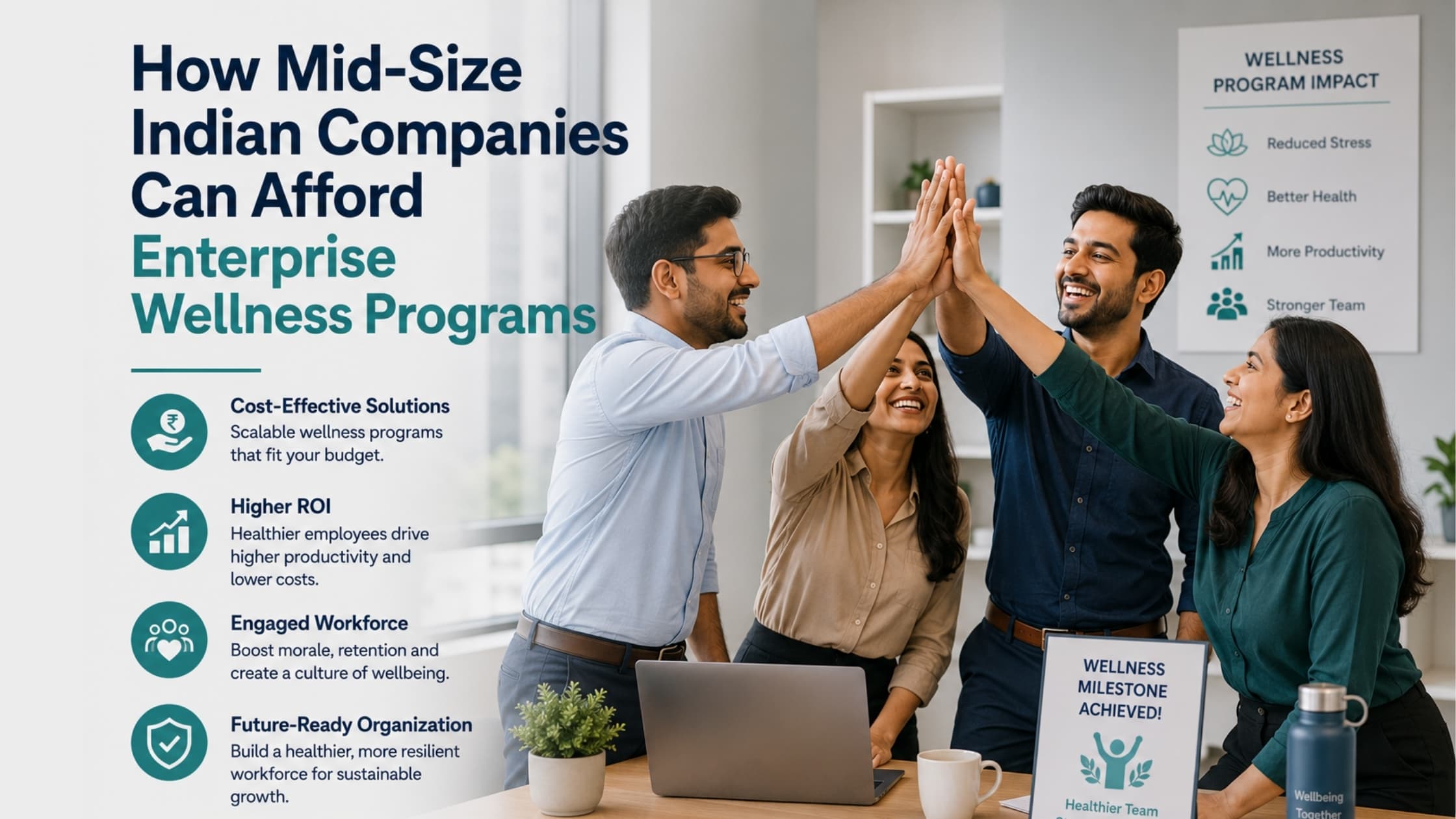
A practical guide to making enterprise-grade employee wellness affordable for 100–500 employee organizations in India.
What Is Affordable Corporate Wellness for SMEs?
Affordable corporate wellness for mid-size Indian companies refers to digitally delivered, modular employee health programs designed to fit SME budgets while still covering mental, physical, financial, social, and purposeful wellness pillars. The old assumption that wellness programs are an enterprise-only investment is outdated.
Digital delivery has changed the cost structure entirely. Where enterprise programs once depended on expensive in-person service delivery — onsite counselors, health camps, physical instructors — digital-first programs strip out most of that cost while maintaining, and often improving, outcome quality.
Why Mid-Size Companies Need This Now
Mid-size organizations carry real workforce health risk, but historically lacked the budget enterprises had to address it. Three shifts make this the right moment to act:
- Digital delivery has collapsed per-employee costs by removing in-person service overhead.
- Pooled purchasing through industry bodies is now giving SMEs access to enterprise-level pricing.
- SMEs see faster ROI than enterprises because a higher share of their workforce sits in revenue-facing roles.
The Real Cost: What Wellness Programs Actually Cost Today
The entry point for a structured digital wellness program in India today is approximately Rs 1,500 to Rs 2,500 per employee per year — Rs 10 to 15 lakh annually for a 500-person organization.
Compare that to the traditional enterprise wellness program cost of Rs 8,000 to Rs 15,000 per employee, which was driven almost entirely by in-person service delivery. Digital delivery removes most of that overhead.
Cost Comparison: Traditional vs Digital Wellness Delivery
Traditional enterprise model: heavy reliance on onsite counselors, physical health camps, and in-person instructors, pushing costs to Rs 8,000–15,000 per employee annually.
Modern digital model: app-based and remote delivery of the same pillars, bringing costs down to Rs 1,500–2,500 per employee annually, while pooled purchasing through industry associations can push this even lower.
How to Build a Wellness Program on an SME Budget
Step 1: Start with a modular design
Mid-size organizations do not need to launch all five wellness pillars simultaneously. A modular approach starts with the two or three pillars that address the most significant health risks in your specific workforce.
Transform your workforce wellbeing today
Interested in learning how Humanova can elevate your team's wellness and HR metrics? Connect with our team for a personalized walkthrough.
- Example: a 200-person IT company starts with mental wellness and physical wellness (highest need based on IT sector burnout data).
- Year two: add financial wellness.
- Year three: add social and purposeful wellness as culture infrastructure.
Each module adds incremental budget while building on the engagement and measurement infrastructure of the previous year.
Step 2: Explore pooled purchasing
Industry associations and employer networks are creating pooled wellness purchasing groups in India, allowing mid-size companies to access enterprise pricing through aggregated volumes. The CII, FICCI, and sector-specific associations are active in this space.
A 200-employee standalone company buying at 200-person pricing pays significantly more per head than the same company accessing a 2,000-person pooled contract through its industry association. Check with your sector association before negotiating individually with wellness vendors.
Step 3: Measure from day one
Build measurement into the program from launch rather than retrofitting it later, so that ROI can be tracked against absenteeism, productivity, and engagement from the very first quarter.
Benefits of an Affordable, Modular Wellness Program
- Lower upfront cost while retaining enterprise-grade program quality.
- Faster ROI than enterprises, since SMEs have a higher share of client-facing or revenue-generating roles — a 20-person sales team with even a 5% reduction in sick days has a more concentrated financial impact than the same improvement across a 2,000-person organization.
- Scalable design that grows with the company instead of requiring a large upfront commitment.
- Access to enterprise pricing through pooled purchasing without enterprise headcount.
What's Next: The Future of SME Wellness in India
As pooled purchasing groups mature and digital delivery becomes the default, the cost gap between SME and enterprise wellness programs will likely keep narrowing. Sector associations are expected to play a larger role in negotiating standardized, aggregated contracts on behalf of mid-size members, making it easier for smaller companies to access enterprise-grade pricing without enterprise headcount.
Conclusion
The affordability barrier to corporate wellness for mid-size Indian companies is largely a perception problem rather than a market reality. Start with a needs assessment, build a modular program against your specific health risks, explore pooled purchasing if available, and measure from day one. The ROI math works at 150 employees just as it does at 1,500.
FAQs
1. Is corporate wellness affordable for companies under 500 employees?
Yes. Digital-first programs now start at roughly Rs 1,500–2,500 per employee per year, far below the Rs 8,000–15,000 per employee cost of traditional in-person enterprise programs.
2. Do we need to launch all wellness pillars at once?
No. A modular approach lets you start with one or two pillars that match your workforce's biggest health risks, then add more pillars in later years.
3. How can pooled purchasing help our company?
Joining a pooled purchasing group through an industry association like CII or FICCI lets you access pricing closer to what a much larger organization would pay, since costs are based on aggregated volume.
4. Will an SME see ROI faster or slower than a large enterprise?
Often faster. SMEs typically have a higher proportion of employees in client-facing or revenue-generating roles, so improvements in absenteeism or productivity have a more concentrated financial impact.