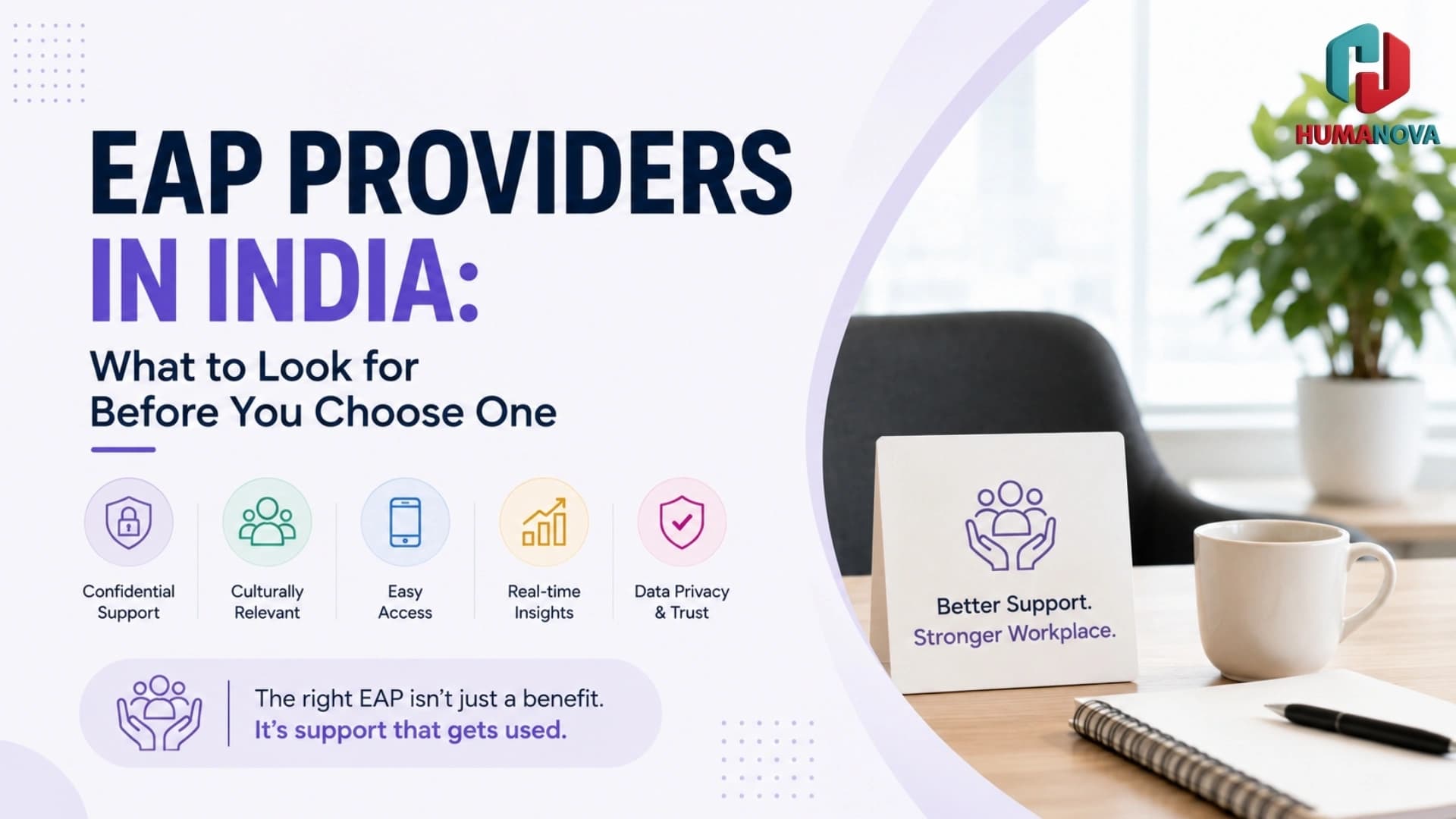
The different types of EAP providers in India tend to be large, global EAP providers that provide standardized EAP networks, regional EAP providers that understand the local language and cultural context, and platform-based providers that combine counselling with real-time engagement and wellbeing data. The best choice is not necessarily the one that is the largest, but it is the one that will be utilized by employees.
The Types of EAP Providers Operating in India
Global Counseling Networks
The providers would usually provide a limited amount of counseling via a call centre or app, usually as part of an international benefits package. They have strong clinical connections but are not necessarily geared to India and in many instances may not be aware of the Indian language requirements, culture or mannerism of seeking help from a clinician.
Regional and Local Providers
Local providers may also have greater cultural and language competencies, as well as counselors who have a greater understanding of context, a component a generic global program may lack. The providers in this category may differ a bit more in coverage and technology infrastructure, making it more important to consider them case-by-case rather than for larger networks.
Platform-Based Wellbeing Providers
A newer category of providers combines confidential counseling with ongoing data, mood tracking, anonymous surveys, and manager-level dashboards, rather than treating counseling as a standalone, disconnected benefit. This model is built around a specific gap in traditional EAPs: low awareness and low utilization.
Why Traditional EAP Utilization Remains Low in India
Most large Indian employers already offer some form of EAP, yet utilization consistently lags far behind enrollment. The gap isn't usually about counselor quality, it's about whether employees remember the benefit exists, trust its confidentiality, and can reach it without friction during an actual moment of stress.
A phone number in a benefits handbook, reviewed once during onboarding, rarely comes to mind months later when someone actually needs support. This is the core design problem any evaluation of EAP providers should focus on solving.
What to Evaluate Before Choosing a Provider
Ease of Access, Not Just Session Count
The number of free sessions offered matters less than how quickly and privately an employee can book one. A provider requiring a call center, a separate login, and a multi-step approval process will see lower usage than one offering direct, in-app confidential chat.
Whether the Provider Offers Any Visibility Beyond Utilization Numbers
Most traditional providers report back to HR with a simple usage percentage once or twice a year. That number alone doesn't tell HR whether a specific team is struggling, whether stress is rising ahead of a product launch, or whether the program is actually preventing burnout, only whether people used it at all.
Language and Cultural Fit for Your Workforce
Counselors who understand regional languages and workplace norms specific to India tend to build trust faster than a purely global, English-only network. This matters more for distributed teams spanning multiple cities and language regions.
Data Privacy and Genuine Anonymity
Ask directly how individual session data is handled, and whether anything beyond aggregate usage ever reaches HR or a manager. Providers that can't clearly answer this question in specific terms are asking employees to trust a system they haven't fully explained.
How Modern Providers Are Closing the Utilization Gap
The strongest current approach pairs confidential counseling with continuous, anonymous data collection, so HR isn't limited to an annual utilization report. Real-time mood tracking and anonymous pulse surveys reveal team-level trends between counseling sessions, giving HR earlier signals than counseling utilization alone ever could.
Humanova was built specifically around this model for Indian HR teams, combining confidential counselor chat with real-time mood tracking and anonymous surveys, so support is easier for employees to reach and HR gets team-level visibility without ever seeing an individual employee's private data.
Providers that stop at counseling access, without this layer of ongoing data, leave HR with the same blind spot traditional EAPs have had for decades: no way to know if a program is working until the annual numbers come in, often well after the damage is done.
Transform your workforce wellbeing today
Interested in learning how Humanova can elevate your team's wellness and HR metrics? Connect with our team for a personalized walkthrough.
FAQ: EAP Providers in India
1. What should I look for first when comparing EAP providers?
Start with ease of access, how quickly and privately an employee can actually reach support. A provider with excellent counselors but a cumbersome booking process will still see low real-world usage.
2. Are global EAP providers better than local ones for Indian companies?
Not necessarily. Global providers often bring deeper clinical networks, but local and platform-based providers frequently offer stronger cultural fit and better visibility into how the program is actually performing across your specific workforce.
3. How can I tell if an EAP provider will actually be used by employees?
Ask about current utilization benchmarks and how sessions are booked. Providers requiring minimal steps between "needing support" and "reaching it," ideally within a tool employees already use, tend to see meaningfully higher usage.
4. Do EAP providers in India offer regional language support?
Coverage varies significantly by provider. If your workforce spans multiple states or language regions, it's worth confirming which specific languages a provider's counselor network actually covers before signing a contract.
5. Is a platform-based EAP provider more expensive than a traditional one?
Not typically, many platform-based providers price similarly to traditional networks while adding ongoing engagement data as part of the same offering, rather than as a separate cost.
6. How do we measure whether our chosen EAP provider is actually working?
Look beyond the annual utilization percentage. Track trends in anonymous survey sentiment, confidential support usage over time, and whether declining team morale gets flagged early enough for HR or managers to respond before it turns into attrition.
Ready to move beyond a once-a-year utilization report and see what's actually happening across your teams?